


Don’t Mistake Nevus Sebaceous on the Scalp for Ordinary Hair Loss — Dr. Moriwaki Clarifies Where Stem Cell Conditioned Media Regenerative Medicine Reaches Its Limit2026.07.20
“I’ve had a bald patch here on my head for as long as I can remember,” “There’s been rough, orange-tinted skin on my scalp since childhood” — patients who describe symptoms like these sometimes turn out to have a condition called nevus sebaceous. Nevus sebaceous is a congenital malformation of the skin appendages (sebaceous glands, hair follicles, apocrine glands), and normal hair follicles simply never developed in that area to begin with. This means that no matter how many rounds of hair regenerative medicine — including stem cell conditioned media — are administered, hair cannot be expected to grow there. Mistaking this lesion for AGA or alopecia areata and continuing treatment costs the patient not only time and money, but also risks overlooking secondary tumors that occasionally develop in adulthood. In this article, Dr. Moriwaki honestly outlines where this lesion sits relative to the scope of hair regenerative medicine, from a clinical perspective.
Key Points of This Article
・Nevus sebaceous is a congenital skin malformation in which the hair follicle itself is underdeveloped, so no oral drug, topical, or regenerative therapy will grow hair there
・It is pathologically different from AGA, alopecia areata, or scarring alopecia — differential diagnosis must come first
・Stem cell conditioned media therapy works on scalps where follicles still exist; nevus sebaceous is intrinsically outside its scope
・Benign or, rarely, malignant secondary tumors can arise in adulthood, so dermatologic or plastic surgical evaluation should take priority
・When there is a sharply demarcated bald patch on the scalp, always perform diagnosis including dermoscopy before starting regenerative treatment
What Is Nevus Sebaceous? — A Congenital Malformation of Skin Appendages
This lesion is a congenital developmental anomaly of sebaceous glands, hair follicles, and apocrine glands that occurs together, and it is typically already present from the newborn period. It commonly appears on the scalp and face (especially the temporal region and around the ears), presenting as a sharply demarcated plaque colored yellow, orange, or light brown. The surface is often rough and bumpy, and normal hair almost never grows from that area.
Typical Appearance and Age-Related Changes
During childhood, the lesion is often relatively flat and inconspicuous. But at puberty, as sebaceous glands develop, it thickens, darkens, and often rises into a warty appearance. Some people feel the lesion “suddenly appeared as an adult,” but in most cases it was there from birth and simply became more visible due to hormonal changes at puberty. Knowing this course also helps in monitoring for the secondary tumors described later.
Why No Hair Grows — The Follicles Themselves Never Formed Properly
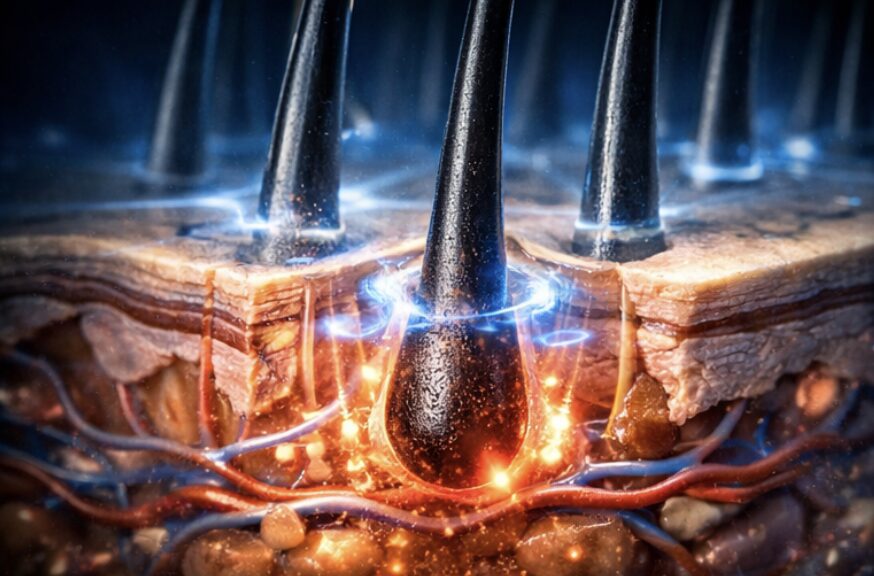
In a normal scalp, hair follicles, sebaceous glands, and arrector pili muscles line the dermis in an organized structure. In nevus sebaceous this developmental process is distorted: follicles are either absent, or when present are stalled in the resting phase and produce almost no hair shaft. Stem cell conditioned media works by nudging “nearly dormant follicles” back toward the growth phase — but where follicular structures are scarce to begin with, there is nothing for the therapy to act upon. This is a real limit of regenerative medicine, and it is a line we must draw honestly for our patients.
Not Mistaking Nevus Sebaceous for AGA or Alopecia Areata
Keywords: “Sharply demarcated” and “Present since birth”
AGA gradually thins density from the hairline or crown, progressing as an ill-defined gradient. Alopecia areata appears as circular or oval patches, but the follicles are still alive, so recovery is possible — and it usually appears suddenly in adulthood. Nevus sebaceous, in contrast, has been present since childhood in the same location, has a crisp border, and the skin texture itself is different — which makes it fully distinguishable with careful history-taking, visual inspection, and dermoscopy. “It’s been there since I was little,” “the border is sharp,” and “the skin is rough” are three major clues that raise suspicion.
Watch for Color and Elevation Changes in Adulthood
Secondary tumors are known to develop in this lesion during adulthood. Most are benign (such as trichoblastoma or syringocystadenoma papilliferum), but malignancies like basal cell carcinoma have been reported, though rarely. Any color change, sudden elevation, bleeding, or ulceration warrants prompt dermatologic evaluation. Before continuing hair regenerative treatment, this risk assessment takes priority. While the frequency is not high, the consequences of missing a lesion can be significant, so cautious observation is required.
Where Nevus Sebaceous Sits Relative to Stem Cell Conditioned Media
Hair Loss That Regenerative Medicine Can Restore, and Loss It Cannot
Stem cell conditioned media scalp therapy can be an option for hair loss where “follicles remain but their function has declined,” such as AGA or diffuse female thinning. But in areas like nevus sebaceous where “follicles themselves are absent or underdeveloped,” there is nothing to functionally restore. The same applies to scarring alopecia after burns or trauma, and to advanced lichen planopilaris where follicles have been destroyed. Distinguishing “hair loss that can regrow” from “skin lesions where hair will not return” at the first consultation is the first responsibility we owe our patients.
Why Dermatologic and Plastic Surgical Evaluation Comes First
Whether from a diagnostic standpoint or from the standpoint of managing future tumor risk, this lesion should be evaluated first by dermatology or plastic surgery. Surgical excision is often chosen given cosmetic considerations and the risk of malignant transformation, and the question of hair regenerative treatment for the post-excision scar is a separate discussion for later. Information from the Japanese Dermatological Association can also help understand congenital diseases of skin appendages. At our clinic, we make it a point at the very first visit to determine whether it is “hair loss where hair can return with treatment” or “a lesion where hair will not return in the first place.” For related topics on hair regeneration, please see our hair regenerative medicine column list here.
Frequently Asked Questions
Q. If I inject stem cell conditioned media into the area of the nevus sebaceous, will hair grow?
Because normal hair follicles never developed in that area, hair cannot be expected to grow from hair regenerative medicine, including stem cell conditioned media. We recommend first having a dermatologic or plastic surgical evaluation and deciding on a plan, including whether excision is appropriate.
Q. Is it safe to leave this lesion alone?
In childhood, observation is often sufficient. But in adulthood, benign or, rarely, malignant secondary tumors may develop. If you notice changes in color or elevation, bleeding, or ulceration, please see a dermatologist promptly. The frequency is not high, but because missing it can be consequential, regular observation is advisable.
Q. If I have it excised, will hair grow in that area?
After excision, the area becomes scar tissue and usually will not grow hair. Cosmetic finish is a strength of plastic surgery, so we recommend consulting about scar visibility at the excision planning stage.
Q. If there is a bald patch on part of the scalp, what possibilities are there besides nevus sebaceous?
Congenital possibilities include aplasia and localized atrichia, while acquired ones include alopecia areata, scarring alopecia, and trichotillomania (hair-pulling disorder). Since treatment strategies differ entirely, accurate differential diagnosis is the top priority. Rather than judging on your own, please consult a medical facility that can examine your scalp.
──────────────
Supervising Physician: Shin Moriwaki, MD
Member, Japan Society of Aesthetic Surgery (JSAS) / Member, American Academy of Aesthetic Medicine
ECFMG Certificate
──────────────
📍AVAN TOKYO 銀座 毛髪再生医療
AVAN TOKYO Ginza Hair Regenerative Medicine
English / 中文 / Tiếng Việt available
Inquiries via DM / LINE / Website / Phone.