


AGA Combination Therapy Tapering: How Dr. Moriwaki Designs the Order and Evaluation Window When Combining Finasteride/Dutasteride with Stem Cell Conditioned Media2026.08.14
More and more men who have been on oral AGA medication for years are now consulting us about adding stem cell conditioned media scalp treatment, or gradually reducing their oral drugs. Layering regenerative medicine that works on the follicular microenvironment on top of finasteride or dutasteride sounds reasonable — but the questions we hear most often once combination therapy starts are: “Which one should I taper first?” and “When should we judge the effect?” These are questions about the AGA combination therapy tapering order and its evaluation timing.
Two treatments with different mechanisms and different response timelines must be lined up on the single time scale of the hair cycle. Stopping both at once tends to invite rebound, while stacking them longer than needed inflates cost and burden. In this article, Dr. Moriwaki of AVAN TOKYO Ginza organizes the medical framework behind AGA combination therapy tapering order and how to design the evaluation window.
Key Points of This Article
・Finasteride/dutasteride play the role of “stopping progression,” while stem cell conditioned media plays the role of “supporting the follicular microenvironment” — the axes of action are fundamentally different
・For AGA combination therapy tapering order, the basic design is usually: first extend the interval of conditioned media, then keep the oral drug as a maintenance dose
・Evaluation should use at least one hair cycle (roughly 3–6 months) as a minimum, reviewing in three stages at 3, 6, and 12 months
・Objectify assessment with the three pillars of hair caliber, hair density, and fixed-point photography — do not decide to stop based on subjective impression alone
・The tapering order must be individualized by severity, age, and lifestyle — no one-size-fits-all “graduation schedule”
Finasteride/Dutasteride and Stem Cell Conditioned Media Have Different Roles
Before we discuss whether to combine or which to reduce first, we need to separate what each treatment actually does at the follicle. Different mechanisms naturally mean different timing and metrics of evaluation.
Oral drugs shut off the “androgen shower”
Finasteride inhibits 5α-reductase type II, while dutasteride inhibits both types I and II, reducing conversion of testosterone into dihydrotestosterone (DHT). The driver of miniaturization in AGA is androgen signaling to the follicle via DHT, and oral therapy tightens that upstream tap. Its principal effect is to “halt progression,” not to revive follicles that have already fully entered dormancy. Stop the medication and blood DHT returns to baseline within weeks; from the most susceptible follicles, miniaturization gradually resumes. This is the single most important premise when thinking about the AGA combination therapy tapering order.
Stem cell conditioned media works on the follicular microenvironment
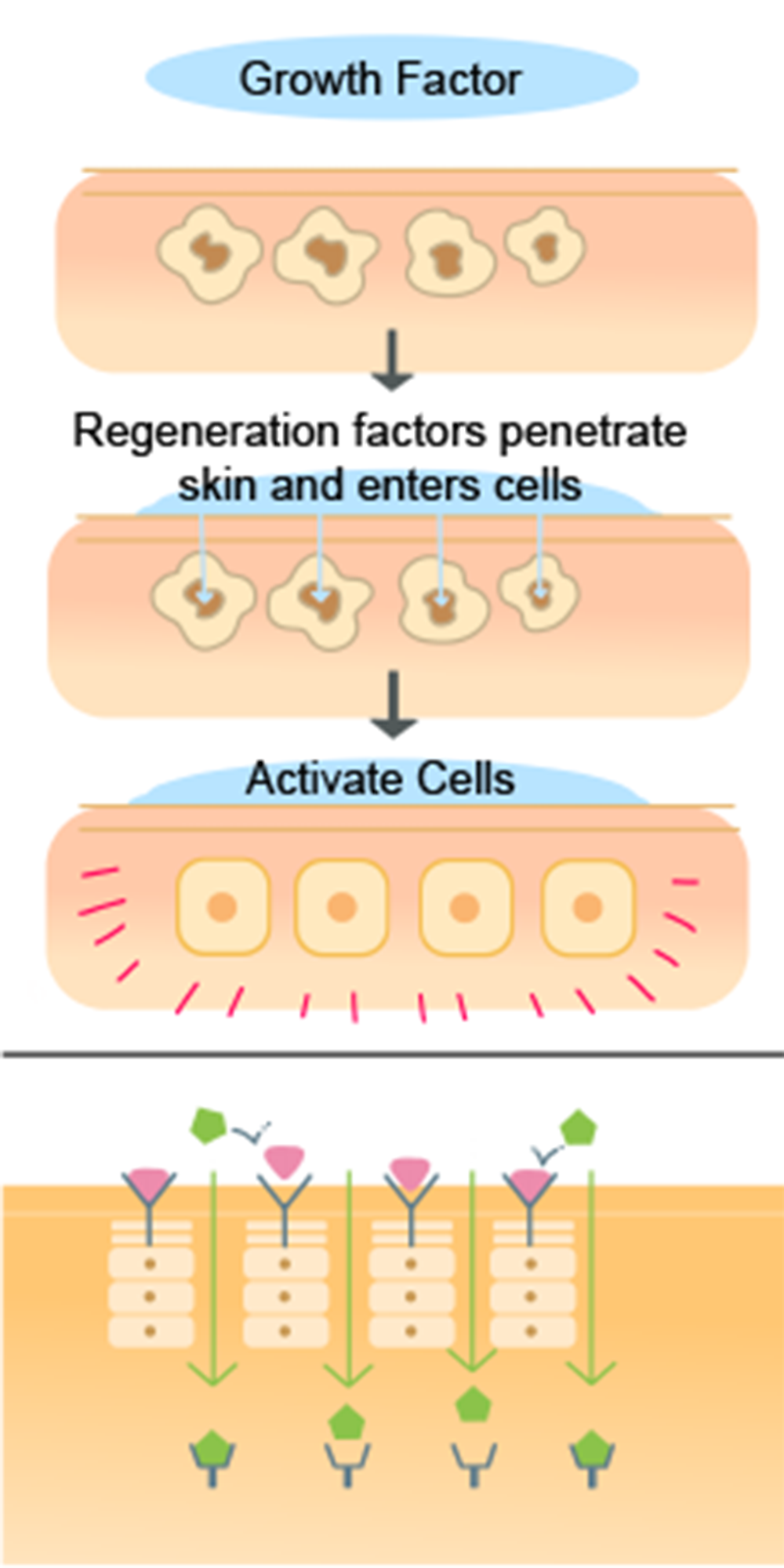
Stem cell conditioned media, on the other hand, is a collection of secreted factors produced during the culture of stem cells derived from adipose, umbilical cord, dental pulp, and other sources. Growth factors, cytokines, and exosome-carried miRNAs may act on layers such as low-grade inflammation cycles, angiogenesis, and the follicular stem-cell niche microenvironment. Because it does not directly intervene in DHT production, conditioned media alone cannot “stop” progression on its own — but it has the potential to fill in the microenvironmental layer that oral medication does not reach.
In other words, oral drugs and conditioned media are complementary, not interchangeable. That is exactly why, when designing “which to reduce first,” we must first weigh the risk of re-activation of the upstream driver.
How to Design the AGA Combination Therapy Tapering Order
Once you appreciate the difference in axes of action, a medical priority emerges for the tapering order. Individual variation exists, but there is a framework worth holding onto as a principle.
Why “stopping oral drugs first” is high risk
Stop the oral drug first and you release upstream DHT suppression. Susceptible follicles are again bathed in the androgen shower, and even if the microenvironment is well tended by conditioned media, miniaturization tends to re-progress over the following months. This risk is especially high in men with strong susceptibility at the frontal and vertex regions, a strong family history, or in their early 40s with room to progress further. In such cases we usually design to keep the oral drug on as a “maintenance phase” first.
Extend the conditioned media interval → keep oral maintenance
In practice, we first lengthen the interval of scalp conditioned media sessions from monthly to every 2 or 3 months. During this period, the oral drug (finasteride or dutasteride) is continued at maintenance dose. If at least six months pass at the extended interval without any regression sign, we can consider stepping down or discontinuing the oral drug next. Conversely, if vellus hairs at the hairline regress or shedding clearly increases as soon as the interval is extended, we prioritize returning to the previous conditioned media schedule. This two-stage tapering is the approach least likely to go wrong for the AGA combination therapy tapering order.
Designing the Evaluation Window and Objective Metrics
The evaluation timing is the flip side of the tapering design. A common failure is to conclude “it’s not working” after just 1–2 months. Any assessment that ignores the hair-cycle scale is destined to be wrong.
Set one hair cycle (3–6 months) as the minimum
Hair moves through anagen, catagen, and telogen over months to years, so the true effect of a change in therapy is only visible “after one cycle of hair has been replaced.” We therefore avoid snap judgments based on shedding volume or visual impression right after the interval is extended, and observe under the same design for at least 3 months, ideally 6. At 3 months, shedding (initial telogen effluvium) tends to settle; at 6 months, hair caliber and vellus hairs begin to change; at 12 months, density and long-term impression on fixed-point photos become visible. This staged timeline is what fits the biology.
The three pillars: hair caliber, hair density, and fixed-point photography
Deciding “it works or not” by feel alone leaves you at the mercy of seasonal variation, lighting, and styling habits. In our clinic we measure hair caliber distribution and hairs per follicular unit by trichoscopy, and take fixed-point photographs under identical lighting, angle, and styling conditions, so we can evaluate on both numbers and images. Caliber and quality often change earlier than raw volume, so it is important not to decide on a therapy change based on density plateaus alone. You can also refer to related articles at our hair regenerative medicine column index for deeper discussion of these metrics.
Reactivation Signs to Watch During Tapering
While stepping through the AGA combination therapy tapering order, the most clinically important decision is where to “step back.” Rather than waiting for numbers to worsen, we consider slowing the taper or reverting to the previous design as soon as the following signs appear.
・Regression of vellus hairs at the hairline (M-zone)
・Sudden increase in shed hairs during shampoo or blow-drying
・Subjective sense that the vertex has become more see-through than before
・Decrease in hairs per follicular unit on trichoscopy
・Shift of the caliber distribution toward finer hairs
These are signs that the upstream DHT driver is reactivating, and conditioned media alone cannot fully push them back. If tapering is pushed through at this stage, restarting the oral drug after regression has fixated may only restore lost density over the course of many months to a year. It is wise to share the design with your physician while also referring to guidelines on AGA and alopecia from bodies such as the Japanese Dermatological Association.
Individualizing the Tapering Order by Age and Severity
One final emphasis: the AGA combination therapy tapering order is not a uniform schedule. A man in his 20s with a strong family history and high susceptibility will lean toward keeping oral therapy long while maintaining conditioned media, whereas a man in his 60s whose progression has slowed and whose density has plateaued may keep the oral drug on maintenance while stretching conditioned media intervals significantly. Lifestyle, plans for conception, tolerability of medication, and financial outlook are all factors that should feed into the decision. A realistic operation is to revisit the design every six months to a year, together with your physician and objective metrics.
Frequently Asked Questions
Q. Is it okay to stop finasteride and dutasteride at the same time?
As a principle, simultaneous discontinuation is not recommended. If DHT suppression is released abruptly, miniaturization can re-progress over the following months from the most susceptible follicles. If cessation is being considered, the safest path is gradual tapering with your physician, supported by conditioned media for the microenvironment and confirmed by objective metrics.
Q. Can stem cell conditioned media scalp treatment fully replace oral drugs?
Because the axes of action differ, it cannot be said that conditioned media completely replaces oral medication. It may act on the follicular microenvironment, but it does not directly intervene in DHT production. It can be a complementary option for patients who cannot tolerate oral therapy, but the choice must be individualized based on severity and susceptibility.
Q. How soon should the effect be judged?
Respecting the hair cycle, we evaluate in three stages at 3, 6, and 12 months. At 3 months, initial shedding tends to settle; at 6 months, hair caliber and vellus hairs start to show change; at 12 months, density and fixed-point long-term impression become clear. It is important not to redesign therapy based on short-term changes at 1–2 months.
Q. If treatment is stopped, will the effect return when resumed?
Individual variation applies, but if resumed while reactivation signs are still mild, response close to the previous design is often obtained. Once regression has fixated, however, recovering lost density can take many months to a year, so early reassessment strongly influences the outcome.
Q. I’m worried about side effects and general health changes.
Adverse events have been reported with both oral drugs and conditioned media. Finasteride/dutasteride can be associated with sexual function or mood changes; conditioned media scalp treatment mainly with bruising, mild swelling, and itching. Share your medical history, concomitant drugs, and allergy tendencies with your physician before starting, and report any post-procedure changes promptly.
──────────────
Supervising Physician: Dr. Shin Moriwaki
Member, Japan Society of Aesthetic Surgery (JSAS) / Member, American Academy of Aesthetic Medicine
ECFMG Certificate
──────────────
📍AVAN TOKYO 銀座 毛髪再生医療
AVAN TOKYO Ginza Hair Regenerative Medicine
English / 中文 / Tiếng Việt available
Inquiries welcome via DM / LINE / Website / Phone.