


When to Taper AGA Treatment After 5 or 10 Years: Designing a Long-Term Maintenance Plan2026.09.10
“I’ve been on AGA treatment for five years — ten years, even — and I’m not sure how much longer I should keep going.” We hear this more and more often from men who have stuck with treatment for the long haul. As the years of finasteride, dutasteride, and minoxidil accumulate, so do the worries about side effects, the monthly costs, and the burden of clinic visits — bringing many patients to the point of reconsidering their AGA treatment maintenance plan. But framing the decision as a binary “stop or continue” risks losing, in a matter of months, the hair you spent years defending. At the five- and ten-year mark, how do you actually judge “when to taper” and redesign the maintenance plan? Dr. Moriwaki of AVAN TOKYO Ginza Hair Regenerative Medicine walks through the framework.
Key Points
・For anyone past five years of AGA treatment, “when to stop” should be reframed as a transition to a maintenance plan, not an abrupt discontinuation.
・Efficacy tends to plateau with long-term treatment, but the follicular environment keeps changing year by year — the same drug at the same dose is not necessarily still optimal.
・An AGA treatment maintenance plan should be designed along three axes: continuation, dose reduction / longer intervals, and treatment switching.
・Stem cell conditioned media can play a support role in the follicular environment as oral and topical agents are stepped down.
・The judgment axes for tapering are four: age × follicular reserve, cumulative side effects, life events, and objective outcomes.
What’s Happening in the Follicle After 5–10 Years of AGA Treatment
Long-term AGA treatment is not just “holding the line on progression”; it is quietly reshaping the follicular microenvironment as well. The same medication does not carry exactly the same meaning at year one and at year ten.
Efficacy Plateau and Follicular Adaptation
Finasteride and dutasteride inhibit 5α-reductase to suppress DHT production and slow AGA progression. Topical and oral minoxidil widen the hair shaft through vasodilation and prolonged anagen. The clear improvement over the first one to two years, however, typically flattens into a plateau by year three, and by year five or ten the picture is one of steady maintenance. During this stretch, the follicular side is quietly changing:
・A gradual decline in androgen sensitivity with age
・Relative shortening of the hair cycle
・Shifts in scalp blood flow and sebum patterns
・Concurrent age-related changes (finer shafts, graying)
In other words, the environment is drifting even while the treatment stays the same. Continuing an identical prescription indefinitely on the assumption that “nothing has changed” has real limits.
The Accumulating Cost of Continuation
Long-term continuation carries its own hidden costs. Monthly spending, compounded over five or ten years, becomes substantial, and a small proportion of patients report sexual side effects (roughly 0.5–2% with continued finasteride, based on published reports). Oral minoxidil can raise concerns about body hair, edema, and palpitations, especially in middle age. Once these burdens outweigh the “value gained from treatment,” it is time to revisit the AGA treatment maintenance plan.
Three Options for the AGA Treatment Maintenance Plan
Rather than “continue” vs. “stop,” recognizing the several options in between is the first step in designing an exit strategy for long-term treatment.
1. Continue the Current Protocol (With Monitoring)
If you have no side effects, the cost is acceptable, and hair status is holding at a satisfying level, continuing your current protocol is the lowest-risk choice. But it should be paired with annual scalp photography from fixed positions, blood tests (liver function, PSA, CBC), and hair-density measurements to catch early signs of change. “Continuation” isn’t unconditional — it is continuation with monitoring.
2. Scaling Down by Dose Reduction or Longer Intervals
Cutting finasteride from 1 mg to 0.5 mg, moving to every-other-day dosing, or reducing topical minoxidil from twice daily to once — these are pragmatic ways to lower side-effect burden and cost without triggering a sudden loss of effect. It is essential to check three to six months after the change that hair density and shaft diameter have not slipped in any meaningful way. A stepwise reduction, rather than an immediate stop, is the safer way to gauge the follicular impact.
3. Switching or Recomposing the Regimen
Moving someone who has been on oral therapy toward topical-first regimens, or layering in scalp injection of stem cell conditioned media so the oral share can drop, is a switching-style redesign. Conditioned media here is not a replacement for the oral drug but a scaffold that lets you reduce the oral dose more safely, cutting rebound risk. Within any AGA treatment maintenance plan, this switching design carries the highest individual variability, and the depth of the physician-patient dialogue tends to decide the outcome.
Four Axes for Judging “When to Taper”
When reviewing long-term treatment, use these four axes in combination. A single indicator should not decide the call — weigh each dimension and then form an overall judgment.
Age and Follicular Reserve
From the late 40s onward, the intrinsic pace of AGA progression tends to slow. If Norwood grade has not advanced even one step in ten years, both remaining follicular reserve and the natural age-related decline in androgen sensitivity are working with you. Conversely, someone in their early 30s whose trajectory is not yet clear should not be in a hurry to “taper.” Judge conservatively through the product of age and follicular reserve.
Cumulative Side Effects and Health Changes
Sexual side effects that were unnoticeable at the start of therapy can surface later as age-related factors converge on the same axis. Oral minoxidil can raise real concerns about blood pressure and heart rate in middle age. The moment you begin to suspect a link between a new health issue and your treatment is exactly when the AGA treatment maintenance plan deserves review.
Alignment With Life Events
A partner’s fertility plans, a job transfer or overseas assignment, retirement, or a change in finances all reshape treatment design. During a partner’s pregnancy attempt, direct teratogenicity from finasteride to the male-partner side is not considered a real risk, but some men choose a temporary pause on emotional grounds. Building temporary reductions or switches around life events is a legitimate part of a maintenance plan.
Objective Maintenance Metrics
Instead of a subjective “feels about the same,” build a three-part record — fixed-position scalp photos, hair-density measurements, and consistent self-photography — captured every year under the same lighting, angle, and humidity. Three consecutive years of solid maintenance is legitimate ground to try a cautious step-down. If shaft diameter is already thinning, however, the answer is not reduction but adding a boost (conditioned media, LLLT, Morpheus8, etc.).
The Role of Stem Cell Conditioned Media in the Maintenance Phase
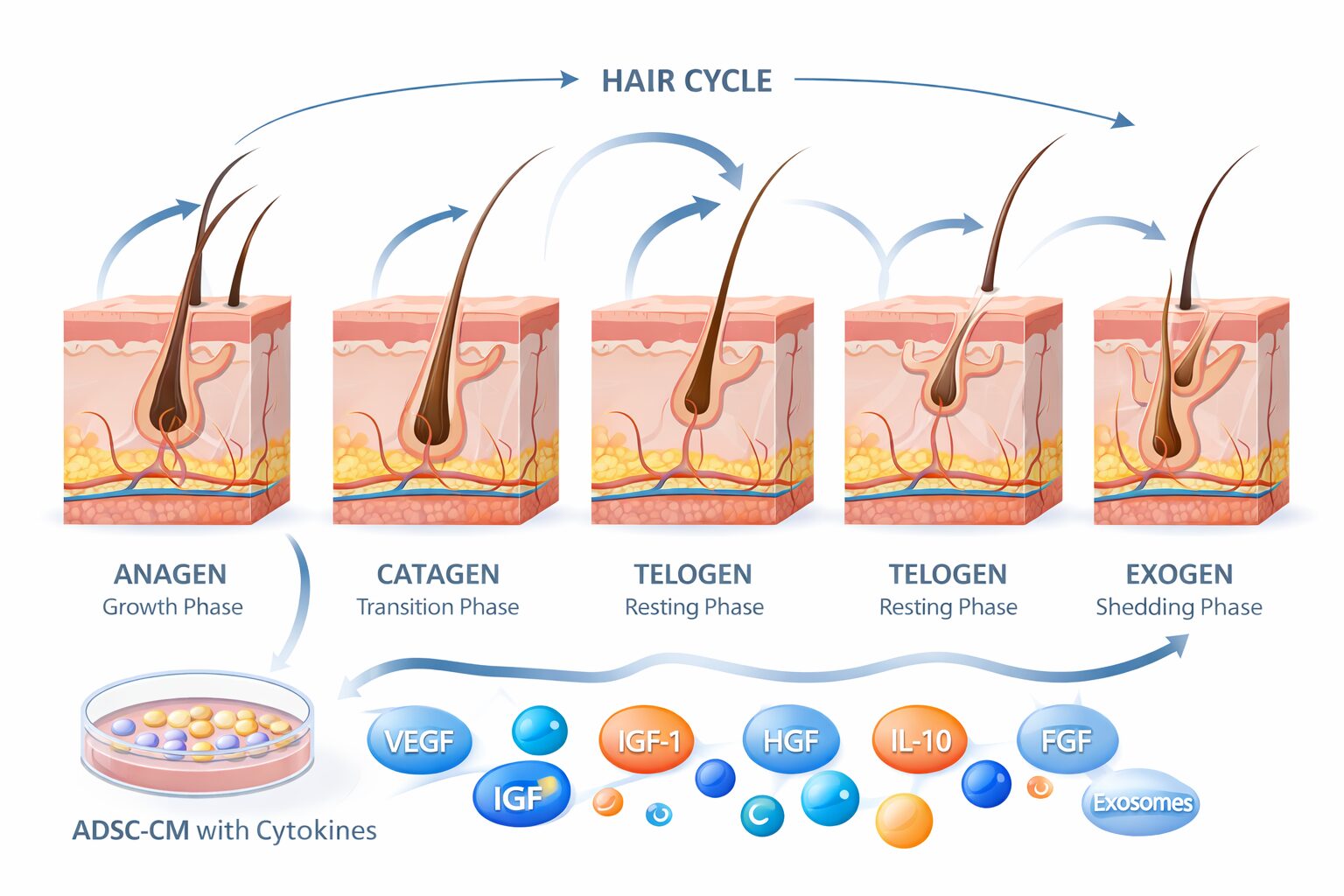
Adding scalp injection of stem cell conditioned media in the mid- to late stage of long-term treatment lets you dial down dependence on oral and topical agents while supporting the follicular environment — angiogenesis, inflammation control, dermal-papilla signaling. Conditioned media does not substitute for pharmacological DHT suppression, but it does support the follicular stem-cell niche, which fits nicely as a scaffold in a stepwise oral-reduction phase. A common cadence is monthly for three to four months in the induction phase, then every three to six months in maintenance. For details and case examples, see our hair regenerative medicine column index. For AGA pharmacotherapy guidelines, the Japanese Dermatological Association is a useful reference.
FAQ
Q. Is it safe to stay on finasteride for ten years?
No serious long-term safety signal has been reported for 10–15 years of continuous use. That said, annual blood work (liver function, PSA, etc.) should be maintained, and dose reduction or a pause should be considered if any sexual side effects appear. Because responses vary, share any change in health with your physician promptly.
Q. What happens if I abruptly stop AGA treatment after many years?”
Within months to a year, progression tends to return to the pre-treatment pace — a “rebound.” After five or ten years of therapy, the follicles have aged, and progression can even accelerate faster than at baseline. A stepwise reduction is the recommended approach.
Q. Can stem cell conditioned media alone maintain results?
In mild AGA with a very slow trajectory, standalone maintenance with conditioned media is worth attempting. In most cases, however, given the absence of DHT-suppressing activity in conditioned media, the realistic approach is to combine it with an oral dose reduction rather than to substitute for it.
Q. My results have plateaued — is there any point in continuing?
A “plateau” often masks the fact that without treatment, progression would have continued. Comparing today’s photographs with those from three and five years ago turns the value of continuation into a quantitative question, not a subjective one.
Q. If hair volume drops after I reduce the dose, can I recover it?
If the reduction is recent, restoring the original dose usually recovers the follicular environment. Left for several months, some follicles that have entered telogen may not fully return. Always build in re-evaluations at three and six months after any dose reduction.
──────────────
Supervising Physician: Shin Moriwaki, MD
Member, Japan Society of Aesthetic Surgery (JSAS) / American Academy of Aesthetic Medicine
ECFMG Certificate
──────────────
📍AVAN TOKYO Ginza Hair Regenerative Medicine
English / 中文 / Tiếng Việt supported
Inquiries via DM / LINE / Website / Phone.