


When a Woman Is Offered a “Men’s Drug” for Hair Loss: Sex Differences and Indications Explained by Dr. Moriwaki2026.10.02
“I went to a clinic to discuss hair thinning, and they prescribed me a drug intended for male AGA.” Many women are surprised and uncertain when this happens. Prescribing male AGA protocols directly to women — without accounting for sex differences in female hair loss treatment — not only limits efficacy but increases hormonal and systemic risks. This column clarifies the pathophysiological differences between male AGA and female pattern hair loss (FAGA), the sex-specific indications of each drug, and the perspective needed to judge whether a recommended drug truly fits the patient.
Key Points
・Sex differences in female hair loss treatment cannot be solved simply by “halving the men’s dose” — pathophysiology and pharmacology must both be considered separately.
・Finasteride and dutasteride are generally contraindicated in premenopausal women; recommending them as “men’s drugs” without careful evaluation is problematic.
・Minoxidil and spironolactone have sex-specific dosing and indication rules; applying the male protocol unchanged distorts both outcome evaluation and side-effect management.
・Stem cell conditioned media acts on the follicular microenvironment without going through sex hormone pathways, making it a viable adjunct for women whose drug options are limited.
Male AGA and Female Pattern Hair Loss Are Not “The Same Disease at Different Intensities”
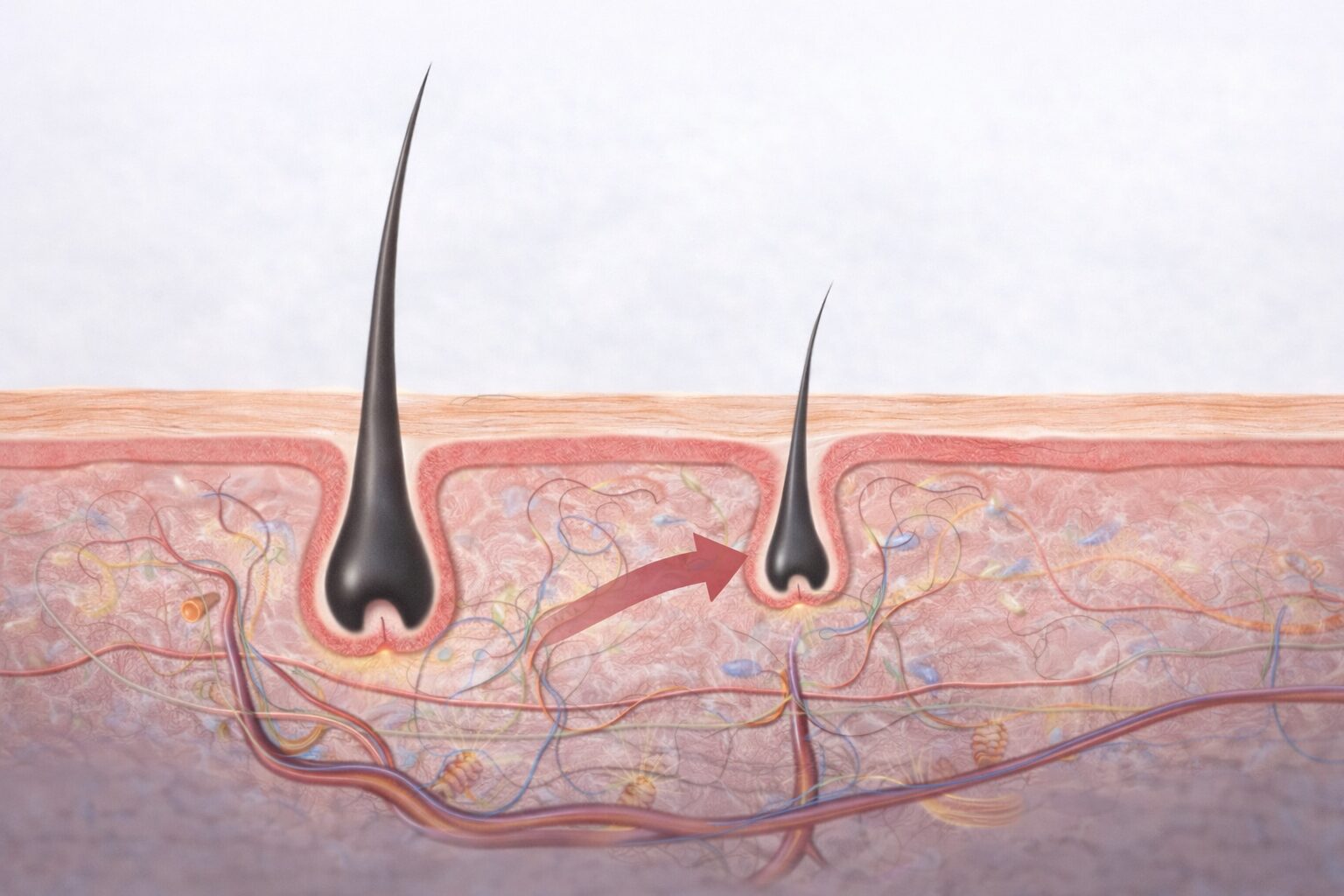
Male AGA follows a relatively simple mechanism: testosterone is converted to DHT (dihydrotestosterone) by 5-alpha reductase (mainly type II), which then binds androgen receptors on frontal and vertex follicles and shortens the anagen phase.
Female pattern hair loss (FAGA), however, cannot be explained by the DHT pathway alone. The classic diffuse thinning over the crown and preserved frontal hairline described in the Ludwig classification is not a “miniature male pattern” — it is its own clinical entity. In women, reduced estrogen-mediated follicular protection, low iron and ferritin, subclinical hypothyroidism, hyperprolactinemia, adrenal/ovarian androgen excess (e.g., PCOS), and overlapping chronic telogen effluvium contribute together to shedding and caliber reduction.
In other words, male and female patterns share the common language of DHT sensitivity but differ in underlying pathophysiology. Applying male protocols to women without accounting for sex differences in female hair loss treatment often leads to an evaluation bias in which subclinical thyroid dysfunction or iron deficiency — which should have been detected by basic labs — is overlooked, while antiandrogens are prescribed first.
Sex Differences in Female Hair Loss Treatment: Drug-by-Drug Indications
Finasteride and Dutasteride (5-alpha reductase inhibitors)
Core drugs in male AGA but generally contraindicated in premenopausal women. If given to a woman of childbearing potential, there is a risk of external genital malformation in a male fetus, and the package insert restricts both administration and physical contact with the tablets. For postmenopausal women, some overseas studies exist, but in Japan this is off-label use and the efficacy data are far less consistent than in men. These are not drugs that can be casually offered just because “it should work in women too”; the indication must be assessed holistically against age, pregnancy plans, and comorbidities.
Minoxidil (Topical and Oral)
Topical minoxidil is proven effective in women, but concentration rules differ by sex. In Japan, OTC minoxidil for women is 1%, and international guidelines typically limit 5% topical use in women due to risks of hirsutism, headache, and dizziness. If a 5% topical formulation is recommended to a woman as-is, the clinician should be able to explain the facial hirsutism risk and the evaluation schedule.
Oral minoxidil was originally developed as an antihypertensive for refractory hypertension; its low-dose use in hair loss has gained attention in recent years. However, systemic side effects — palpitations, edema, hypertrichosis, lightheadedness — exist, and women are generally started at lower doses than men. A prescription that “starts at the same dose as men” warrants careful consideration.
Spironolactone (an antiandrogenic diuretic)
Abroad, spironolactone has a defined role in female pattern hair loss treatment, but in Japan it is off-label for hair loss. Side effects include hyperkalemia, menstrual irregularities, and breast tenderness, and renal and electrolyte monitoring is required. This is a drug used in women, but it is worth knowing as an alternative — a counter to prescriptions that push ahead with male protocols without realizing spironolactone exists.
For related hair regenerative medicine articles, see our hair regenerative medicine column index. For prescribing guidelines, see the Japanese Dermatological Association guidelines for male and female pattern hair loss.
Five Lenses to Judge Whether the Recommended Drug Fits You
When you feel a “men’s drug” has been proposed in consultation, here are five lenses that reflect sex differences in female hair loss treatment.
First, were blood tests performed first? Prescribing antiandrogens before even a baseline evaluation of TSH, free T4, ferritin, prolactin, DHEA-S, and testosterone reflects an incomplete evaluation design. Second, was there a careful conversation about pregnancy plans and childbearing potential? This is especially critical for finasteride and dutasteride. Third, how specific was the side effect explanation? Facial hirsutism, edema, menstrual changes, and electrolyte abnormalities should be named explicitly. Fourth, is the evaluation interval defined? “We’ll reassess at 3–6 months with standardized scalp photography and hair caliber measurement” is a concrete evaluation axis. Fifth, were alternatives and adjunctive options offered? Scalp environment optimization, lifestyle factor intervention, and stem cell conditioned media should be discussed rather than defaulting to a single drug.
If several of these five are vague and “the same drug as men” is still being pushed, it is worth asking first for a redesigned evaluation plan rather than debating the drug itself.
Stem Cell Conditioned Media Bypasses the Sex-Difference Constraints
Scalp treatment using stem cell conditioned media acts differently from drugs that intervene directly in sex hormone pathways. Growth factors such as VEGF, IGF-1, HGF, and FGF are thought to influence the follicular microenvironment, supporting angiogenesis, matrix cell activity, and follicular stem cell maintenance. Because it does not act through the androgen receptor pathway, it is a reasonable adjunct for women whose pharmacological options are narrowed by pregnancy plans, childbearing potential, or electrolyte concerns.
That said, stem cell conditioned media is not a universal solution. If scarring alopecia, active inflammatory dermatosis, or an unresolved cause of acute telogen effluvium is present, resolving the underlying pathology comes first. In our view, respecting sex differences in female hair loss treatment means three things: never applying male protocols unmodified, never relying on a single drug, and always offering a clear evaluation axis with alternatives.
Frequently Asked Questions
Q. I’m female — can I split a finasteride tablet in half and take it at a lower dose?
No, not for premenopausal women. As long as pregnancy is possible, fetal risk from systemic absorption cannot be fully avoided, and the package insert restricts both administration and physical contact. Even in postmenopausal women, Japanese use is off-label, so self-directed dose splitting should be avoided.
Q. Is it safe to use 5% topical minoxidil designed for men?
Overseas, 5% topical is sometimes selected for women, but facial hirsutism (cheeks, forehead), headache, and palpitations can occur more frequently than with 1%. The real question is not “use or don’t use” but “if used, is side-effect monitoring and the evaluation interval properly designed?”
Q. I was told to start oral minoxidil at the same dose as a man.
Standard practice is to start women at a lower dose than men, titrating while monitoring palpitations, edema, hirsutism, and blood pressure. We recommend asking your physician for the rationale behind the starting dose and the planned evaluation timeline.
Q. I’m trying to conceive. What hair loss treatments are available?
During attempts to conceive and during pregnancy, finasteride, dutasteride, and oral spironolactone are generally avoided. Scalp environment care and stem cell conditioned media scalp treatment, which do not act through sex hormone pathways, are realistic options to center the plan on. Please discuss specifics at consultation.
Q. “Isn’t it discriminatory for men and women to be given different drugs?”
It is not discrimination; it is safety design based on physiological sex differences. Sex differences in female hair loss treatment are not about superiority or inferiority — they reflect individualized care that respects differences in hormonal environment, pregnancy potential, and pharmacodynamic response.
──────────────
Supervising Physician: Shin Moriwaki, MD
Member, Japan Society of Aesthetic Surgery (JSAS)
Member, American Academy of Aesthetic Medicine
ECFMG Certificate
──────────────
📍AVAN TOKYO 銀座 毛髪再生医療
AVAN TOKYO Ginza Hair Regenerative Medicine
English / 中文 / Tiếng Việt supported
Inquiries welcome via DM / LINE / Website / Phone.