


A Treatment Map for Female Hair Loss When Finasteride Cannot Be Used — Dr. Moriwaki Organizes What Stem Cell Conditioned Media Can and Cannot Cover2026.08.16
“I was told the drug that works best cannot be used in women” — one of the most common confusions we hear in the female hair loss clinic. Finasteride and dutasteride are core drugs in male-pattern AGA treatment, but they are in principle not usable in women of childbearing potential due to teratogenic risk, and even in postmenopausal women they occupy an off-label, evidence-limited position. Yet female hair thinning is by no means rare: consultations for FAGA (female-pattern hair loss), diffuse thinning, postpartum shedding, and menopausal hair loss come in across a wide age range. Female non-finasteride hair loss treatment is not a “one-drug decides it” idea, but a medical portfolio design combining multiple axes of action. Dr. Moriwaki at AVAN TOKYO Ginza organizes what stem cell conditioned media can and cannot cover, alongside topical drugs, internal-medicine background correction, and physical scalp approaches.
Key Points of This Article
・Female non-finasteride hair loss treatment is not decided by a single drug but designed as a portfolio combining multiple axes of action
・Finasteride and dutasteride carry teratogenic risk even from transdermal absorption; women of childbearing potential should avoid not only oral use but also skin contact with crushed or split tablets
・Topical minoxidil, topical anti-androgens, and correction of internal-medicine background (iron, thyroid, hormones) form the foundation
・Stem cell conditioned media handles calming the inflammatory cycle in the follicular microenvironment and supplementing growth signals, but has no pharmacologic action to block the DHT signal itself
・Designing the combination with these limits in mind is the realistic path to results in female non-finasteride hair loss treatment
Why Finasteride Cannot Be Used in Women as a Rule
Contraindicated in women of childbearing potential
Finasteride and dutasteride inhibit 5α-reductase, suppressing the conversion of testosterone to the more potent dihydrotestosterone (DHT). This action is highly effective for slowing AGA progression, but if a pregnant woman ingests the drug or has skin contact with crushed or broken tablets, there is a theoretical teratogenic risk of causing abnormalities in the external genital development of a male fetus. For this reason women of childbearing potential should avoid not only ingestion but the handling of these drugs, and the Japanese Dermatological Association’s clinical guidelines for male and female pattern hair loss do not, as a rule, recommend 5α-reductase inhibitors for women. Please refer to the Japanese Dermatological Association guidelines for details.
Casual use is not recommended in postmenopausal women either
Some think, “If pregnancy is impossible, surely it can be used after menopause.” However, finasteride’s efficacy for postmenopausal female-pattern hair loss did not show clear superiority in large placebo-controlled trials, and the evidence is limited. Reports of some effect with dutasteride exist, but all are off-label with dosing, duration, and safety not established. Therefore female non-finasteride hair loss treatment is realistically built around other options even after menopause.
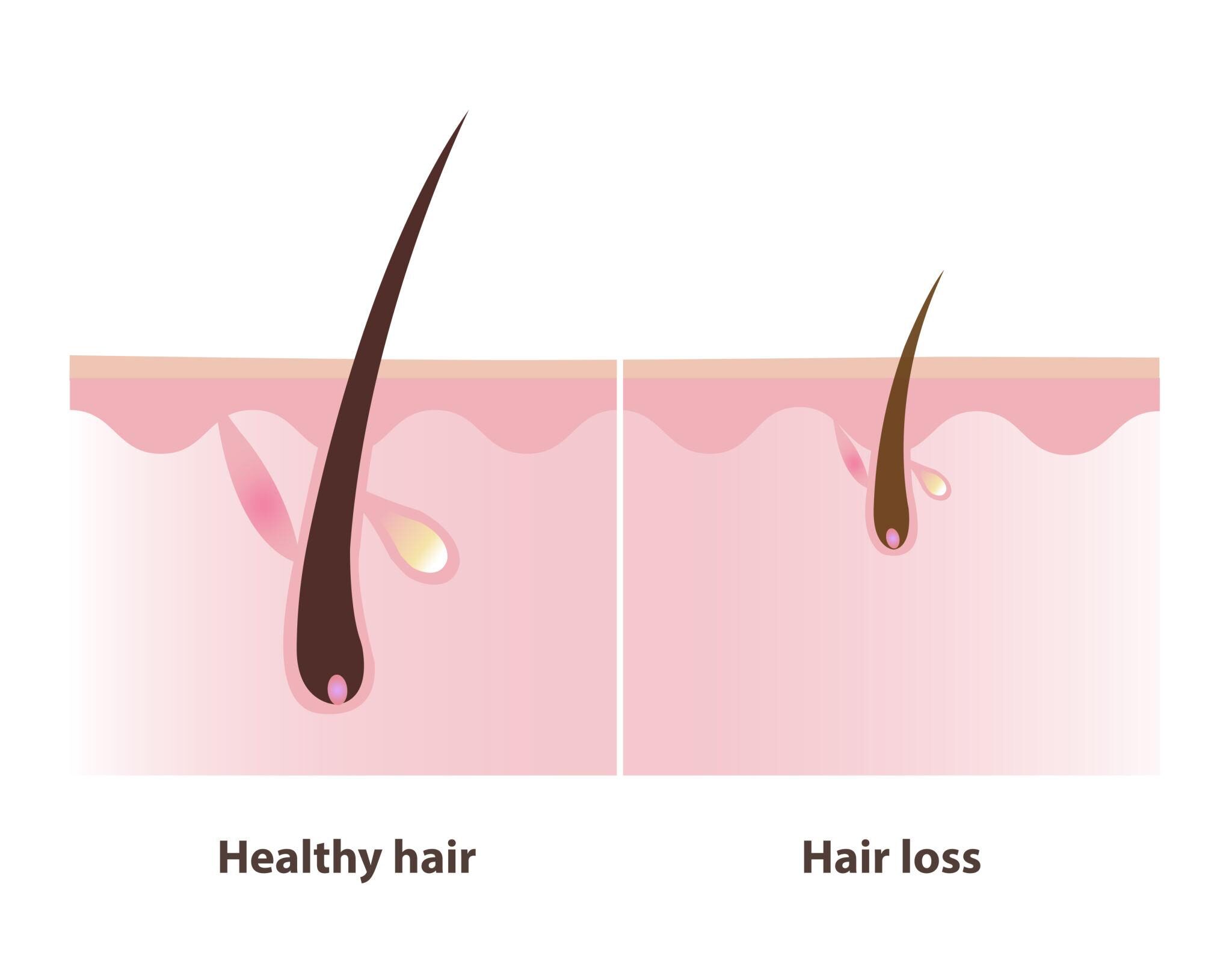
A Map of Options for Female Non-Finasteride Hair Loss Treatment
Topical minoxidil: the first-line option with the thickest evidence
Topical minoxidil is designated Grade A as first-line therapy for female-pattern hair loss in the Japanese Dermatological Association’s guidelines. Its mechanism is not fully elucidated, but perifollicular vasodilation, extension of the anagen phase, and direct action on matrix cells are thought to work in combination. Even for women who cannot use finasteride, topical minoxidil can be continued long-term as a daily scalp topical and occupies the foundational position in female non-finasteride hair loss treatment. However, patients should be told in advance that effect assessment requires at least 4–6 months, that rebound tends to occur on discontinuation, and that initial shedding may occur.
Topical anti-androgens: intervening on DHT at local concentrations
Rather than giving up on intervening in the DHT signal, one option is “topical anti-androgens” limited to transdermal use at local concentrations. Topical spironolactone has less systemic transfer from transdermal absorption than oral administration, and its use to target local anti-androgen action on the scalp is spreading, mostly overseas. Topical finasteride at low concentrations also has data showing less systemic exposure than oral, and it is sometimes considered as part of female non-finasteride hair loss treatment. Both are off-label, and cautious judgment is needed in women of childbearing potential in light of the possibility of trace transfer into the blood.
Internal-medicine background: three axes of iron, thyroid, and hormones
Female hair loss often does not conclude at “a scalp problem,” and carefully evaluating the three internal-medicine backgrounds — iron, thyroid, and hormones — through blood tests is the starting point of treatment design. Low serum ferritin calls for oral iron (or IV iron in intolerant cases); if TSH/FT4 suggest subclinical hypothyroidism or postpartum thyroiditis, endocrine workup follows; menstrual abnormalities or galactorrhea call for prolactin/PCOS assessment. These are prerequisites to clear before stacking pharmacotherapy or regenerative medicine.
Physical approach to the scalp: Scalp Morpheus
Applying microneedle RF devices such as Morpheus8 to the scalp — “Scalp Morpheus” — is an attempt to activate the follicular microenvironment via RF thermal stimulation and the wound-healing cascade from fine needles, and is used in clinical practice in combination with conditioned media drug delivery. However, it may not be suitable for those with keloid tendencies or severe inflammatory scalp conditions, and individual indication judgment is needed.
What Stem Cell Conditioned Media Can and Cannot Cover
Can cover: inflammation control and growth-signal supplementation in the follicular microenvironment
Stem cell conditioned media is a biological product containing bioactive substances (cytokines, growth factors, exosomes) secreted extracellularly when stem cells collected from adipose, umbilical cord, or dental pulp are cultured ex vivo. In female non-finasteride hair loss treatment, there are chiefly two domains conditioned media can cover. One is correction of the chronic microinflammatory cycle around follicles, aiming to rebalance a follicular microenvironment tilted toward inflammatory cytokines like IL-1β and TNF-α using anti-inflammatory cytokines and growth factors. The other is supplementation of follicular growth signals such as VEGF, IGF-1, and HGF, expected to push a hair cycle biased toward telogen back toward anagen.
Cannot cover: pharmacologic blockade of the DHT signal itself is impossible
On the other hand, stem cell conditioned media has no pharmacologic action to inhibit 5α-reductase. It therefore cannot stop the androgen stimulation that DHT-sensitive follicles continue to receive, and this limit — not intervening on the root driver of AGA/FAGA — should be honestly communicated. Stem cell conditioned media is not “a substitute for finasteride,” but is medically appropriately positioned as a complement that strengthens axes of action other than finasteride.
How Female Non-Finasteride Hair Loss Treatment Is Actually Built
In realistic treatment design, we first prioritize correcting the internal-medicine background, then continue topical minoxidil as the foundation, and combine topical anti-androgens, stem cell conditioned media, and Scalp Morpheus according to the degree of progression and the patient’s life stage. Effect assessment is minimum 4 months, standard 6 months, evaluated objectively with fixed-point photography and trichoscopy findings; if change is scant, we review the combination. Please also see our column archive on hair regenerative medicine. Female non-finasteride hair loss treatment is not a single reversal but a portfolio operation combining multiple axes of action over the long term — the shortcut to results.
Frequently Asked Questions
Q. Can I receive stem cell conditioned media scalp treatment during pregnancy?
We do not, as a rule, recommend scalp conditioned media treatment during pregnancy or lactation. Safety data for conditioned media itself are not established in clinical trials targeting pregnant or breastfeeding women, and combined with peripheral factors such as local anesthesia and procedure stress, we take a cautious stance. Please discuss restart timing after childbirth and completion of lactation individually.
Q. Can topical minoxidil and stem cell conditioned media be used together?
Yes, they can. Since their axes of action differ, they do not cancel each other out, and many cases continue them in parallel. However, on the day of the procedure the scalp is in an open-microchannel state, so we ask patients to temporarily discontinue topical minoxidil on the day of and the day after treatment, with a resumption guideline of 48 hours post-procedure.
Q. I am postmenopausal — is conditioned media an option?
Conditioned media is an option even for postmenopausal women. Since estrogen decline after menopause changes the nutritional and vascular environment of the follicular microenvironment, conditioned media aimed at anti-inflammation and growth-signal supplementation is not a poor fit. That said, when DHT sensitivity is the main driver, considering combination with topical anti-androgens tends to link more clearly to results.
Q. How many sessions until effects are visible?
The hair cycle runs through anagen, catagen, and telogen phases, and effect assessment of conditioned media treatment requires at minimum 4 months from starting, and standardly 6 months of follow-up. Our standard protocol is 3–6 sessions monthly during induction, then switching to a maintenance phase at 3–6 month intervals; because of individual variation, we adjust frequency while objectively evaluating with fixed-point photography and trichoscopy.
Q. How should I think about cost compared with pharmacotherapy alone?
Compared with the monthly cost of topical minoxidil monotherapy, conditioned media treatment has a higher per-session unit price. However, for women who cannot use finasteride, axes of action are limited, so there is meaning in combining another axis before hitting a plateau on a single agent. We recommend estimating not by total sum but by “maintenance cost that can be continued while inserting effect assessments.”
──────────────
Supervising Physician: Shin Moriwaki, M.D.
Member, Japan Society of Aesthetic Surgery (JSAS) / Member, American Academy of Aesthetic Medicine
ECFMG Certificate
──────────────
📍AVAN TOKYO Ginza Hair Regenerative Medicine
AVAN TOKYO Ginza Hair Regenerative Medicine
English / 中文 / Tiếng Việt available
Inquiries welcome via DM / LINE / Website / Phone.