


Third-Party Evaluation in Hair Treatment: The Gap Between Family Reactions and Objective Metrics — Explained by Dr. Moriwaki2026.10.04
Patients who have been on hair treatment for several months often tell us, “I showed photos to my family and they said, ‘you haven’t changed.'” In fact, there is a non-trivial gap between this third-party evaluation and the objective metrics clinics use. Third-party evaluation in hair treatment heavily influences whether a patient stays motivated to continue, yet it does not necessarily reflect treatment efficacy accurately. In this column, Dr. Moriwaki organizes how to interpret your family’s reactions and which objective metrics to reference.
Key Points
・Third-party evaluation in hair treatment is strongly affected by variability in lighting, hairstyle, and timing of comparison, so it tends to diverge from objective metrics.
・Clinics track progress using quantitative indicators such as hair diameter, follicular unit density, and hairs per unit area.
・When family members say “I don’t see a change,” it usually points to a mismatch in observation conditions, not treatment failure.
・A fixed-point photographic protocol before and after treatment helps close the distance between third-party evaluation and objective metrics.
・Agreeing on evaluation criteria in advance makes decisions about continuing treatment much easier when subjective and objective views diverge.
Why Third-Party Evaluation in Hair Treatment Fluctuates
Inconsistent observation makes change invisible
Your family sees your head every day. This “continuous observation” creates a cognitive bias that makes gradual change hard to detect. Hair changes of 0.3–0.4 mm per day are impossible for the human eye to notice. Add morning bedhead, whether you used product that day, indoor light color temperature, and photo angle — if each snapshot differs on any of these, the same scalp can look like two different scalps.
The baseline memory keeps getting overwritten
What psychology calls “normalization bias” also kicks in. As three and then six months pass since you started treatment, your family’s mental image of “your hair” quietly updates to the current state. Few people remember your pre-treatment density accurately. The result is “wasn’t it always about like this?” — a quiet undercount of treatment effect.
What Objective Metrics Clinics Actually Use
Three numbers that get quantified
The objective counterpart to third-party evaluation in hair treatment consists mainly of three measures. The first is hair diameter (the thickness of a single hair), measured on a micron scale. The second is hairs per follicular unit, and the third is hair density per unit area. These are captured with a dedicated trichoscope and numerically analyzed with imaging software. Diameter usually moves first — changes appear in one to three months. Density changes take longer, typically becoming visible after six months.
Fixed-point photography as the foundation
For these indicators to serve as trustworthy numbers, imaging conditions must be strictly matched. Same lighting, same distance, same angle, same hairstyle, same camera settings — clinics call this a “fixed-point photographic protocol” and align it between the pre-treatment and evaluation visits. Self-photos at home are hard to use for decisions precisely because this uniformity cannot be reproduced. For continuation decisions, basing judgment on in-clinic fixed-point photos is important. AGA assessment methods are also summarized in guidelines by the Japanese Dermatological Association.
How to Decide When Third-Party Evaluation and Objective Metrics Disagree
Treat family reactions as information, not verdicts
You do not need to take a family’s “no change” as a denial of treatment efficacy. Rather, drawing out the angle and lighting under which they felt that way turns the comment into useful data to cross-check against your objective metrics. A specific observation like “the hairline looks the same but the crown feels a bit fuller” is a cue to zoom in on regional values on the trichoscope.
Base continuation decisions on multiple axes
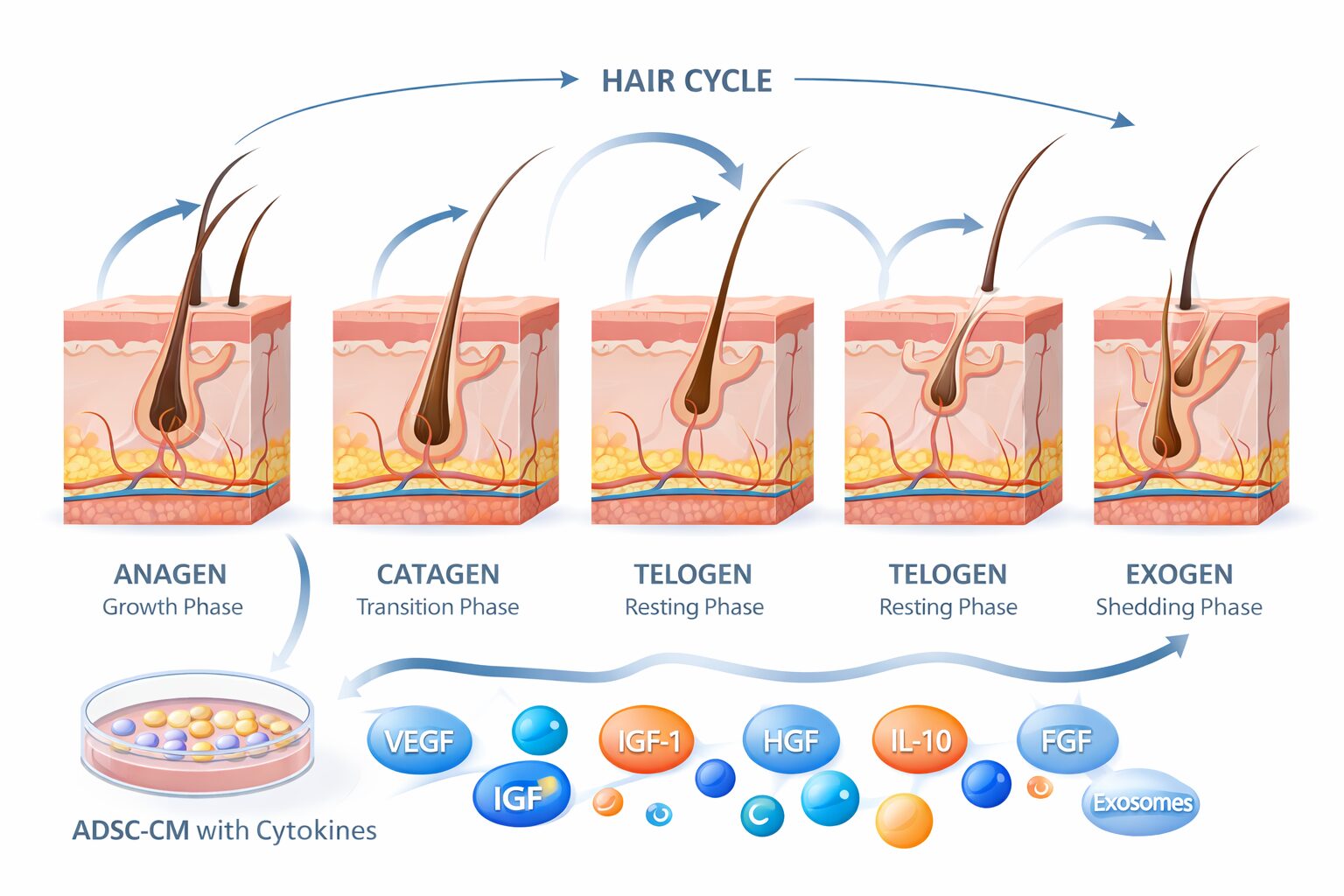
Deciding to stop based on third-party evaluation in hair treatment alone should be avoided. Lay out your objective indicators (diameter, count, density), subjective signs (shedding, scalp sensations), elapsed time since treatment began, and remaining headroom to adjust treatment intensity — and judge from there. The first three months are especially a period when change is slow for hair-cycle reasons; stopping here because of family comments can mean ending before the effect you were about to see.
Prepare before showing photos to family
If you do want family input, comparing two fixed-point photos is by far the fairest approach. Not everyday mirror glances or your usual styled hair, but two frames shot under identical conditions. Just adding this one step substantially raises the accuracy of third-party evaluation.
Designing an Evaluation Framework That Supports Continuation
Agree on evaluation axes up front
At the start of treatment, it helps to clarify — with yourself, and with family if relevant — what counts as “evidence of effect.” Rather than a qualitative target like “obviously more hair,” quantitative goals such as “20% increase in crown density” or “10-micron increase in mean hair diameter” make you far less vulnerable to the gap between third-party evaluation and objective metrics. For related perspectives, see also our hair regenerative medicine column index.
Dr. Moriwaki’s view
The gap between third-party evaluation and objective metrics in hair treatment is not a technique problem — it is an observation problem. Treatment can be working and still not reach your family’s eye. Conversely, family may feel “a little fuller” when the numbers moved only slightly. What matters is not discarding either source, and anchoring continuation decisions on objective metrics. Avoiding categorical judgments and overclaiming, and tracking progress over the long term with individual variation and the hair cycle in mind, is what maximizes treatment outcome.
Frequently Asked Questions
Q. Should I stop treatment if my family says “no change”?
No — please avoid deciding on your family’s subjective view alone. Treatment efficacy is confirmed by trichoscopic fixed-point photography and quantitative assessment of diameter and density. Give treatment at least three to six months, then judge continuation together with the objective metrics.
Q. Can I do fixed-point photography on my own?
In a simplified form, yes — but matching lighting, angle, hairstyle, and distance strictly is difficult, so it is not enough as a basis for continuation decisions. Treat clinic-shot fixed-point photos as the baseline and use home photos as a supplement.
Q. When is third-party evaluation actually useful?
It is useful when you show them before-and-after photos shot under identical conditions. Impressions from face-to-face daily interactions are heavily swayed by lighting and hairstyle, so their reliability is low.
Q. If objective metrics show effect but family doesn’t notice, is that a failure?
No. Small increases in diameter or density are often changes you can detect only with instruments. Reaching “visible change” that family notices typically requires continued treatment through two to three hair cycles.
Q. When is the right timing to show treatment photos to family?
Milestones like six and twelve months after starting treatment, comparing fixed-point photos shot at the clinic, are recommended. Short-interval comparisons tend to show small changes due to the hair cycle, so third-party evaluation shakes more as well.
──────────────
【Supervising Physician】Shin Moriwaki, MD
Member, Japan Society of Aesthetic Surgery (JSAS)
Member, American Academy of Aesthetic Medicine
ECFMG Certificate
──────────────
📍AVAN TOKYO Ginza Hair Regenerative Medicine
(AVAN TOKYO 銀座 毛髪再生医療)
English / 中文 / Tiếng Việt supported
Inquiries welcome via DM / LINE / Website / Phone.