


Beyond “Results Vary by Individual”: The Duty to Explain Hair Treatment Outcome Prediction — Dr. Moriwaki on How Far Stem Cell Conditioned Media Can Honestly Speak About What to Expect2026.08.16
“Results vary by individual” — this phrase appears in almost every consultation about hair regenerative medicine. It is convenient and technically correct, but if the conversation ends there, the patient signs a costly contract with no real picture of what to expect from their own treatment. As physicians, we have a duty to unpack what that “individual variation” actually consists of, and to draw an honest line between what stem cell conditioned media scalp treatment can and cannot deliver. In this article, from the perspective of Dr. Moriwaki at AVAN TOKYO Ginza, we organize the clinical axes that make hair treatment outcome prediction discussable, the ceiling of what those axes can tell us, and the questions patients should bring to their first consultation.
Key Points of This Article
・Rather than ending the conversation at “results vary by individual,” the first step in a physician’s duty of explanation is to share four clinical axes for hair treatment outcome prediction (age, progression stage, family history, follicular reserve) with the patient
・When using stem cell conditioned media for hair regeneration, hair treatment outcome prediction must separate what can be expressed probabilistically from what is determined by each patient’s unique biology
・Trichoscopy, standardized photography, and blood tests form a minimum triad for establishing a movable baseline at the first visit
・Framing the question as “will it work or not” is unhelpful; putting into words at the first visit “on which axis, at what timing, and how large a change” is expected prevents wavering later
・A clinic that cannot share a treatment outlook before contract is a common source of post-contract trouble — this is an important criterion when choosing a hair regeneration clinic
Why “Results Vary” Easily Becomes a Thought-Terminating Phrase
“Results vary by individual” is, medically, entirely accurate. Even the same stem cell conditioned media hair treatment, at the same frequency and interval, produces different responses across patients. But the real function of this sentence should not be “I will not explain further,” but rather “let us unpack what that variation is made of, together.”
From the patient’s side, being told “results vary” leaves too little information to move forward comfortably. At minimum, patients deserve to know whether they belong to a more responsive or less responsive profile, on which axis and by when any response might appear, and what will be considered next if the response is weak. Signing a high-cost contract without any of this articulated is unhealthy from both a medical and a consumer-protection standpoint. Hair treatment outcome prediction cannot be spoken about in exact numbers, but it can absolutely be spoken about in probabilities and conditions.
Four Clinical Axes That Make Hair Treatment Outcome Prediction Discussable
When reading “likelihood of response” for stem cell conditioned media hair treatment, we mainly check the following four axes. Each is a tool for converting “individual variation” from a black box into a variable that can be handled clinically.
1. Age and Follicular Recovery Reserve
The responsiveness of hair follicle stem cells gradually declines with age. Two patients with the same visible thinning — one in their 20s and one in their 60s — have very different biological reserves to invest in follicular recovery. Younger patients tend to have a higher proportion of “still-mobile follicles,” and hair diameter and anagen ratio are more likely to shift with stem cell conditioned media scalp treatment. That said, young patients with rapid progression or a heavy family history do not automatically fall into “young therefore likely to grow.”
2. Progression Stage and Recession Speed
The Norwood classification in men and the Ludwig classification in women describe progression as a still image, but for hair treatment outcome prediction the more important information is dynamic: how many years it took to reach that stage. A patient who receded sharply over six months and one who progressed slowly over ten years carry different levels of androgen pressure on their follicles. Rapidly progressive types tend to respond less stably, and in many cases upstream suppression (oral or topical agents) must be prioritized in the initial phase.
3. Family History and Androgen Sensitivity
When both paternal and maternal lines show heavy early-onset thinning, we design treatment assuming high genetic androgen sensitivity. Genetic testing can be a supplementary reference, but rarely surpasses a careful family history interview. In highly sensitive profiles, even if stem cell conditioned media improves the scalp environment, the response may plateau without upstream hormone suppression via oral therapy.
4. Current Follicular Reserve (Trichoscopy Findings)
Magnified trichoscopy of the scalp reveals hairs per follicular unit, variation in hair shaft diameter, and residual vellus hair. This is the single most “current-state” piece of information available for hair treatment outcome prediction. A scalp with preserved vellus hair and intact follicular diameter has significant room for anagen extension via stem cell conditioned media. Where follicles have fully fibrosed, however, conditioned media may reach the tissue but structural reconstruction is honestly not to be expected.
What Stem Cell Conditioned Media Adds on Top of Hair Treatment Outcome Prediction
Once the four axes above draw a rough map of “likelihood of response,” stem cell conditioned media is layered on as an intervention aimed at the follicular microenvironment. Growth factors contained in the media (IGF-1, HGF, VEGF, etc.) and extracellular vesicles have been reported in basic research to be involved in peri-follicular angiogenesis and anagen-extension signaling, but this is never a linear “the more you inject, the more it grows” relationship.
What matters here is drawing the line between “what stem cell conditioned media can target” and “what it cannot,” and sharing that line in writing — not verbally — at the first visit. It can target the environment of follicles still in anagen and can influence the responsiveness of follicles that are miniaturizing. It cannot rebuild fully scarred follicles anatomically, and it cannot correct systemic endocrine status. When these two categories are conflated at contract, complaints of “it didn’t work” often turn out to include goals that were medically unachievable from the start.
Six Questions to Bring to the First Consultation
To keep the conversation from ending at “results vary,” here are six questions patients can bring to their first visit.
First, given my age, progression stage, family history, and trichoscopy findings, where does my hair treatment outcome prediction fall? Second, if change appears, will it show first in volume, diameter, or hair quality, and at which month will you judge? Third, if the expected response is weak at three to four months, will you consider continuation, escalation, change, or discontinuation, and what are the branching criteria? Fourth, could you explain in writing, applied to my case, what stem cell conditioned media can and cannot target? Fifth, if I want to stop midway, how is the contract treated, and can my evaluation data be carried forward? Sixth, if I need to transfer to another clinic, in what format will you release my treatment history and evaluation data?
Dr. Moriwaki considers a clinic unable to answer these six items not yet prepared to share hair treatment outcome prediction with its patients.
Three Common Vocabularies to Align Between Doctor and Patient
To “align” hair treatment outcome prediction between physician and patient, three common vocabularies are needed. First, the evaluation axis — will the primary readout be volume, diameter, quality, vellus hair density, or scalp show-through? Second, evaluation timing — will judgment be at 2 weeks, 3 months, 6 months, or 12 months? Third, the size of change — are we chasing a marked improvement, aiming to slow progression, or aiming for maintenance? When these three are put into words at the first visit, any later feeling of “this isn’t what I expected” can be discussed medically instead of emotionally.
For guidelines on AGA treatment and dermatological information on alopecia, please also refer to the Japanese Dermatological Association. For other columns from our clinic on hair regenerative medicine using stem cell conditioned media, please see our list of related hair regenerative medicine columns.
Frequently Asked Questions
Q. If a clinic says “results vary by individual,” should I not ask any further?
On the contrary, that is where the conversation should begin. Individual variation can be broken down into four axes — age, progression, family history, and trichoscopy findings — so ask specifically, “How do I look on each of these four axes?” A clinic that avoids that answer may not be ready to share hair treatment outcome prediction with you.
Q. How precisely can you predict outcomes at the first visit?
A precise point estimate is not possible, but a probabilistic positioning (more likely / less likely to respond) and a conditional outlook (on which axis, by when, how much change) can be described quite concretely from first-visit information. This remains an outlook — it will be updated during the course of treatment.
Q. If the response is poor, does that mean the stem cell conditioned media treatment failed?
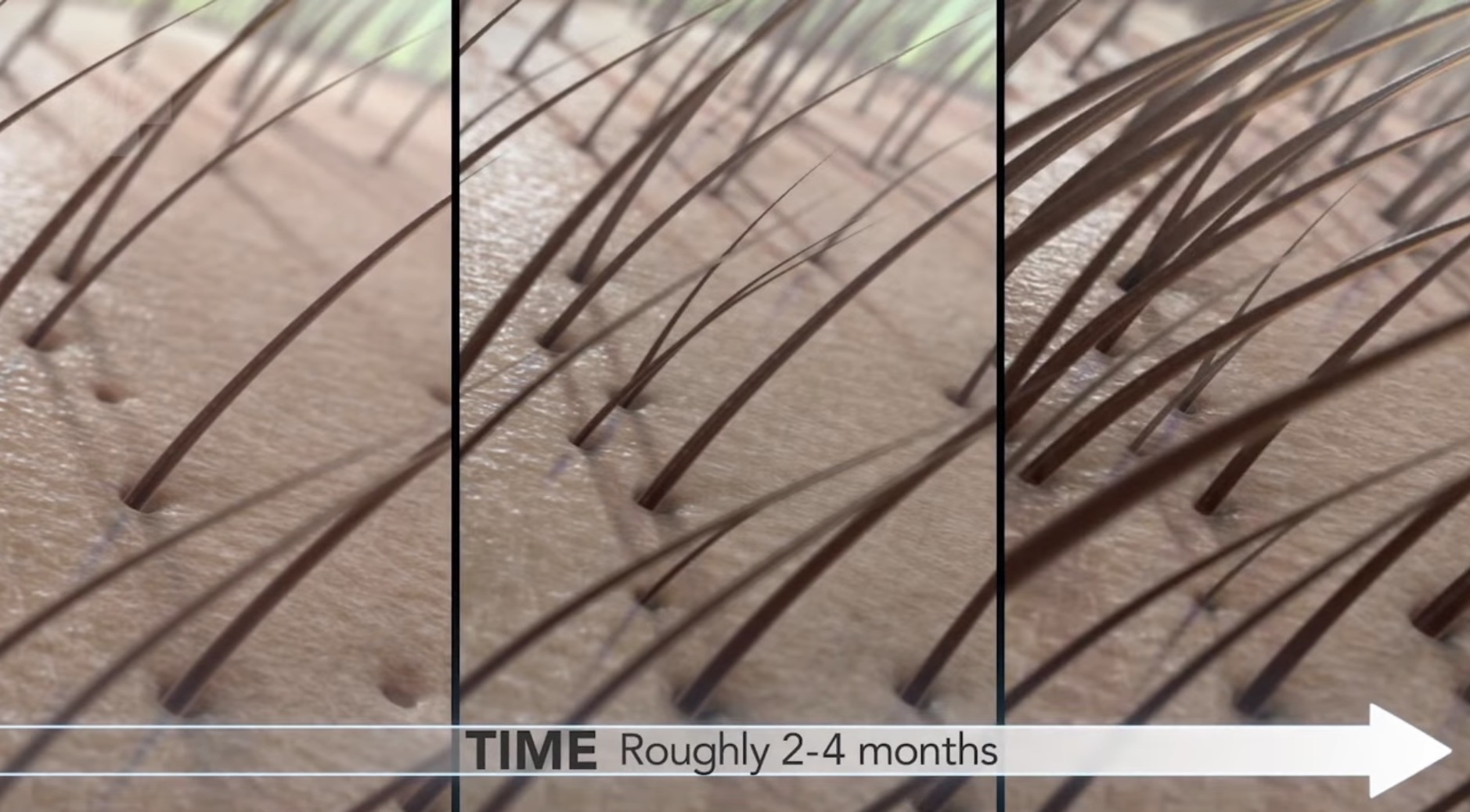
Not necessarily. A poor response may reflect delivery, evaluation timing, follicular reserve, or the absence of adjunctive therapies. When response is weak at 3–4 months, we first reassess the evaluation axis and timing, then medically judge whether continuation, escalation, change, or discontinuation is appropriate.
Q. With a heavy family history, is stem cell conditioned media hair treatment meaningless?
No. But when genetic androgen sensitivity is high, improving the scalp environment alone may not be enough to counter upstream hormonal pressure. In such cases, a realistic design combines oral or topical suppression with stem cell conditioned media addressing the follicular environment in parallel.
Q. Can the outcome prediction change during treatment?
Yes. In fact, updating the first-visit outlook based on interim trichoscopy findings and life-context changes is the natural workflow. Outcome prediction is not a prophecy but a working hypothesis physicians and patients revise together.
──────────────
Supervising Physician: Shin Moriwaki, M.D.
Member, Japan Society of Aesthetic Surgery (JSAS) / Member, American Academy of Aesthetic Medicine
ECFMG Certificate
──────────────
📍AVAN TOKYO Ginza Hair Regenerative Medicine
AVAN TOKYO Ginza Hair Regenerative Medicine
English / 中文 / Tiếng Việt available
Inquiries welcome via DM / LINE / Website / Phone.