


Male AGA Progressing at Both the Hairline and Vertex Simultaneously: How to Set Treatment Priorities — Dr. Moriwaki Explains the Difference in Response Between the Frontal and Vertex Scalp and How to Allocate Stem Cell Conditioned Media2026.08.03
“My hairline and my vertex are thinning at the same time” — this is a common concern that generates hesitation precisely because both areas are on the patient’s mind. In male AGA with simultaneous hairline and vertex progression, applying the “same amount, evenly split” strategy to both areas often makes the response harder to read and results less predictable than expected. Because the frontal scalp and the vertex differ in follicle characteristics and speed of response, the sequence in which treatment is allocated will shape the outcome six months to a year later. In this article, Dr. Moriwaki at AVAN TOKYO Ginza organizes how stem cell conditioned media should be allocated in cases of simultaneous hairline and vertex progression, together with the roles of oral and topical medications.
Key Points
・In male AGA with simultaneous hairline and vertex progression, rather than an even split it is more useful to weight intensity by “speed of progression” and “remaining density.”
・The frontal follicles are highly androgen-sensitive and slower to respond, while the vertex tends to show visible change on photographs more readily.
・Stem cell conditioned media is a complementary option that acts on the follicular microenvironment; the foundation of oral medication to “halt progression” is a prerequisite.
・Age and life context (public-facing profession, upcoming events) should be respected as axes of subjective priority.
・Effect should be judged in 3–6 month blocks — not by “hair count” but by “recovery of hair caliber,” “reduction of visible scalp,” and “maintenance of hair volume.”
Why the Frontal Scalp and Vertex Respond Differently
When the hairline and vertex are progressing at the same time, it is tempting to treat both areas with “the same protocol,” but follicular responsiveness differs by region. Understanding this difference is the starting point for allocation.
Frontal follicles show relatively higher 5-alpha-reductase activity
The follicles at the frontal scalp (hairline and M-shape recession area) exhibit relatively higher activity of 5-alpha-reductase type II, which favors conversion of testosterone to DHT (dihydrotestosterone). DHT is the main factor that shortens the follicular life cycle, and the frontal scalp is therefore considered particularly susceptible to androgens. Interventions such as finasteride or dutasteride, which are 5-alpha-reductase inhibitors, become especially important for “halting progression” in this area. However, precisely because the frontal follicles are highly sensitive, the time required for them to move into a “recovery” phase after treatment also tends to be relatively longer.
The vertex tends to show visible response earlier
By contrast, the vertex generally retains better blood-flow conditions than the frontal scalp, and oral and topical minoxidil as well as stem cell conditioned media are clinically discussed as therapies whose “response is easier to see on photographs” in this region. In other words, when hairline and vertex are progressing together, patients tend to feel short-term change more clearly at the vertex, while a realistic strategy for the hairline is a long-term one of “defense — slowing progression.”
What happens when both areas are treated equally
With limited visits and drug costs, if both areas are dosed evenly, results are often “neither area convincingly moves” — or “while the faster-responding vertex feels reassuring, the slower-responding hairline continues to recede in the meantime.” Even allocation looks fair, but it is often the hardest allocation to evaluate.
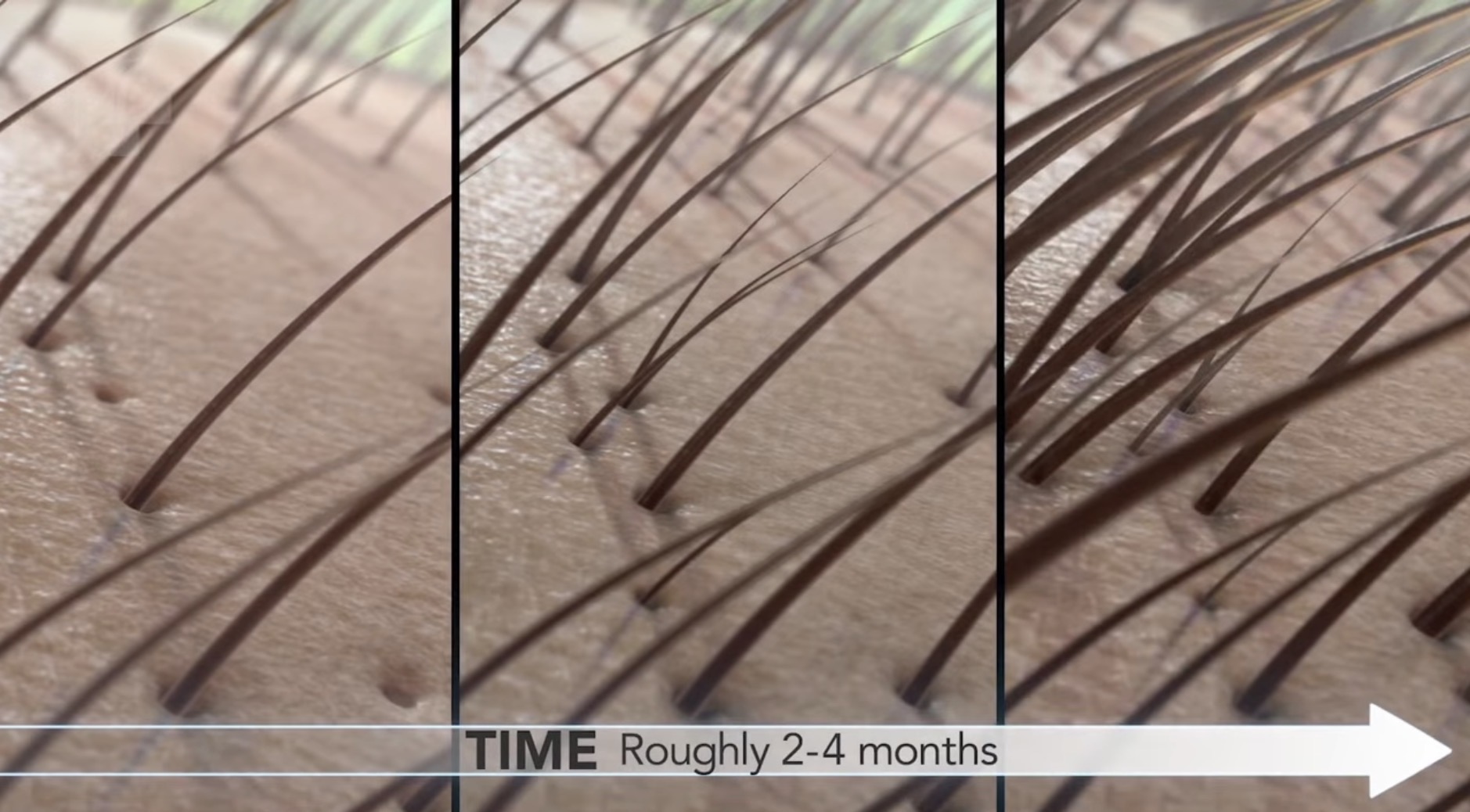
Four Axes for Setting Treatment Priority in Simultaneous Hairline and Vertex AGA
When deciding which area to weight first in cases of simultaneous hairline and vertex progression, we recommend combining the following four axes. Medical priority and the patient’s life context do not always align, so both need to be laid out carefully.
① Speed of progression
Using photographs, mirror memory, and cap-line marks, identify which area has “clearly receded” over the past 6–12 months. The faster-progressing area needs early, heavier “stopping” intervention, and a concentrated allocation of oral medication plus stem cell conditioned media should be considered. When speed is difficult to read, we may first insert several months of observation with standardized photography and trichoscopy.
② Remaining density and follicular reserve
In areas already at Norwood V–VI where most follicles have been lost, the response to conservative regenerative approaches becomes limited. It is realistic to prioritize the area where follicular reserve remains, and to consider follicular unit hair transplantation as a separate track for the area where reserve has been lost.
③ The patient’s subjective priority
“My work involves public speaking, so the hairline is my top concern” — “I want the vertex to look less transparent by a photo shoot six months from now.” Such subjective priorities based on life context are an important element of treatment design. When medical priority and subjective priority diverge, laying both explicitly on the table and reaching a joint decision also affects the rate of treatment adherence.
④ Age and life background
For patients in their 20s–30s who must defend density over the coming decades, and for patients in their 40s–50s for whom “maintaining current density is enough,” the goal itself changes. It becomes necessary to separate “attacking areas” from “defending areas” according to age.
Allocating Stem Cell Conditioned Media — Induction and Maintenance
A two-phase design that switches strategy between “induction” and “maintenance” phases is effective for stem cell conditioned media in simultaneous hairline and vertex progression cases.
Induction phase: concentrate on the priority area
For the first 3–4 months, allocate a larger share of stem cell conditioned media to the higher-priority area (whichever has faster progression or higher subjective priority). Rather than “equal to both areas,” allocations such as 7:3 or 6:4 that concentrate on the priority area make it easier to evaluate changes in the follicular microenvironment of that area using objective measures.
Maintenance phase: reallocate based on response
At six months, evaluate changes in hair caliber and volume using objective measures (trichoscopy, standardized photography). Extend intervals in areas that are responding, and shift allocation toward areas with poor response. Rather than “sticking to the initial allocation forever,” a willingness to revise as the course unfolds is what shapes results.
Roles of oral and topical medication
Stem cell conditioned media is a “complementary option that conditions the follicular microenvironment” and does not by itself halt AGA progression. Building the “stopping” foundation with oral finasteride or dutasteride, backing up growth signals with minoxidil, and then conditioning the microenvironment with stem cell conditioned media — this three-layer structure is the baseline design for male AGA with simultaneous hairline and vertex progression.
For related articles on hair regenerative medicine, please also see our list of hair regenerative medicine columns. Regarding AGA clinical guidance, the public information from the Japanese Dermatological Association is a useful reference.
How to Judge Effect
Judging by “whether hair increased” alone gives unstable evaluations in simultaneous hairline and vertex progression cases. Combining the following three objective axes supports rational decisions about whether to continue treatment.
First, “recovery of hair caliber” — the thickness of hair measured by microscope is the first indicator to thin in AGA and the first to return under treatment. Second, “reduction of visible scalp” — compare the exposed scalp area on standardized photographs under identical lighting and angle. Third, “maintenance of hair volume” — on a horizon of six months to a year, confirm at minimum that progression has stopped. Judging by photographs alone allows illusions caused by lighting or styling, so combining several objective measures is the honest way to evaluate. Individual variation exists, and no definitive result can be guaranteed.
Frequently Asked Questions
Q. Should treatment start from the hairline or the vertex?
The basic principle is to first firmly “stop” the area with faster progression. If one area has clearly receded in the past six months, allocation should preferentially defend that area. If both are progressing at similar speed, the patient’s subjective priority (life context) may be respected. Regardless of which is prioritized, the “stopping” effect of oral medication works on both areas simultaneously, so starting from oral medication is the realistic sequence.
Q. Once I have stem cell conditioned media injections, can I stop the oral medication?
It is safer not to stop. Stem cell conditioned media does not by itself halt AGA progression; it is a complementary option that conditions the follicular microenvironment. If oral medication is discontinued, DHT-driven follicular shortening resumes, and the gains from stem cell conditioned media may be lost over several months to a year. If you are considering stopping oral medication due to concerns about side effects, please always discuss it with your prescribing physician.
Q. What if both areas are progressing quickly?
Rather than spreading treatment thinly across both areas, one strategy is to first consider intensifying oral medication (including dutasteride), and to concentrate stem cell conditioned media in the area where follicular reserve remains. When progression is rapid, however, evaluation by a dermatologist or hair specialist to rule out other forms of alopecia (autoimmune, drug-induced, etc.) must come first.
Q. When should I judge the effect?
At a minimum of three months, and preferably at six months. In terms of the hair cycle, there is not enough material to evaluate treatment response before three months. Combining standardized photography with microscopic measurement of hair caliber, judgment based on “has thin hair become thicker” and “has progression stopped” — rather than “has count increased” — helps a calm decision about whether to continue treatment.
Q. Is it true that the hairline is “hard to recover”?
Because frontal follicles are highly androgen-sensitive and their blood-flow conditions are relatively less favorable, it is clinically noted that recovery tends to take longer than at the vertex. However, this does not mean “it will never return.” By continuing over the long term the “stopping” foundation of oral medication together with the microenvironmental conditioning of stem cell conditioned media, at minimum “slowing progression” and “maintaining hair caliber” is well within reach. Because individual variation is large in this area, we recommend evaluation in person based on objective measures.
──────────────
Supervising Physician: Shin Moriwaki, MD
Member, Japan Society of Aesthetic Surgery (JSAS)
Member, American Academy of Aesthetic Medicine
ECFMG Certificate
──────────────
📍AVAN TOKYO 銀座 毛髪再生医療
AVAN TOKYO Ginza Hair Regenerative Medicine
English / 中文 / Tiếng Việt available
For consultations, please contact us via DM / LINE / Website / Phone.