


Hair Loss After Moving, a Job Change, or Divorce: The 3-Month Delayed Shedding Explained2026.09.30
Moving house, changing jobs, going through a divorce, losing someone close. It is not unusual to notice a sudden surge in hair shedding two to three months after such a life event. Telogen effluvium after a life event is a delayed form of hair loss that leaves many patients asking, “Why now, when things have finally calmed down?” But when you understand the hair cycle, this time gap has a clear medical explanation. In this article, supervised by Dr. Moriwaki, we walk through why hair loss peaks about three months after a major life event, how to tell it apart from AGA, and what regenerative scalp treatments including stem cell conditioned media can and cannot do.
Key Points
・Telogen effluvium after a life event is classified as Acute Telogen Effluvium, appearing roughly 2–3 months after a strong stressor.
・The delay is dictated by the hair cycle: hairs pushed prematurely into the telogen phase remain in place for 2–3 months before shedding.
・Most cases self-resolve within a year, but recovery is slower when AGA or chronic telogen effluvium is also present.
・Moving, a job change, or divorce typically stack three stressors at once: psychosocial strain, disrupted sleep and diet, and shifts in body weight and hormones.
・Treatments that restore scalp environment can shorten recovery time and prevent aggravation when AGA is running in parallel.
Why the Shedding Arrives 3 Months Late
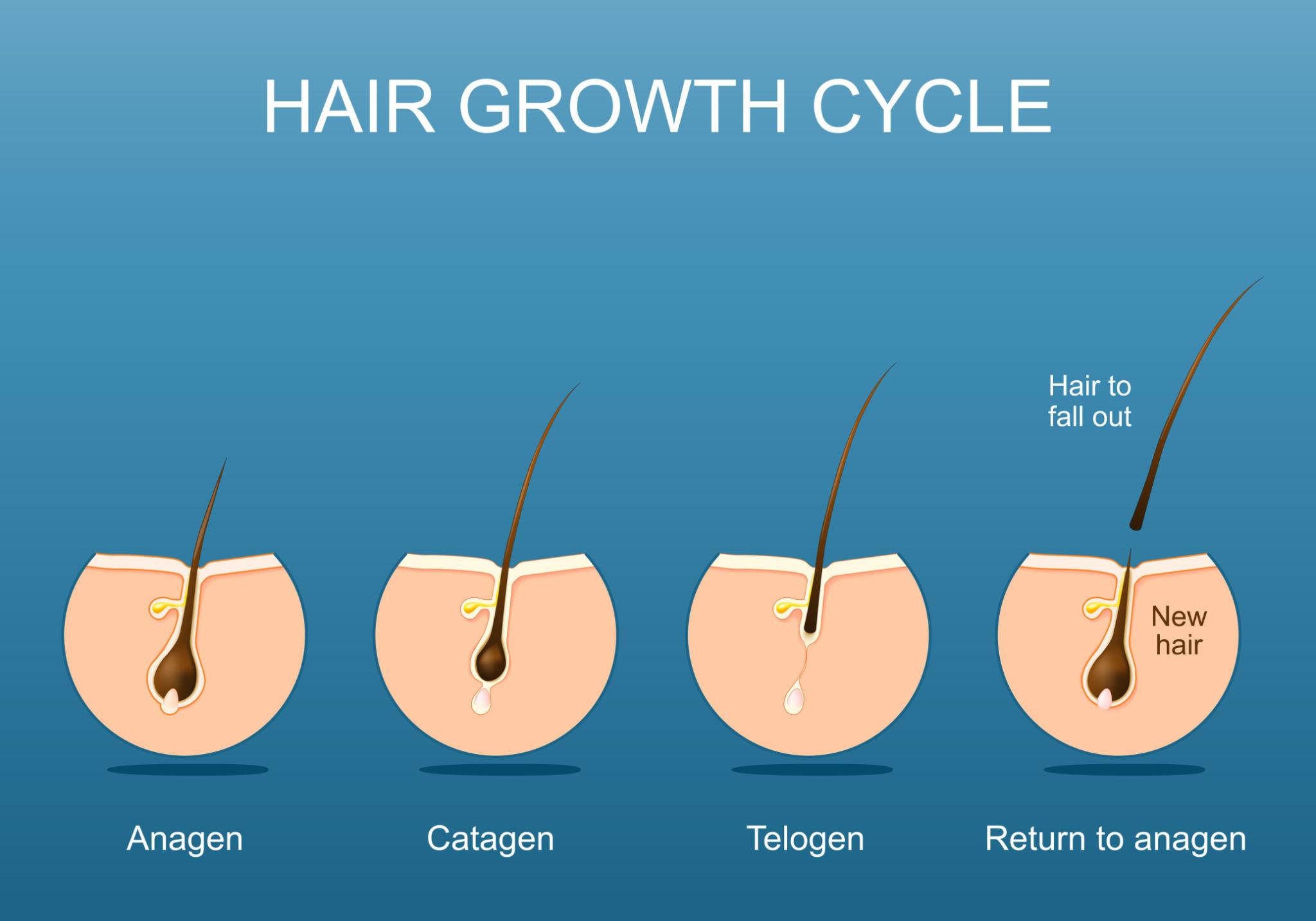
Healthy hair cycles through the anagen (growth, 2–6 years), catagen (transition, 2 weeks) and telogen (resting, 2–4 months) phases. At any moment, 85–90% of hairs are in anagen and 10–15% in telogen. When a strong stressor hits, a portion of anagen hairs is forced into telogen ahead of schedule, a process called anagen release.
Hairs that enter telogen do not fall out immediately. They sit in the follicle while a new hair slowly pushes them out, and they typically shed about 2–3 months later. That is why the shedding surfaces long after the actual stress event, creating a confusing gap between cause and effect.
Three Stress Pathways Life Events Impose on Hair Follicles
Events like moving, a job change, or divorce rarely act through a single mechanism. They stack multiple loads on the follicle simultaneously, and “it was mentally hard” only tells part of the story.
Psychosocial Stress
Prolonged tension raises cortisol and induces inflammatory cytokines (IL-1β, TNF-α) around the follicle. Signals that maintain the anagen phase weaken, and the shift into telogen accelerates. Clinically it is common to see the peak of shedding arrive when the person has finally relaxed — the follicles register the accumulated load only after the pressure lifts.
Disrupted Sleep and Nutrition
Moving or a job change rebuilds daily rhythms from scratch. Reduced deep sleep lowers growth hormone and follicle stem cell repair signals; changes in diet destabilize protein, iron, zinc and vitamin D supply. Matrix cells in the follicle are among the fastest-dividing in the body, so they register nutritional dips quickly.
Weight and Hormonal Shifts
Divorce, bereavement, and long-distance job assignments frequently bring rapid weight changes. Sudden dieting or overeating disturbs thyroid balance and, in women, estrogen and prolactin — another trigger for telogen effluvium. A few months of appetite loss can show up much later as visible thinning.
Distinguishing Telogen Effluvium After a Life Event from AGA
The key question is whether the shedding is a transient telogen effluvium or a life event that has exposed underlying AGA. Pure acute telogen effluvium usually recovers within 6–12 months once the cause resolves. Signs that suggest AGA is also present include:
・Selective thinning at the hairline or crown (telogen effluvium is diffuse across the scalp)
・Shed hairs that are thin and short (follicular miniaturization)
・A family history of early-onset male or female pattern hair loss
・Shedding that fails to slow after 6 months or density that does not recover after a year
Microscopy for hair caliber and, where indicated, blood work for hormones, iron and thyroid help sort this out. It is not unusual for a life event to unmask a genetically programmed AGA that had been quietly progressing. For AGA guidance, see the Japanese Dermatological Association guidelines.
How Treatment Is Framed for Telogen Effluvium After a Life Event
When the process is transient, time is the primary treatment — but relying on time alone is not always enough.
The first layer is rebuilding sleep, nutrition, and scalp basics: adequate protein, iron, zinc, and vitamin D; less blue light before bed; correct washing. Rapid weight loss is best avoided while shedding is active.
If telogen effluvium after a life event drags on or shows signs of underlying AGA, scalp treatment with stem cell conditioned media becomes a legitimate option. Growth factors such as IGF-1, KGF and VEGF in the conditioned media are reported in basic research to promote the return from telogen to anagen and quiet perifollicular inflammation. It is not a guaranteed regrowth solution: effects are confined to follicles that still exist, and 3–6 months are needed before results can be judged.
You can browse the broader picture of scalp regenerative care at the hair regenerative medicine column index to help decide whether your shedding is the kind that resolves on its own, or the kind that benefits from earlier intervention.
FAQ
Q. I noticed heavy shedding 2–3 months after a major life event. What should I do first?
Stabilize sleep, meals, and exercise first, and observe the scalp closely. If shedding well above 100 hairs a day continues for over two weeks, or if the scalp is visibly showing more than before, see a dermatologist or hair specialist.
Q. How long does natural recovery usually take?
Density most commonly returns within 6–12 months after the causal stress is reduced. If improvement is limited beyond a year, chronic telogen effluvium or coexisting AGA should be evaluated.
Q. Is it safe to start scalp treatment while shedding is active?
Treatment during the acute phase is possible, but the safe path is to first examine the follicles with microscopy and match intensity to the current stage. Aggressive procedures introduced too quickly can add a transient shedding surge on top of the ongoing loss.
Q. Can purely emotional events like a breakup really affect hair?
Yes. Sustained psychosocial stress alters the follicular environment through cortisol elevation and inflammatory cytokines. It is not “just imagination” — it is a measurable interplay of hormones, immunity, and the autonomic system.
Q. Does stem cell conditioned media help even in transient telogen effluvium after a life event?
Even in transient cases, it can shorten recovery by calming inflammation and accelerating the return to anagen. That said, the foundation remains removing the stressor and rebuilding daily life — treatment is best positioned as an accelerator, not a substitute.
──────────────
Supervising Physician: Shin Moriwaki, MD
Member, Japan Society of Aesthetic Surgery (JSAS)
Member, American Academy of Aesthetic Medicine
ECFMG Certificate
──────────────
📍AVAN TOKYO 銀座 毛髪再生医療
AVAN TOKYO Ginza Hair Regenerative Medicine
English / 中文 / Tiếng Việt available
Inquiries via DM / LINE / Website / Phone are welcome.