


Male AGA: Dermatology vs Aesthetic Clinic — Dr. Moriwaki on Self-Pay Scope2026.09.06
“I want to start AGA treatment, but I don’t know whether to see a dermatologist or an aesthetic clinic.” Many men in their 30s and 40s ask us this. With limited time and budget, the choice often gets postponed indefinitely.
However, the treatment scope of male AGA self-pay care differs greatly from insurance-covered dermatology. Understanding both correctly is the shortest path to avoiding wasted detours.
This article organizes the situations where men choose an aesthetic clinic over a dermatologist, and the scope differences between insurance-covered and self-pay care behind that choice.
Key Points
・Insurance-covered dermatology focuses on “treating disease” — strong for alopecia areata and other disease-classified hair loss
・AGA (male pattern baldness) is generally outside insurance coverage; oral drugs, topicals, injections, and stem cell conditioned media are self-pay
・The scope of male AGA self-pay care is a trinity: “stop progression” + “promote regrowth” + “improve scalp environment”
・Combination protocols and regenerative approaches that dermatology cannot prescribe are the strength of aesthetic clinics
・If symptoms lean toward disease (itching, inflammation, bald patches), see a dermatologist; if the goal is progressive thinning or density recovery, an aesthetic clinic is more suitable
Main Reasons Men Choose Aesthetic Clinics Over Dermatology
1. AGA Is Not a “Disease” but a “Progressive Constitutional Change”
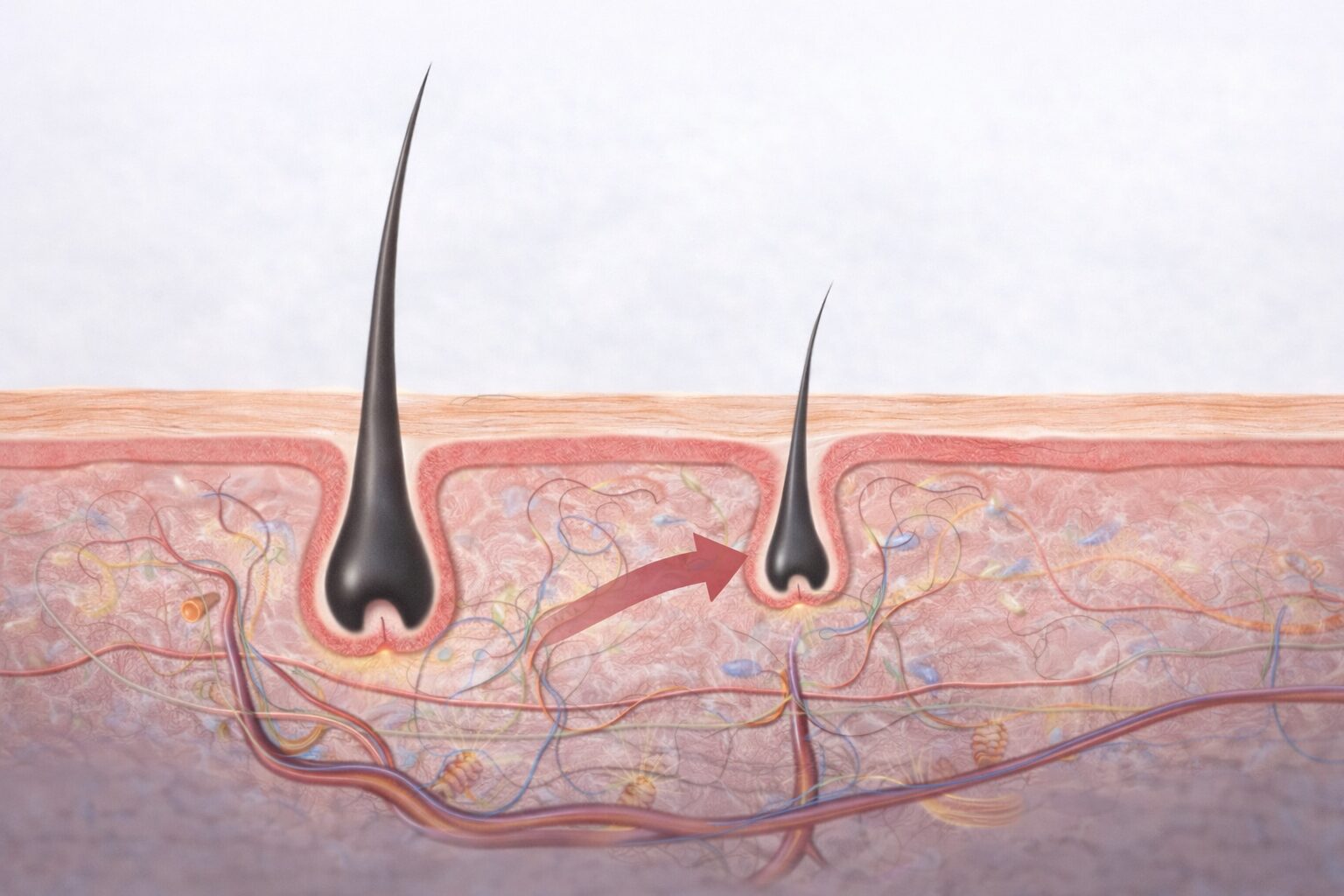
AGA is a constitutional progressive phenomenon in which DHT (dihydrotestosterone) gradually atrophies hair follicles. Because it is not life-threatening, it falls outside public insurance coverage.
Even when men consult insurance-covered dermatology about AGA, they are told “treatment will be self-pay,” and clinics that actively handle it are limited. As a result, more men gravitate toward aesthetic clinics specializing in AGA treatment.
2. The Range of Treatment Options Is Completely Different
Insurance-covered dermatology handles “disease-based” hair loss such as topical/oral steroids for alopecia areata and antifungals for seborrheic dermatitis.
By contrast, male AGA self-pay care freely combines oral finasteride/dutasteride, topical minoxidil, mesotherapy, and scalp injection using stem cell conditioned media. The biggest difference is that you can simultaneously target “stopping,” “regrowing,” and “protecting.”
3. You Can Design Around Progression Stage
Whether you sit at Norwood II or V changes the necessary intervention drastically. Standard treatment under insurance tends to be uniform, but self-pay care at aesthetic clinics allows fine tuning of treatment intensity based on individual progression, age, and lifestyle. Whether you want to “stop now” or “restore density” changes which drugs and injection frequency are chosen.
Knowing the “Scope” of Male AGA Self-Pay and Insurance Care
The Scope of Insurance-Covered Care
Insurance-covered care aims at “treating disease” under the public health insurance system, providing diagnosis and standard treatment for illnesses. In dermatology, this includes alopecia areata, seborrheic dermatitis, scalp eczema, and folliculitis.
These have objective diagnostic criteria and established treatment procedures. If the scalp shows itching, redness, pustules, or bald patches, insurance-covered dermatology should be prioritized first to control inflammation.
The Scope of Self-Pay Care
On the other hand, male AGA self-pay care aims at “symptom improvement, progression suppression, and aesthetic satisfaction” and is designed tailor-made for each patient.
Unbound by uniform insurance protocols, it can freely combine oral drugs, topicals, injections, and regenerative approaches. In particular, delivering stem cell conditioned media rich in growth factors to the scalp draws attention as an option not available in insurance-covered treatment.
For scientific guidance on AGA treatment, please also refer to the guidelines for male and female pattern hair loss from the Japanese Dermatological Association. The guidelines classify finasteride, dutasteride, and topical minoxidil as recommendation grade A — these form the backbone of self-pay treatment.
Dermatology and Aesthetic Clinics: “Role Division,” Not “Opposition”
What matters is that dermatology and aesthetic clinics are not opposing forces. If you enter self-pay care while inflammation, eczema, or pustular disease persists on the scalp, injections and topicals will not perform to their full potential.
First have the dermatologist stabilize the scalp environment, then combine progression suppression and hair growth promotion at the aesthetic clinic — this sequence often becomes the shortest path in the end. For related topics, please also see the list of related columns on hair regenerative medicine.
Conclusion — Choose by Symptom, Decide by Goal
Male AGA self-pay care and insurance-covered dermatology are not a matter of which is better; they should be used according to purpose and symptoms.
If you have inflammation, itching, or bald patches, first suppress the disease with insurance-covered dermatology; if your goal is progressive thinning or density recovery, self-pay care at an aesthetic clinic combining oral drugs, topicals, and stem cell conditioned media is more suitable. Clarifying “what is the current scalp condition” and “what is the goal” is the first step of a wasteless treatment plan.
FAQ
Q. Is AGA not covered by insurance?
Correct. AGA (male pattern baldness) is positioned as a “progressive constitutional change” and is generally outside public health insurance coverage. Oral drugs, topicals, and injection therapy are all treated as self-pay.
Q. Should I visit a dermatologist first before going to an aesthetic clinic?
If the scalp shows itching, redness, pustules, or bald patches, we recommend seeing a dermatologist first. Proceeding to AGA treatment after the scalp environment stabilizes maximizes the effect of injections and topicals.
Q. What is the benefit of using stem cell conditioned media in male AGA self-pay care?
Growth factors and cytokines act on the microenvironment around hair follicles, offering synergy with existing treatments. Individual variation exists, so the fundamental design combines it with oral and topical therapy.
Q. I’m worried about costs becoming too high.
Because self-pay care is out of pocket, the cost varies widely by treatment content. Our clinic presents priorities based on progression and goals during counseling and guides you toward a reasonable treatment design.
Q. Once I start treatment, will I be unable to stop?
Discontinuing oral drugs tends to restart progression within several months to half a year. However, combining regenerative approaches sometimes allows gradual adjustment of oral intensity. Design tailored to each situation is essential.
──────────────
Supervising Physician: Shin Moriwaki, MD
Member, Japan Society of Aesthetic Surgery (JSAS) / American Academy of Aesthetic Medicine
ECFMG Certificate
──────────────
📍AVAN TOKYO Ginza Hair Regenerative Medicine
English / 中文 / Tiếng Việt supported
Inquiries via DM / LINE / Website / Phone.