


When the “Shape” of Hair Loss Changes Around Menopause — Dr. Moriwaki on the Boundary Between FAGA Patterns and Diffuse Thinning2026.08.06
“Up until my mid-forties I mostly noticed the part line widening, but around menopause the overall shedding increased and the whole head lost volume.” Many women feel this way. Menopausal diffuse hair loss is often dismissed as “just age,” but behind it, two things advance in parallel: a major shift in the hormonal environment supporting the follicle, and age-related changes in follicle stem cells. Here, Dr. Moriwaki of AVAN TOKYO Ginza Hair Regenerative Medicine breaks down, medically, what changes in the scalp of women around menopause, and honestly delineates what stem cell conditioned media scalp therapy can and cannot address.
Key Points
・Menopausal diffuse hair loss emerges from two endocrine shifts advancing at the same time: a sharp drop in estrogen and a relative androgen predominance.
・In younger to midlife women, the Ludwig-type (crown-centered) widening is prominent; after menopause, a whole-scalp reduction in hair diameter — including temporal and occipital areas — is often added.
・This age group frequently overlaps with internal-medicine backgrounds such as iron, thyroid, vitamin D, and zinc, so blood work is indispensable at the initial visit.
・Stem cell conditioned media is a therapy that acts on the peri-follicular micro-inflammatory and signaling environment; it is positioned to complement topical minoxidil and other treatments.
・It is not a therapy that regenerates completely lost follicles — understanding “what can be preserved” and the “time axis” is the starting point for realistic goal setting.
Why the “Shape” of Menopausal Diffuse Hair Loss Changes
Estrogen decline and shortened hair cycle
Estrogen is thought to act in the direction of prolonging the anagen (growth) phase of the follicle. When ovarian estradiol secretion drops rapidly with menopause, this prolonging effect is lost, and the entire hair cycle tends to shorten. When anagen becomes shorter, each hair transitions to telogen (rest phase) before it can grow long and thick; hairs that regrow after shedding come in thinner and shorter — and the accumulation of this cycle is what patients perceive as “loss of overall volume.”
Relative androgen predominance and site differences
After menopause, the absolute amount of androgen also gradually declines, but because the drop in estrogen is larger, the ratio tilts toward androgen predominance. Follicles in the vertex and frontal areas concentrate androgen-sensitive 5α-reductase and androgen receptors, so miniaturization (fiber thinning) accelerates in these regions. Meanwhile, temporal and occipital follicles are inherently less androgen-sensitive, and in young women with FAGA they are not prominent — but after menopause, the added fatigue of follicle stem cells with age can surface as whole-scalp diffuse hair loss.
Distinguishing Ludwig-Type from Whole-Scalp Patterns
The central widening captured by the Ludwig classification
The Ludwig classification, long used for female FAGA, evaluates a mid-line-dominant widening pattern of the crown parting in stages I–III. In younger to midlife women this central pattern is prominent, and the hairline is relatively preserved — a point that differs from male AGA. In clinic, we record the current state using this classification axis at the initial visit and use it as an index to track over time.
The “including the sides” thinning that appears after menopause
In menopausal diffuse hair loss, in addition to this central pattern, cases arise where hair diameter and density reduction advance simultaneously in temporal and occipital regions. Under a microscope, even in the occipital area — usually considered the donor zone — variability in hair diameter (anisotrichosis) and reduced hair count per follicular unit can be observed in some cases, a feature not commonly seen in young women with FAGA. In such cases, the situation should be viewed not as “isolated progression of AGA” but as a state overlapping with age-related changes in the follicle environment.
Christmas-tree pattern and other conditions to rule out
The Olsen pattern, where the frontal hairline recedes in a Christmas-tree shape, is also reported in women, and some patients add this element after menopause. However, diffuse hair loss in this period requires many differential diagnoses: diffuse alopecia areata, telogen effluvium, cicatricial alopecias (such as lichen planopilaris), thyroid dysfunction, iron deficiency, zinc deficiency, drug-induced etc. Before deciding “it’s menopause,” the diagnostic sequence — history, inspection, trichoscopy, blood work, and if necessary skin biopsy — is essential.
What Stem Cell Conditioned Media Scalp Therapy Can and Cannot Target
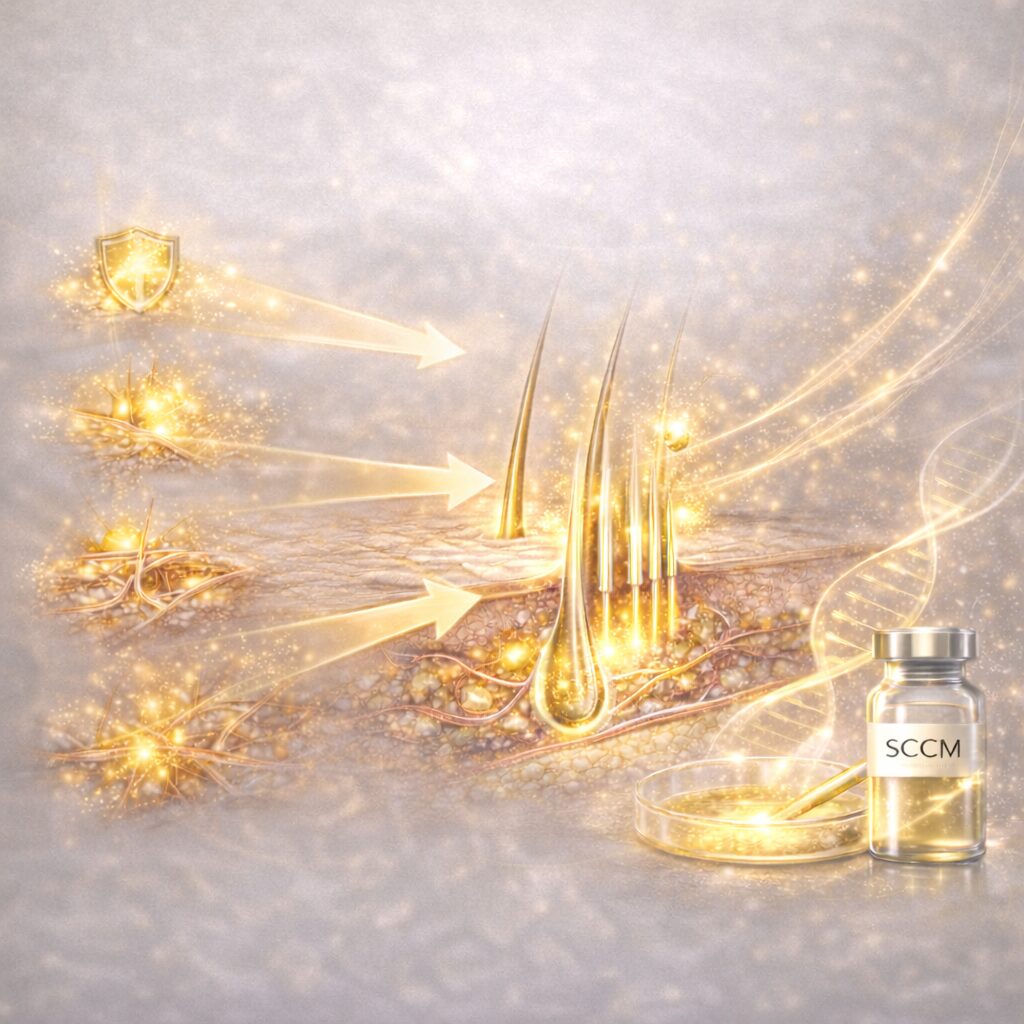
Stem cell conditioned media (secretomes obtained from cultured supernatants of adipose-derived or other stem cells) is positioned as a complementary therapy for menopausal diffuse hair loss, one that “acts on the peri-follicular microenvironment.” Multiple growth factors including IGF-1, HGF, VEGF, and TGF-β, together with miRNA groups carried by exosomes, are thought to be involved in suppressing peri-follicular micro-inflammation, promoting angiogenesis, and regulating extracellular matrix metabolism. Combined with topical minoxidil, oral spironolactone when appropriate, and correction of baseline conditions such as iron, thyroid, and vitamin D, it is used as a way of building the “foundation” of the scalp environment.
On the other hand, stem cell conditioned media is not a therapy that creates a new follicle where one has been completely lost. There are limits to the change that can be expected for follicles that have miniaturized over many years around menopause, or for scarred follicles. A realistic schedule is to confirm response over at least 3–6 months, and usually 6–12 months, using standardized photography, trichoscopy, and hair diameter measurement under consistent conditions. Related articles are available at the hair regenerative medicine column index. For internal-medicine backgrounds of female hair loss and differentiation from skin diseases, general information from the Japanese Dermatological Association is also useful reference.
Frequently Asked Questions
Q. If diffuse hair loss began after menopause, will HRT (hormone replacement therapy) improve it?
The primary purpose of HRT is management of menopausal symptoms such as hot flashes and reduced bone density, not hair loss therapy itself. While there are reports of the hair environment stabilizing with estrogen replacement, depending on the type of progestin included it may actually raise the risk of thinning. A realistic approach is coordination among gynecology, dermatology, and hair clinics, judging from both whole-body health and hair.
Q. Is stem cell conditioned media scalp therapy safe after menopause?
Menopause itself is not a contraindication. However, this age group is also a period when comorbidities such as osteoporosis, diabetes, dyslipidemia, and use of anticoagulants/antiplatelet agents increase. We confirm whole-body condition and medications at the initial visit before setting up the treatment plan. Because time to re-epithelialization of skin also tends to be longer than in younger patients, the interval between sessions and the downtime estimate are individually adjusted.
Q. Over how many months should the change in menopausal diffuse hair loss be judged?
Given the nature of the hair cycle, the first three months tend to be a period of initial shedding and little visible change, and are not suitable for judgment. We evaluate over at least 3–6 months, and preferably 6–12 months, using standardized photography and objective indices such as hair diameter and density. Maintaining record consistency rather than rushing to switch treatments ultimately improves judgment accuracy.
Q. What should I have checked in blood work?
Generally, ferritin (storage iron), TSH and FT4 (thyroid function), 25-OH vitamin D, zinc, and when needed total testosterone, DHEA-S, prolactin, CBC, and liver/kidney function. Around menopause, multiple internal-medicine backgrounds tend to overlap, so it is important to view findings together with lab numbers rather than judging by skin findings alone.
Q. I don’t want to use oral medication — can stem cell conditioned media alone still be treatment?
A choice not to combine with oral medication is possible in itself, and the decision is made based on constitution, lifestyle, and past medication experience at other clinics. However, with monotherapy the speed and range of expected change tend to be limited, so we adjust the goal setting having shared this in advance.
──────────────
Supervising Physician: Shin Moriwaki, MD
Member of the Japan Society of Aesthetic Surgery (JSAS) / Member of the American Academy of Aesthetic Medicine
ECFMG Certificate
──────────────
📍AVAN TOKYO 銀座 毛髪再生医療
AVAN TOKYO Ginza Hair Regenerative Medicine
English / 中文 / Tiếng Việt supported
Inquiries via DM / LINE / Website / Phone.