


Why Night Shift Men Show More Hair Loss: Androgens and Hair Cycle2026.09.28
“My hair started falling out after I moved to a shift rotation” — at AVAN TOKYO, we increasingly hear this from men working in police, fire services, medicine, factories, logistics and IT operations. Epidemiologically, night shift male hair loss appears more frequent and progresses faster than in men working typical daytime hours. It is easy to dismiss as “just sleep deprivation,” but underneath sits a male-specific mechanism: the diurnal rhythm of testosterone and the circadian synchronization of the hair cycle. This article separates the discussion from general shift-work alopecia and focuses on androgens and the hair cycle.
Key points
・Behind night shift male hair loss lies a flattened morning testosterone peak and chronically dysregulated timing of DHT production
・Hair follicles express clock genes such as BMAL1; the anagen–catagen switch is synchronized with the circadian rhythm
・Shift work misaligns light exposure, meal timing and core body temperature, robbing matrix cells of their nighttime mitotic peak
・The damage is not irreversible, but requires a multi-layer design combining lifestyle redesign, oral drugs, topicals and stem-cell conditioned media
・Whether treatment is planned “on the assumption that shift work continues” is the fork between halting progression and giving up
Male testosterone runs on a morning-peaked rhythm
Adult male testosterone peaks from early morning through the late morning, then declines through the evening — a clear diurnal pattern maintained during sleep, especially through the normal switching of REM and non-REM stages. When shift work pushes sleep into daytime and desynchronizes light exposure from sleep, the morning testosterone peak flattens and thin peaks scatter across the day and evening. Even at the same total quantity, a flattened rhythm weakens feedback control and the follicle — the target tissue — loses the “contrast” of its signal.
Further, in scalp follicles, 5α-reductase type II converts testosterone to DHT, and basic research shows that this enzyme activity also fluctuates diurnally. When the rhythm collapses, conversion continues during hours that would normally see low DHT exposure, and AGA-sensitive follicles in the frontal and vertex regions come closer to a state of round-the-clock attack. Night shift male hair loss often “progresses faster than expected for the same Norwood stage” precisely because of this temporal derangement.
The hair cycle itself is entrained to the body clock
The transitions between anagen, catagen and telogen are governed by clock genes such as BMAL1, CLOCK and PER1, whose expression oscillates. Knockout of BMAL1 delays anagen entry and abolishes the mitotic peak of follicle stem cells in animal studies. Human matrix cells also tend to divide more actively during the nighttime dip in core body temperature — one reason people say “hair grows while you sleep.”
Shift work shifts this core temperature trough into the daytime, and daytime sleep tends to be shallow and fragmented, so matrix cells lose the contiguous window of synchronized division they need. As a result, anagen shortens and follicles move earlier into catagen/telogen, perceived as telogen effluvium and thinning density. It is not a single night shift but months and years of accumulated shifts that determines the damage.
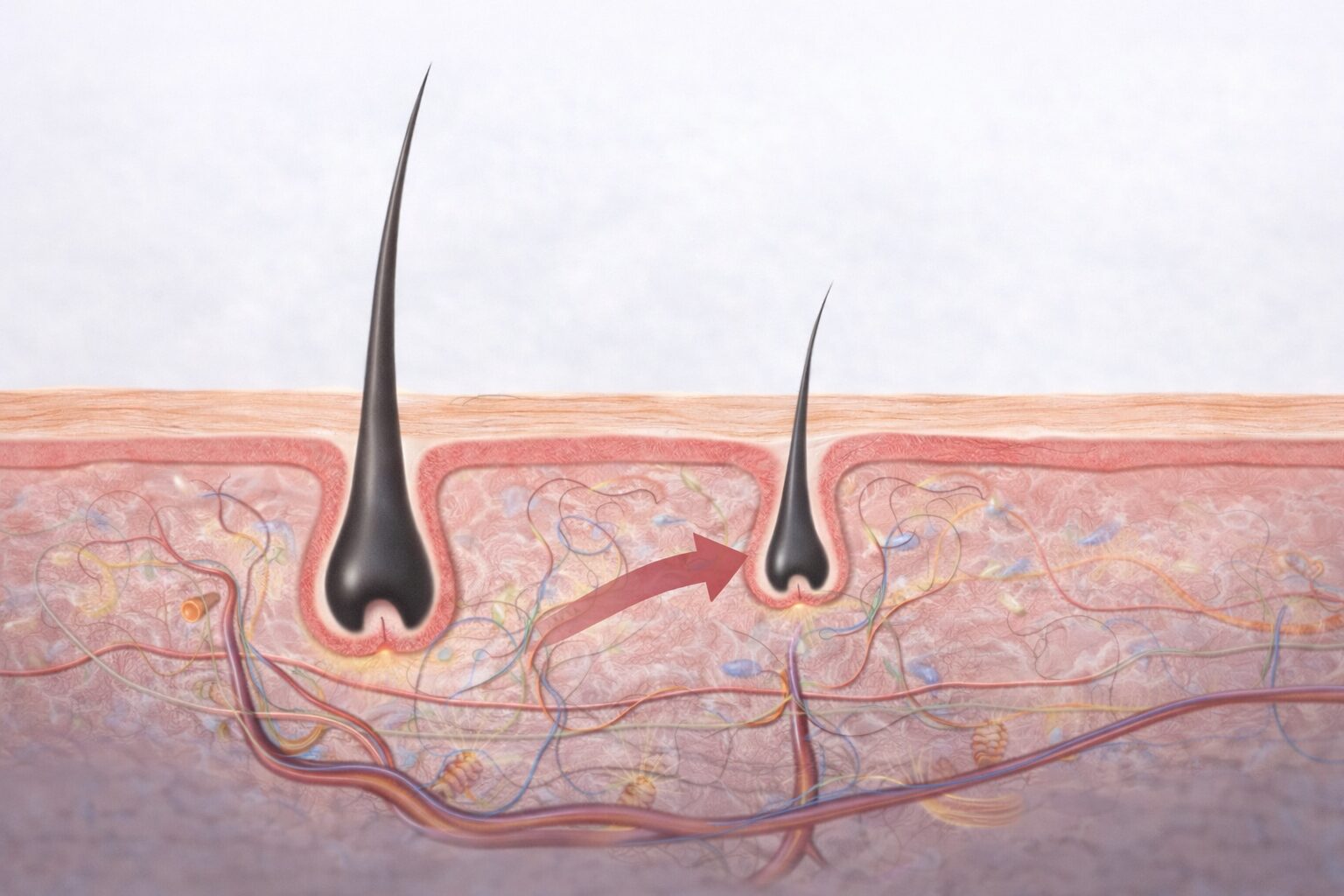
Three Zeitgebers that determine night shift male hair loss
Circadian rhythm is influenced more by external synchronizers (Zeitgebers) than by absolute sleep duration. The practical strategy is to “align Zeitgebers deliberately with the shift schedule.”
First, light. Bright morning sun after a night shift tricks the body clock into thinking “morning has come,” making the ensuing sleep shallow. Wear sunglasses on the way home and use blackout curtains to restrict light exposure. Second, meals. Heavy high-carb, high-fat meals during night shifts disturb metabolic rhythm and widen the gap between peripheral and central clocks. Switch to lighter meals overnight and eat one settled meal after the shift before sleeping. Third, exercise and temperature. Intense exercise after a night shift keeps sympathetic tone high and prevents core temperature from dropping. A bath or gentle stretching raises temperature first, and sleeping as it falls preserves the temperature rhythm that matrix cells need. See also the guidelines of the Japanese Dermatological Association on AGA treatment.
Design scalp therapy “assuming shift work continues”
What makes night shift male hair loss difficult is that lifestyle redesign alone cannot catch up. Because the work cannot be quit, rhythm-related damage never fully reaches zero, and AGA progression from androgens accumulates on top. Treatment is best split into a “stopping layer” and a “supporting layer.” The stopping layer is oral finasteride/dutasteride, which suppresses DHT conversion itself. The supporting layer is topical minoxidil and stem-cell conditioned media for scalp environment care. Conditioned media contain many growth factors and cytokines and are thought to calm chronic scalp inflammation while re-tuning the perifollicular microenvironment.
In cases with time-axis stress on follicles, combining direct scalp intervention rather than relying on oral medication alone increases the chance of preserving anagen. Our clinic schedules sessions to the shift rotation to prioritize sustainable continuation. Related articles can be found in the hair regenerative medicine column archive.
Note that AGA is progressive, and conditioned media alone cannot halt every case. The expected range varies by remaining follicle reserve, progression speed and age. Sharing indications and limits at the first visit, and planning in units of multiple years, is the realistic approach.
Frequently asked questions
Q. If I quit shift work, will my hair loss reverse?
Partly. When the telogen effluvium component is large, leaving shift work and re-synchronizing the circadian rhythm can restore perceived density over several months to a year. However, once AGA predisposition has manifested, that portion does not recover naturally, and oral, topical and scalp therapies must run in parallel.
Q. Is it true that shift work worsens hair loss more in men than in women?
Male-pattern hair loss is heavily driven by the testosterone-to-DHT pathway, so the “worsened by shift work” pattern tends to be more visible in men. In women, diffuse hair loss and hormonal fluctuations play larger roles, and the mechanism differs. That said, telogen effluvium from shift work does occur in women too.
Q. Can supplements after a shift compensate for the rhythm?
Melatonin, vitamin D and zinc are commonly discussed, but the evidence that any one of them normalizes the hair cycle alone is limited. Treat supplements as auxiliary and prioritize the three Zeitgebers — light exposure, meal timing and exercise.
Q. Where do stem-cell conditioned media fit for night shift male hair loss?
Conditioned media belong to the “supporting layer” that tunes the scalp environment; oral drugs form the “stopping layer.” Combining oral, topical and conditioned media handles the dual burden of rhythm disruption and androgens better than any single therapy. Indications are evaluated at the first visit.
Q. How long before we can judge whether treatment is working?
Because lifestyle rhythm is a large variable, we use six months — slightly longer than usual — as the evaluation benchmark. We judge by scalp photography and subjective symptoms together, checking whether anagen is recovering.
──────────────
Supervising physician: Shin Moriwaki, MD
Member, Japan Society of Aesthetic Surgery (JSAS) / Member, American Academy of Aesthetic Medicine
ECFMG Certificate
──────────────
📍AVAN TOKYO Ginza Hair Regenerative Medicine
AVAN TOKYO 銀座 毛髪再生医療
English / 中文 / Tiếng Việt supported
Inquiries: DM / LINE / Website / Phone