


Why Postpartum Hair Loss Shows Up First at the Frontal Hairline — Dr. Moriwaki on Synchronized Hair Cycles, Follicular Miniaturization, and How Stem Cell Conditioned Media Can Run Alongside Recovery of the Scalp Environment2026.07.28
“About six months after giving birth I suddenly started shedding — and in the mirror, it’s my hairline that looks the most recessed.” This is one of the most common complaints in our clinic. Postpartum frontal hairline thinning appearing first is not an unusual outcome; it reflects a structural feature of the postpartum hair cycle. In this article, Dr. Shin Moriwaki walks through why the frontal hairline looks thin before other areas, layering the synchronized shedding of hair cycles with region-specific follicular miniaturization, and where stem cell conditioned media fits as a way to run alongside the recovery of the scalp environment during and after breastfeeding.
Key Points
・Postpartum frontal hairline thinning stands out because “synchronized shedding” and the “frame-of-the-face visibility” overlap.
・During pregnancy, estrogen dominance prolongs the anagen phase; after delivery, those hairs enter telogen together.
・The forehead reflects light easily, and hair-shaft variation (anisotrichosis) amplifies the visual contrast.
・During lactation, drug options are limited; stem cell conditioned media can run alongside as a way to condition the scalp environment.
・If shedding does not settle even after a year, prioritize internal-medicine differentials such as thyroid, iron, and prolactin.
The Synchronized Shedding Behind Postpartum Frontal Hairline Thinning
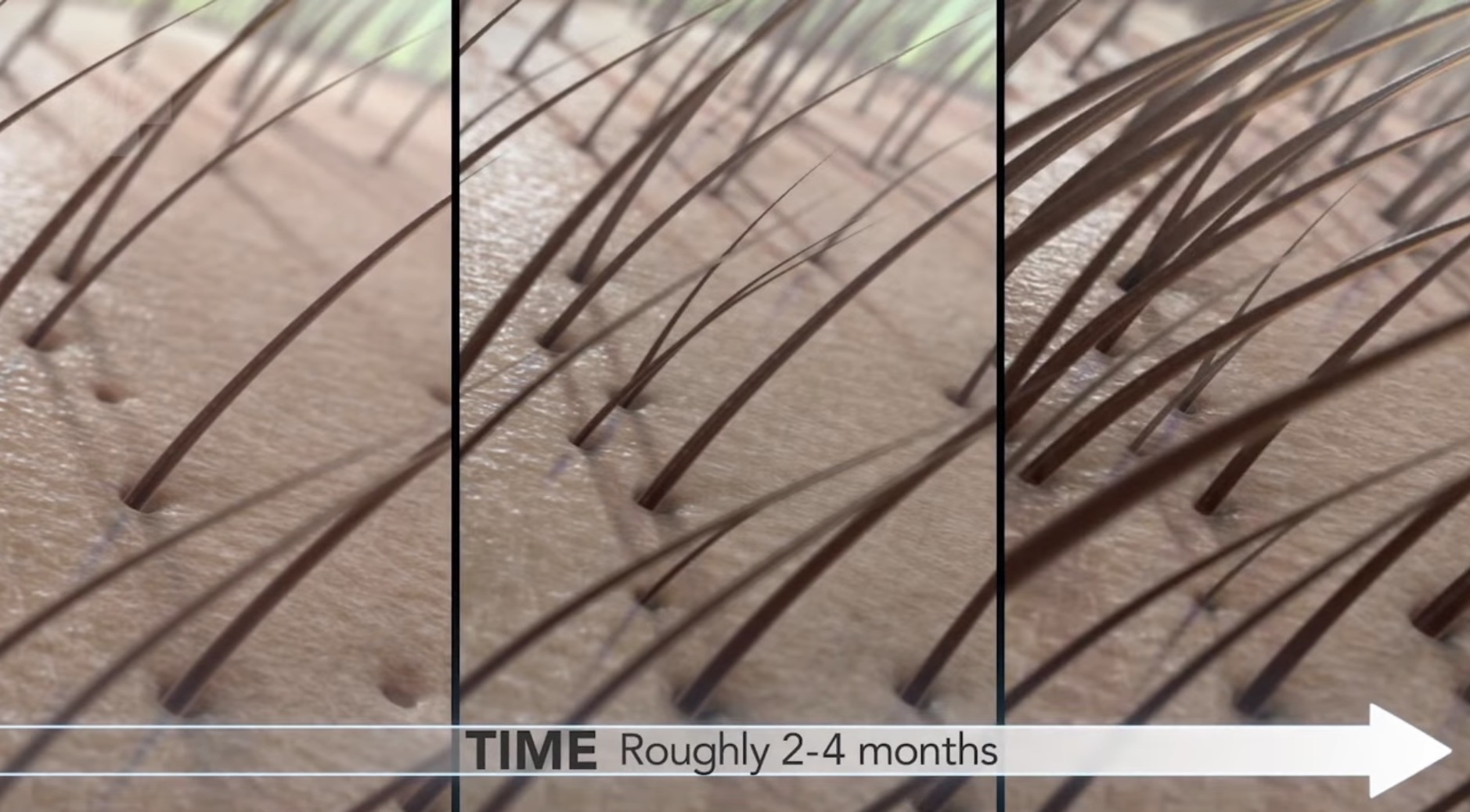
During pregnancy, high estrogen levels artificially prolong anagen (the growth phase); hairs that would normally have entered catagen or telogen remain in place. About two weeks after delivery, estrogen returns rapidly to pre-pregnancy levels, and those prolonged hairs enter telogen all at once. With a 2–4 month lag, this shows up as the massive shedding around 3–6 months postpartum that many mothers describe as “the drain going black.” This is postpartum telogen effluvium. Because the frontal hairline is naturally framed by short, fine hairs, even a modest reduction in density makes the boundary with the scalp look recessed — and postpartum frontal hairline thinning becomes the first thing patients notice.
Why the Framing Hairline Registers Before Other Regions
The hairline frames the face, and it is observed daily from every angle — mirror, selfie, ambient lighting. Thinning at the crown can be masked by styling, but the hairline changes its impression the moment the parting, wispy hairs, and vellus density decline. The forehead also has a distinct pattern of sebaceous and sweat glands and vascular routing, and it reflects light at angles that differ from other scalp regions. What amplifies the sense of “white scalp” is less the absolute reduction in hair count than the variation in shaft diameter (anisotrichosis) combined with the contrast of reflected light. Postpartum, sleep deprivation, nutritional gaps, and hormonal swings compound one another, temporarily increasing the number of fine, short hairs and intensifying this visual contrast.
Follicular Miniaturization After Delivery and the Idea of “FAGA Unmasking”
In most women, postpartum shedding resolves naturally over 6–12 months. In some, however, recovery is incomplete. If there is an underlying predisposition to FAGA (female-pattern androgenetic alopecia), the synchronized shedding can act as a trigger: frontal follicles never return to their original caliber and settle in as short, fine miniaturized hairs. A meaningful subset of women who first notice thinning after pregnancy fall into this “postpartum-triggered FAGA unmasking” category. When postpartum frontal hairline thinning has not recovered after more than a year, it should be re-evaluated not as simple postpartum shedding but through an FAGA lens that weighs family history, rate of progression, and shaft-diameter distribution. See our collection of columns on hair regenerative medicine for further reading.
Options During Breastfeeding, and Running Stem Cell Conditioned Media Alongside the Scalp Environment
During lactation, the mainstay pharmacologic options — topical minoxidil, finasteride, dutasteride — are largely off-limits, and there is little room for “doing something aggressive” about postpartum shedding. The baseline strategy in this period is threefold: (1) secure iron, protein, zinc, and adequate sleep; (2) prevent scalp dryness and low-grade inflammation; (3) allow spontaneous recovery. Stem cell conditioned media scalp therapy is drawing attention as an approach that does not rely on oral or topical drugs but conditions the microenvironment of the scalp; growth factors and cytokines are thought to act on perifollicular blood flow, inflammation, and dermal papilla signaling. That said, comparative-trial data on systemic effects during breastfeeding are limited, and at our clinic we default to initiating this therapy after weaning is complete, meanwhile providing consultation focused on optimizing the scalp environment and daily habits. When postpartum frontal hairline thinning has been of concern for more than six months, the framework laid out by the Japanese Dermatological Association for evaluating alopecia is also worth referencing.
We cannot promise that stem cell conditioned media “will definitely restore the hairline.” Indications, limits, and individual variability must be explained carefully; positioning the therapy as something that runs alongside overall postpartum recovery is the realistic stance.
Frequently Asked Questions
Q. Does postpartum hair loss always show up at the hairline first?
Not always. Some women notice it first at the parting or the temples. But the frontal hairline is the “frame” that is checked in the mirror daily, and hair-shaft variation plus reflected light make it the region where thinning is most easily perceived.
Q. Can I have stem cell conditioned media scalp therapy while breastfeeding?
As a rule, we recommend beginning after weaning. Comparative-trial data on systemic effects during lactation are limited, and we prioritize a safety margin. During breastfeeding we focus on conditioning the environment through lifestyle, nutrition, and scalp care.
Q. How long does postpartum shedding usually last?
Most cases settle spontaneously over 6–12 months. If shedding persists beyond a year, or the hairline continues to recede, prioritize internal-medicine differentials such as postpartum thyroiditis, iron deficiency, or elevated prolactin — and consider treatment designed for FAGA if appropriate.
Q. How do you differentiate hairline recession due to FAGA from postpartum shedding?
Distribution, progression rate, and family history are the key criteria. Postpartum shedding tends to thin the hair diffusely with spontaneous recovery, whereas FAGA presents with a persistent mixture of short, fine hairs spreading from the crown. Microscopic observation of shaft-diameter distribution is useful.
Q. Can supplements prevent postpartum hair loss?
Correcting deficiencies of iron, protein, vitamin D, or zinc is meaningful — but this is a “filling the gap” intervention, and it has limited ability to stop postpartum shedding itself.
──────────────
Supervising Physician: Shin Moriwaki, MD
Member, Japan Society of Aesthetic Surgery (JSAS) / Member, American Academy of Aesthetic Medicine
ECFMG Certificate
──────────────
📍AVAN TOKYO Ginza Hair Regenerative Medicine
AVAN TOKYO Ginza Hair Regenerative Medicine
English / 中文 / Tiếng Việt available
Inquiries welcome via DM / LINE / Website / Phone.