


Why you should honestly disclose “hair loss treatments received at other clinics” at your first visit — Dr. Moriwaki maps how a full prior treatment disclosure shapes the design of stem cell conditioned media scalp therapy2026.08.04
“Do I really need to mention that I was treated for hair loss at another clinic before?” — this is a question we hear from many patients at the first visit. The short answer: a complete prior treatment disclosure is indispensable for designing your upcoming stem cell conditioned media scalp therapy. The drugs used, the injection frequency, and how long any gap has lasted since discontinuation all significantly change the intensity and sequence of the next steps. Dr. Moriwaki, who oversees hair regeneration care at AVAN TOKYO Ginza, walks through what this means clinically.
Key points of this article
・A prior treatment disclosure covers oral medication, topicals, injections, and hair transplantation — and forms the basis for judging stem cell conditioned media dosing intervals and concomitant drugs.
・Timing of finasteride/dutasteride continuation or discontinuation, and topical minoxidil history, directly shape how initial shedding and treatment response are interpreted.
・Without records of the lot, composition, and number of injections received elsewhere, we effectively have to read the scalp’s reaction history from a blank slate.
・When there has been a treatment gap, the stage of the hair cycle at which we “restart” changes the design of the loading phase.
・Withholding a prior treatment disclosure out of embarrassment or fear of being “scolded” is itself a loss of treatment opportunity for the patient.
Why a prior treatment disclosure shapes stem cell conditioned media therapy design
Continuation or discontinuation of oral drugs sets the hair-cycle baseline
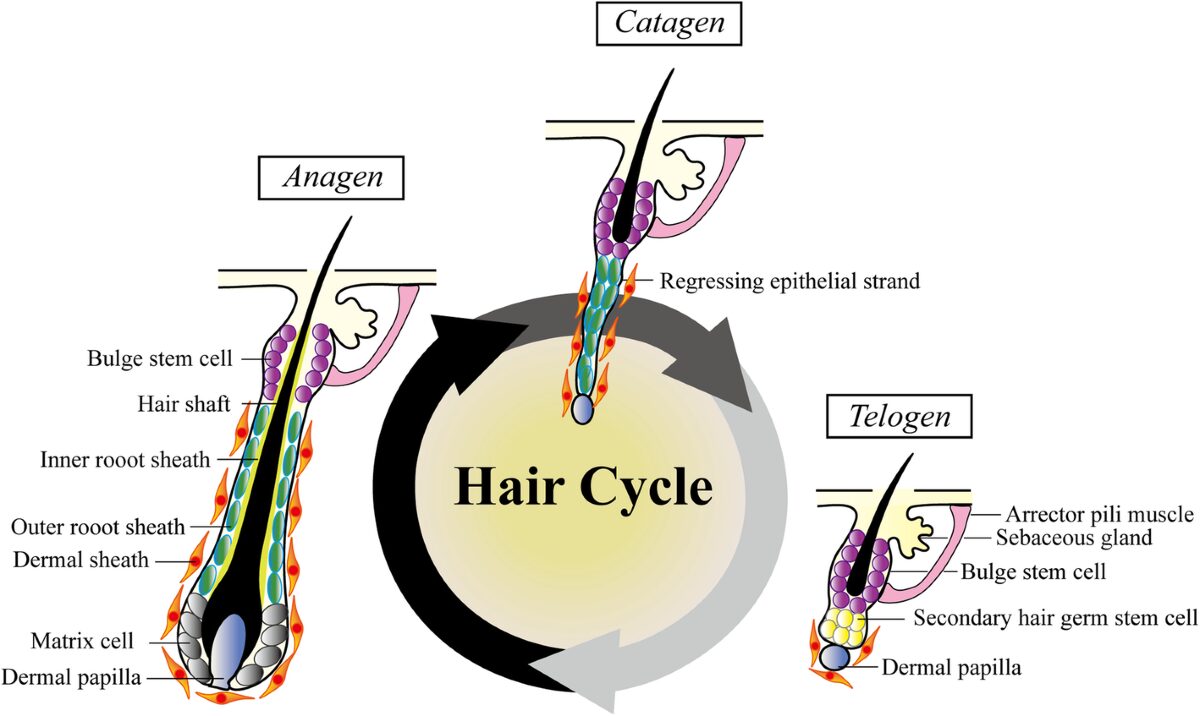
5α-reductase inhibitors such as finasteride and dutasteride take roughly three to six months from the start of oral use to synchronize the hair cycle and thicken miniaturized hairs. Without knowing the duration of use and the date of discontinuation at another clinic, we cannot tell whether the scalp in front of us is “currently responding to therapy” or is in “a withdrawal-related transitional shedding phase.” The same microscope image can be interpreted in opposite ways, and our judgment on how densely to schedule stem cell conditioned media during the loading phase becomes unstable.
History of topical minoxidil and injection therapy shapes how initial shedding is read
A temporary increase in shedding a few weeks after starting topical minoxidil or scalp injection of conditioned media — “initial shedding” — is a normal response in which telogen hairs are pushed out. If a patient continues topical minoxidil that was started elsewhere and we mistake that shedding for a side effect of the first injection at our clinic, we may stop necessary treatment prematurely. To separate these on a timeline, we need the start date, discontinuation date, and current dose.
Hair transplant history changes both the site and the technique we choose
After hair transplantation, the scalp differs between the donor area (usually the occipital region) and the graft area in terms of scar tissue, blood flow, and skin mobility. If we proceed with microneedle RF or conditioned media injection without knowing the surgical technique (FUE/FUT) or the number of years since surgery, we underestimate the risk of bleeding at scar sites, pigmentation, and thermal load on grafted hairs. Information on technique, years, and graft counts is essential to design the procedure on the safe side.
See the AVAN TOKYO Ginza column index on hair regenerative medicine for our thinking on treatment design, evidence, and case management.
Five pieces of information we ask you to share as prior treatment disclosure
Drug name, dose, duration of use, and discontinuation date
Please share, as honestly as you can, the drug name and dose — finasteride 1 mg, dutasteride 0.5 mg, the concentration of oral or topical minoxidil, and so on. The most reliable way is to bring the prescription package, your medication notebook, or the my-page of your online clinic. Sharing the start date, discontinuation date, and even “the period when I started missing doses” makes it much easier to read where you stand in the hair cycle.
Type and number of injection or laser treatments
For conditioned media injection, HARG, PRP, exosomes, and LED or laser-based scalp treatments, please share as best you can the number of sessions, intervals, and last treatment date. If you have a certificate of analysis or clinic treatment records, please bring them. AGA practice guidelines emphasize a detailed grasp of treatment history as a prerequisite for individualized care (see the Japanese Dermatological Association guidelines).
Hair transplant and scalp surgery history
For hair transplantation, share what you remember about the technique (FUE/FUT), graft count, year performed, post-op sense of density gain, and graft survival. Scar locations can be assessed on inspection, but scalp flexibility and blood flow recovery differ with the number of years post-surgery, so this is information we ask you to share at the first visit.
Concurrent use of over-the-counter tonics and supplements
Please also share any topical products containing minoxidil bought outside a medical setting, supplements such as zinc or saw palmetto, and hair-care shampoos. Quasi-drugs and overseas mail-order products can contain unexpected ingredients that complicate the interpretation of scalp reactions.
Reasons for discontinuation and memory of side effects
“Sexual side effects,” “scalp itch,” “couldn’t keep up financially” — reasons for discontinuation and any memory of side effects are the raw material we use to avoid repeat problems in the next plan. This part varies greatly between individuals, but the more openly it is shared, the more the patient benefits.
If it feels “hard to disclose”
Some patients describe telling a doctor about prior treatment as “awkward.” But because the design of stem cell conditioned media therapy is built on top of prior treatment disclosure, hiding it lowers the quality of care. We do not run consultations that criticize previous clinics or revisit their fees. Gaps, mid-course dropouts, or parallel visits to multiple clinics — whichever the pattern, if you tell us honestly, we work with you to find the best entry point from there.
Individualized planning has limits, and outcomes vary between individuals. We cannot promise a specific effect, but the more accurate the information, the more we can reduce the risks of wasteful duplication, unsafe combinations, and missed findings. Building a relationship where you can disclose without hesitation is also part of our responsibility.
Frequently asked questions
Q. I no longer have records of my prior treatment at another clinic — is my memory still useful?
Memory alone is enough. Even if you cannot recall the exact drug name, a rough outline such as “I took a pill for about a year and stopped six months ago” or “I received three scalp injections” gives us significant clues for reading your current scalp state. Disclosure does not need to be perfect.
Q. Should I also disclose medication prescribed by an online clinic?
Yes — oral and topical medications prescribed through online care should be included in your prior treatment disclosure. Generics and overseas medicines can differ in ingredient strength, which directly affects decisions about combination therapy.
Q. I’m anxious about being recommended a treatment that previously gave me side effects.
We will not casually reintroduce a treatment that caused side effects for you. Memory of side effects takes top priority in planning, and we build a plan starting from lower-risk alternatives, centered on stem cell conditioned media.
Q. May I attend another clinic and yours in parallel?
It is not medically forbidden, but overlapping injection therapies increase the burden on the scalp and make interpretation of results difficult. Precisely when you want to attend in parallel, sharing schedules across clinics becomes essential.
Q. Could what I disclose become known to others?
Medical records are strictly managed under the Personal Information Protection Act and the Medical Care Act. Your disclosure is not shared with third parties; its purpose is limited to your individual treatment planning.
──────────────
[Supervised by] Shin Moriwaki, MD
Member, Japanese Society of Aesthetic Surgery (JSAS) / Member, American Academy of Aesthetic Medicine
ECFMG Certificate
──────────────
📍AVAN TOKYO Ginza Hair Regenerative Medicine
English / 中文 / Tiếng Việt available.
Inquiries welcome via DM / LINE / Website / Phone.