


How Protein Supplements Affect Hair Regeneration Treatment with Stem Cell Conditioned Media: Whey, Casein, and Soy Through the Androgen Pathway Explained by Dr. Moriwaki2026.08.10
“I started drinking protein for muscle building and now my hair seems to be thinning” or “Can I continue protein during AGA treatment?” — we increasingly receive these questions from patients undergoing stem cell conditioned media hair treatment. Protein supplements and hair treatment actually intersect on two different axes: “protein intake” and “hormonal pathway.” In this article, Dr. Moriwaki of AVAN TOKYO Ginza organizes the medical perspective on how three types of protein supplements — whey, casein, and soy — relate to hair treatment.
Key Points of This Article
・Protein supplements and hair treatment interact on two axes: “protein intake” and “androgen pathway”
・Whey protein raises blood IGF-1 and insulin along with muscle synthesis, which may indirectly affect follicular androgen sensitivity
・Soy protein isoflavones may weakly suppress 5α-reductase in basic research, but clinical hair growth effects have not been established
・Protein intake can generally be continued during stem cell conditioned media hair treatment, but overconsumption and nutritional imbalance require attention
・To maximize treatment effects, prioritize “total daily protein distribution and micronutrients” over “choice of protein type”
Three Perspectives on Protein Supplements and Hair Treatment
Protein supplements are broadly divided into three types — whey, casein, and soy — each with different protein sources, absorption speeds, and accompanying components. Here we organize the key points that patients receiving stem cell conditioned media hair treatment should understand.
Whey Protein — Milk-Derived Fast-Absorbing Type
Whey protein is extracted from milk whey, has a well-balanced essential amino acid profile, and is characterized by rapid absorption. While ideal for muscle synthesis after training, from a hair treatment perspective, its “dairy origin” requires attention. Dairy products promote the secretion of insulin-like growth factor (IGF-1), which has been suggested to indirectly influence the sensitivity of androgen receptors in hair follicles.
Casein Protein — Slowly Absorbed Milk Protein
Casein is also milk-derived but forms a gel in the stomach and is absorbed slowly, making it suitable for bedtime or between-meal nutrition. While it contains dairy-derived components like whey, the difference in absorption speed makes sudden insulin and IGF-1 fluctuations less likely.
Soy Protein — Plant-Based Protein from Soybeans
Soy protein is a plant-based protein extracted from soybeans and contains trace amounts of isoflavones (phytoestrogens). Isoflavones have been reported in basic research to have weak estrogen-like effects and 5α-reductase inhibitory action, prompting theoretical discussion that they may act favorably for AGA. However, at present, there is no established evidence that soy protein intake alone can produce clinical hair growth effects.
Drawing Medical Boundaries Between Protein and the Androgen Pathway
“Drinking protein raises testosterone and worsens hair loss” — many patients express this concern. Here we clarify what can and cannot be said scientifically.
Whey Protein, Testosterone, and DHT
There is currently no clear clinical evidence establishing that whey protein intake itself significantly raises blood testosterone and directly worsens AGA. However, the IGF-1 elevation from dairy-derived sources may theoretically influence follicular androgen receptor sensitivity over the long term. For individuals with progressing AGA who take extreme amounts — such as “consuming large quantities of whey daily after every workout” — careful observation is needed regarding whether it affects the assessment of stem cell conditioned media hair treatment effects.
Soy Protein and Phytoestrogens
Isoflavones in soy such as daidzein and genistein have been reported at the in vitro level to weakly inhibit 5α-reductase type II. Although this targets the same enzyme as finasteride, the effect is incomparably weaker than pharmaceuticals. Simply thinking “switching from whey to soy will improve hair loss” is a scientific overreach; individual differences, constitution, and other lifestyle factors must also be considered.
How to Combine Stem Cell Conditioned Media Hair Treatment with Protein Supplements
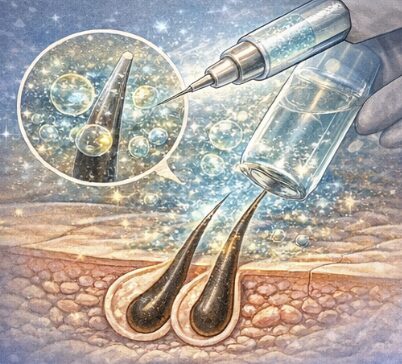
Stem cell conditioned media scalp treatment supports the hair growth cycle by improving the follicular microenvironment. To maximize this treatment effect, sufficient total body protein intake is a prerequisite. It is important to reframe the relationship between protein supplements and hair treatment within the broader framework of “overall dietary nutrition design.”
Prioritize Total Daily Protein Distribution
Hair is made of a protein called keratin, and hair matrix cell metabolism requires sufficient amino acid supply. Ideally, 1.0 to 1.6 grams of protein per kilogram of body weight should be distributed across morning, noon, and night meals along with protein supplements. Rather than agonizing over “the type of protein,” adjusting “total daily intake and distribution” is more likely to yield synergy with stem cell conditioned media hair treatment.
Overconsumption and Nutritional Imbalance
Even with large protein intake, there is a ceiling on muscle synthesis, and excess protein is metabolized and burdens the liver and kidneys. Replacing meals with protein shakes alone tends to cause deficiencies in zinc, iron, vitamin B group, and other micronutrients essential for hair. Patients receiving stem cell conditioned media hair treatment should consult with their physician about the overall nutritional design.
For scientific guidelines on AGA treatment, please also refer to the guidelines from the Japanese Dermatological Association. You can view related articles including other topics on our hair regenerative medicine column list.
Frequently Asked Questions
Q. Does drinking protein worsen hair loss?
There is no clear clinical evidence establishing that protein supplements themselves are a direct cause of hair loss. However, dairy-derived IGF-1 elevation and nutritional imbalances from overconsumption may theoretically affect hair environment indirectly. It is important to maintain appropriate amounts and use them within a balanced diet.
Q. Should I avoid whey during stem cell conditioned media scalp treatment?
There is no clear basis at present for avoiding whey during treatment. However, if AGA is progressing and you are in the treatment effect assessment period, sharing your intake amount and type with your physician as part of monitoring will enable more precise treatment design.
Q. Will switching to soy protein improve hair loss?
Isoflavones in soy have been reported at the in vitro level to weakly inhibit 5α-reductase, but the effect is not strong enough to produce clinical hair growth effects on its own. We do not recommend relying solely on changing protein type as a hair growth strategy.
Q. How many grams of protein should I take per day?
Generally, 1.0 to 1.6 grams per kilogram of body weight is a guideline, adjusted for exercise level and age. Rather than concentrating in one meal, distributing intake across morning, noon, and night provides continuous amino acid supply to hair matrix cells.
Q. What is the most important point about the relationship between stem cell conditioned media hair treatment and protein?
Prioritizing “total daily protein and micronutrient balance” over “choice of protein type.” Protein is a dietary supplement; secure zinc, iron, vitamin B group, quality fats, and other nutrients essential for hair from your diet, then use protein supplements.
──────────────
【Supervisor】Shin Moriwaki, M.D. (Supervising Physician)
Member of the Japan Society of Aesthetic Surgery (JSAS) / Member of the American Academy of Aesthetic Medicine
ECFMG Certificate
──────────────
📍AVAN TOKYO 銀座 毛髪再生医療
AVAN TOKYO Ginza Hair Regenerative Medicine
English / 中文 / Tiếng Việt available
For inquiries, please contact us via DM / LINE / Website / Phone.