


First-move protocol for rapidly progressive AGA where hair has clearly receded within six months — Dr. Moriwaki organizes the priority of ‘stop, support, observe’ for the first three months2026.07.26
“My hairline is clearly thinner than six months ago.” “The amount of hair falling in the shower has suddenly increased, and I can see it darkening the floor.” These short-term self-reported changes may indicate what is clinically called rapidly progressive AGA. Even within the same category of male pattern hair loss, the pace of progression dramatically changes what should be done in the first three months. Rather than trying every treatment at once, structuring the initial move with clear priorities determines the success or failure of the entire treatment plan. From the perspective of Dr. Moriwaki, this article organizes the order of treatments to place in the first three months, and the easily overlooked comorbid factors that must be considered.
Key points of this article
・Rapidly progressive AGA is a practical clinical concept referring to a state where obvious hair recession can be confirmed on photographs within six months to one year.
・In the first three months, the principle is to follow the order of “stop, support, observe” — introducing multiple treatments simultaneously from the outset is not recommended.
・When progression is sudden, comorbid conditions outside AGA — such as alopecia areata, telogen effluvium, thyroid dysfunction, and iron deficiency — should always be ruled out at least once.
・Stem cell conditioned media scalp treatment is an option that acts on the follicular microenvironment as a “supporting” layer, and its role differs from that of 5α-reductase inhibitors.
・The evaluation goal at the three-month mark is not “density recovery” but “whether progression has once been halted.”
What kind of state is ‘rapidly progressive AGA’?
There is no established diagnostic classification called rapidly progressive AGA; clinically, it is a practical concept referring to AGA with a progression speed at which obvious recession can be visually confirmed in a short period. As a rough guide, it applies to cases where recession can be identified when photographs are compared over six months to one year, or where the Norwood classification has clearly advanced by one stage or more. At the moment a patient becomes aware of a sudden increase in hair loss, it is more natural to assume that follicular miniaturization has already progressed to some extent.
The mindset of looking at ‘speed’ rather than ‘age’
AGA treatment design is often discussed along age axes such as “20s” or “40s,” but even within the same age group, the urgency of the first move differs greatly depending on the pace of progression. Some people in their 20s progress slowly, while others in their 40s suddenly accelerate. In a rapidly progressing phase, the top priority becomes “protecting even one more of the currently remaining follicles,” and the discussion of density recovery must be temporarily set aside.
Priority order to follow in the first three months
In rapidly progressive AGA, the principle is to act in the order of “stop, support, observe.” Stumbling on the initial move greatly inflates the recovery cost over the following year. “Doing everything simultaneously” may seem rational at first glance but is actually a trap that makes it impossible to evaluate what worked and what did not.
Step 1: ‘Stop’ — prompt introduction of 5α-reductase inhibitors
The first consideration is whether oral medications that suppress DHT production (finasteride, dutasteride) can be introduced. If there are no contraindications or relevant history, they are placed first as the foundation for stopping progression. Postponing this decision with “I’ll think about it later” means the follicles lost during those months cannot be regained. Rapidly progressive AGA is a condition where time itself becomes a cost. Even when there is anxiety about side effects, there is room to consider individualized options such as concurrent topical minoxidil or dose adjustment.
Step 2: ‘Support’ — topical minoxidil and stem cell conditioned media scalp treatment
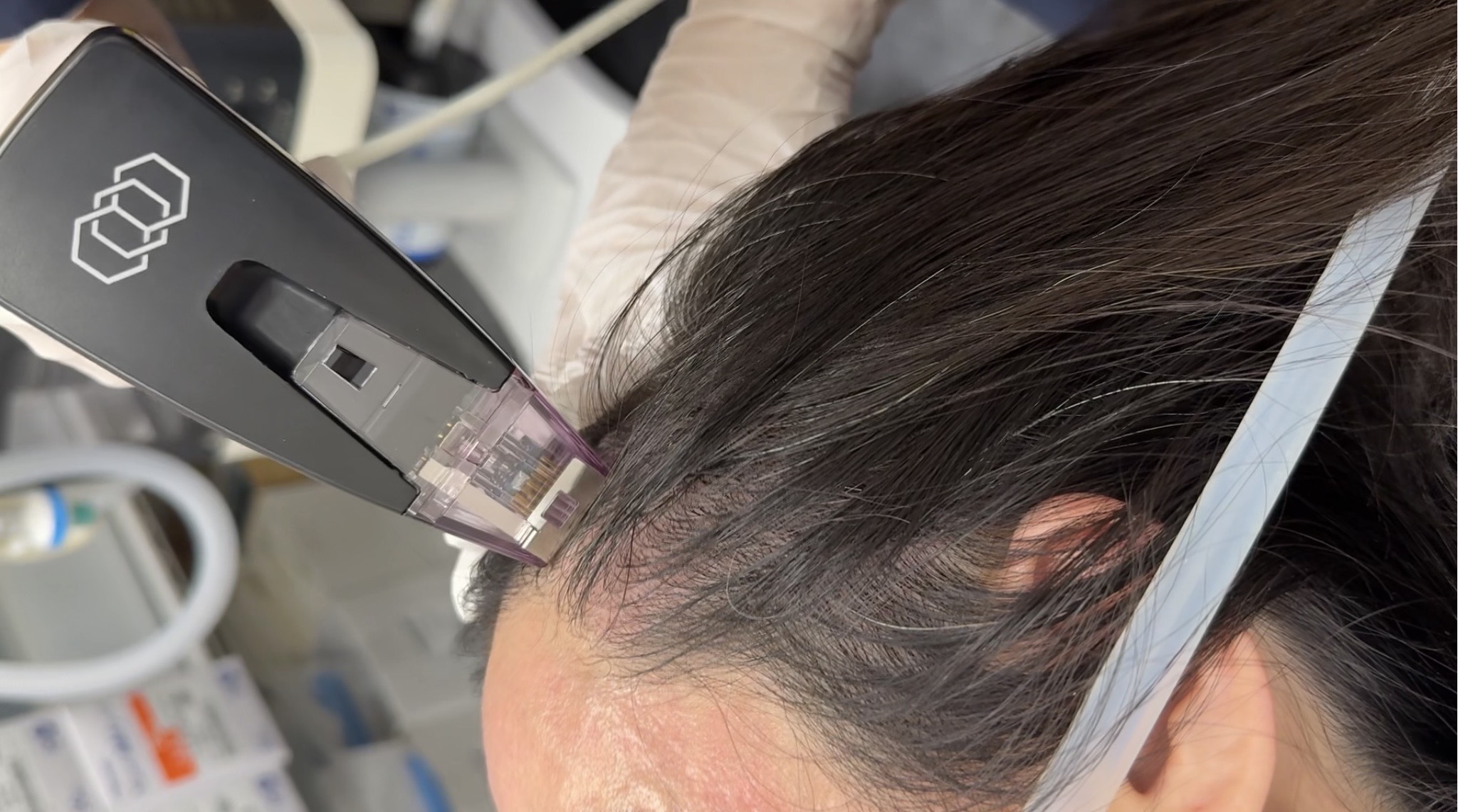
After stopping the DHT flow, one design is to combine topical minoxidil and stem cell conditioned media scalp treatment as a layer that “supports” the remaining follicles. Stem cell conditioned media is a secretion containing growth factors and cytokines that is expected to act on the inflammatory and vascular environment around follicles. Oral medication alone may not deliver sufficient recovery signals to weakened follicles, and there are situations where adjusting the microenvironment from the scalp side is complementary. However, believing that conditioned media alone can stop progression is a mistake — it is fundamentally an auxiliary role placed on top of the oral medication foundation. Effects vary by individual, so please decide after receiving an explanation that takes indications and limitations into account.
Step 3: ‘Observe’ — fix a baseline with photographs and microscope images
A surprisingly underestimated point is the baseline record at the initial visit. Take head photographs under standardized conditions (same distance, angle, and lighting) and always keep microscope images of the hairline and crown. Judgments at three and six months can only be objectified through comparison with this initial record. When photographic conditions differ each time, the very material for determining whether the situation is “unchanged” or “worsened” is lost.
Comorbid factors that must be ruled out in rapidly progressive AGA
The more sudden the progression, the more cases mix in that are not simple AGA. It is not uncommon for a pattern to emerge where “I thought it was AGA and started treatment, but actually another type of alopecia was in the background.” Skipping this step can result in hair loss not decreasing even when oral medication is strengthened, and identifying the cause may take more than six months.
Check thyroid, iron deficiency, and drug-induced causes at least once
Hypothyroidism or subclinical thyroid abnormalities, iron deficiency due to low serum ferritin (especially in women), or side effects of newly started medications may be hidden in the background. Clearing these up once with a blood test increases the accuracy of subsequent efficacy judgments. Careful medical and medication history-taking should also be done at this stage.
Coexistence of alopecia areata or telogen effluvium
Some states that appear to have progressed suddenly are actually cases where AGA is overlapped with telogen effluvium or alopecia areata with unclear borders. Looking at whether the scalp exposure pattern and hair shedding occur in “areas” or in “points” provides clues for differentiation. Before structuring an AGA treatment plan, suspecting these coexistences at least once is the safer approach.
Reassessment at three months: what to evaluate
The evaluation goal at the three-month mark is not “whether hair has grown” but “whether progression has once been halted.” The first success signal is that a brake has been applied to the pace of progression; density recovery is tracked over six to twelve months using different indicators. Adding treatments in a rush here makes it impossible to evaluate what worked and what did not. Precisely because it is rapidly progressive AGA, the simplicity of the initial move protects the accuracy of judgment six months later. For overall treatment design and related columns in hair regenerative medicine, please refer to our hair regenerative medicine column index. For clinical guidelines on AGA, please also refer to the guidelines of the Japanese Dermatological Association.
Frequently Asked Questions
Q. In rapidly progressive AGA, is it acceptable to start immediately with stem cell conditioned media scalp treatment?
In principle, it makes more sense to first place the “stopping” layer through oral medication as the foundation. Conditioned media scalp treatment plays an auxiliary role supporting the follicular microenvironment and does not suppress the action of DHT on its own. However, when there are contraindications or side effects to oral medication, an individualized design that arranges the supporting-side options first also exists.
Q. Once AGA has suddenly progressed within six months, will density never return to what it was?
The shorter the period lost, the more likely that follicles that have only recently entered the telogen phase still remain, giving meaning to a rapid initial response. That said, setting “complete restoration” as the goal tends to create a gap in expectations, so it is realistic to place progression halting as the primary goal and density recovery as a secondary goal spanning six to twelve months. Since individual variation exists, careful follow-up is a prerequisite.
Q. Do I need to receive blood tests every time?
Once items such as thyroid, iron, and liver function are cleared at the initial visit, this is often sufficient for cause identification. Thereafter, only necessary items are retested according to symptom changes and the timing of oral medication introduction.
Q. Is it a failure if there is no visible change at three months?
At the three-month point, feeling that “the speed of progression has slowed” is a sufficient response. Judgment is made by comparing changes in hair loss volume and whether the worsening of scalp exposure has stopped, against photographs taken initially. Evaluating an increase in density is usually done after six months.
──────────────
Medical supervisor: Dr. Shin Moriwaki (森脇 進)
Member of the Japan Society of Aesthetic Surgery (JSAS) / Member of the American Academy of Aesthetic Medicine
ECFMG Certificate
──────────────
📍AVAN TOKYO Ginza Hair Regenerative Medicine
AVAN TOKYO Ginza Hair Regenerative Medicine
English / 中文 / Tiếng Việt supported
Inquiries welcome via DM / LINE / Website / Phone.