


Is Hair Loss Treatment Worth It in Your 60s? Senescent Alopecia vs AGA2026.10.08
“Does it even make sense to start hair loss treatment after turning 60?” This is one of the most common questions I hear in clinic. Hair loss in this age group cannot be explained by male pattern baldness (AGA) alone — it almost always overlaps with senescent alopecia, the gradual, age-related loss of vitality across the entire follicular population. Deciding whether treatment is meaningful starts with separating these two.
Key points
・Hair loss in your 60s progresses as a mix of AGA and senescent alopecia, so treatment should address both
・DHT inhibitors alone cannot halt the overall thinning — the follicular stem cell niche also needs support
・The realistic goal is not “to regrow lost hair” but “to stop the decline of surviving follicles and restore hair quality”
・Age itself is less important than follicular reserve, systemic health, and treatment adherence
・Stem cell conditioned media can meaningfully improve the scalp environment even in patients in their 60s
What is actually happening to the scalp in your 60s
When people hear “thinning hair,” AGA usually comes to mind first. But in patients over 60, a different process runs in parallel beneath the surface: senescent alopecia. The two differ in mechanism and in how they respond to treatment, so the same symptom calls for different strategies.
AGA is driven by dihydrotestosterone (DHT)
In AGA, 5-alpha reductase converts testosterone into DHT, which binds to androgen receptors on susceptible follicles and shortens the anagen phase of the hair cycle. The frontal and vertex regions are hit first because their follicles are far more androgen-sensitive, while the sides and back remain relatively protected. Treatment centers on DHT suppression with finasteride or dutasteride.
Senescent alopecia is a decline in the follicular stem cell niche
The age-related process runs on an entirely different axis. The follicular stem cells in the bulge region and the microenvironment (niche) that supports them gradually lose function with time. The anagen phase shortens, matrix cell division slows, and the whole scalp sees finer shafts and lower density. Unlike AGA, this spreads evenly — the sides and back thin as well — and standard AGA medications alone cannot stop it.
How to distinguish senescent alopecia from AGA
Since both processes overlap in your 60s, deciding which carries more weight guides the treatment plan.
Reading the pattern of progression
If only the hairline and vertex are visibly receding and translucent, AGA is likely the dominant driver. If thinning is uniform and even the normally protected occipital and temporal regions show reduced caliber, senescent alopecia carries greater weight. Microscopic examination of hairs per follicular unit and variation in shaft diameter helps separate AGA-style miniaturization from the uniform thinning of age.
Family history and the arc of onset
Is this AGA that has been progressing step by step since the patient’s 30s or 40s and has now shifted up another gear in their 60s? Or was density well-preserved into the late 50s, with the overall volume loss only emerging in the past few years? The history alone narrows the picture considerably. The former pattern points to AGA; the latter points to age-related change.
Does treatment in your 60s really have value?
The answer is yes — provided the goal is reframed from “regrow” to “stop the decline and rebuild hair quality.”
Betting on the reserve of surviving follicles
Where follicles have been fully lost, neither stem cell conditioned media nor oral medication can bring them back. But follicles that are simply miniaturized or stuck in extended telogen are only “invisible,” not gone — and even in your 60s, the right intervention can push them back into anagen. A scalp where fine hairs are faintly visible across the whole area is actually a strong indication that intervention is worthwhile.
Lifting the scalp environment is the key
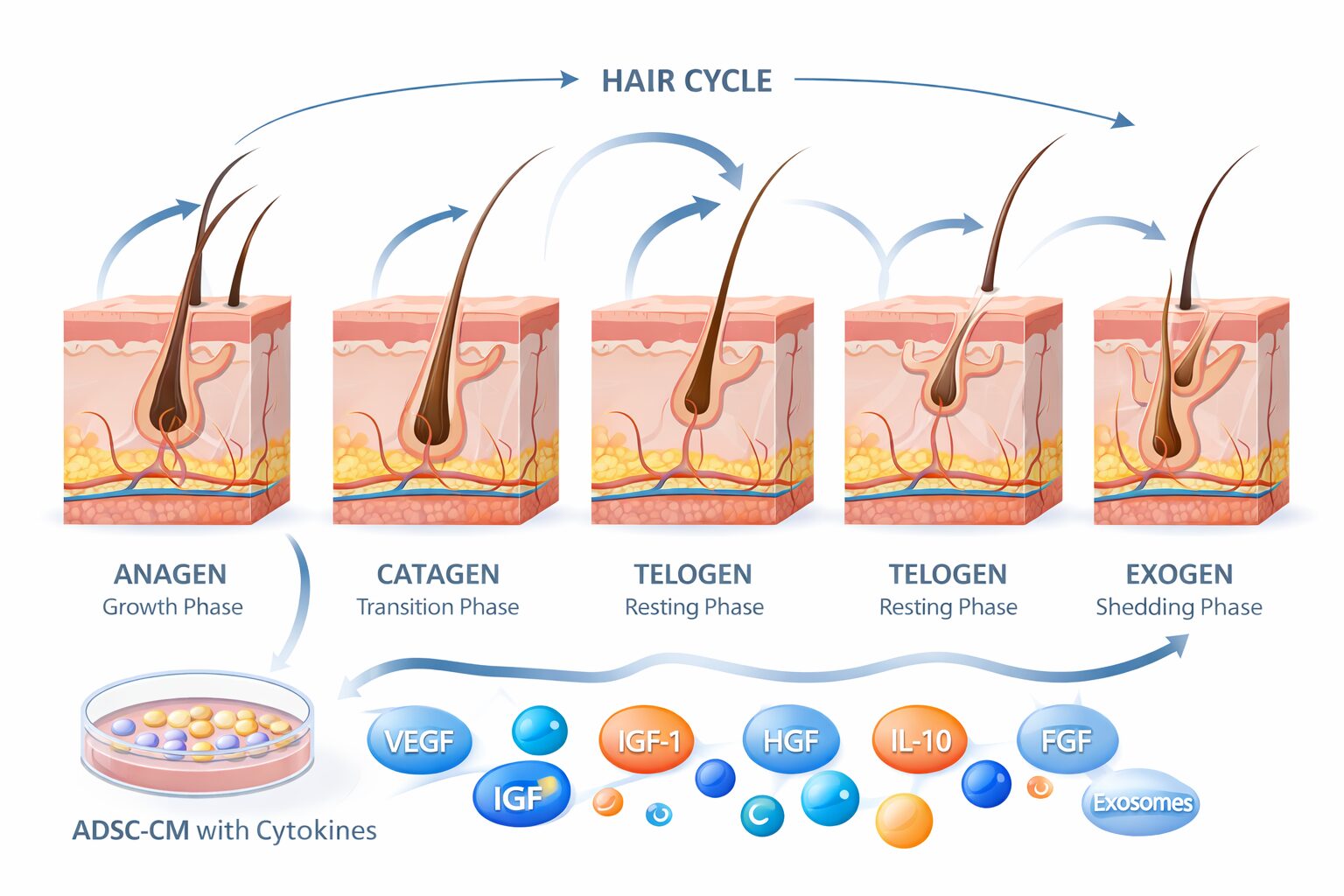
Because the core problem is exhaustion of the follicular stem cell niche, DHT suppression alone is not enough — the vasculature, fibroblasts and growth-factor environment surrounding each follicle must be rebuilt. Growth factors in stem cell conditioned media such as IGF-1, HGF and VEGF act on niche perfusion and the extracellular matrix, extending anagen in surviving follicles. We discuss related mechanisms and cases on the hair regeneration column index.
Three axes to lock down before starting treatment in your 60s
Alignment with systemic health and medications
Many patients in their 60s are on multiple drugs for cardiovascular, prostate or endocrine conditions, so interactions with finasteride or dutasteride, and dose adjustments based on hepatic and renal function, must be reviewed. When oral treatment is not feasible, scalp delivery of stem cell conditioned media has a small systemic footprint and remains viable. The Japanese Dermatological Association publishes AGA guidelines that help situate evidence-based options.
Realistic adherence
The hair cycle moves on a scale of months, so evaluation takes at least six months and often a year or more. In your 60s, work, caregiving duties, and health can disrupt visit rhythm, so building a realistic cadence from day one is itself a condition for treatment to succeed. A year of visits every two months yields far more information than six months of inconsistent attempts.
Scaling expectations to time
Follicular recovery in your 20s and in your 60s run at different speeds. Rather than drawing conclusions at six months, picking up changes in hair quality, resilience and manageability — not just density — is what prevents both inflated hopes and premature giving up.
Frequently asked questions
Q. Isn’t it too late to start in my 60s?
Areas where follicles are entirely gone are difficult, but as long as fine, short hairs remain, there is room for treatment. Age itself matters less than follicular reserve, systemic health, and adherence. Patients with fine hairs scattered across the scalp often have the most to gain.
Q. Can oral medication alone stop senescent alopecia?
AGA medications suppress DHT and do not directly address follicular stem cell niche decline. When AGA is also present, DHT suppression forms the foundation, but halting the overall thinning requires parallel support of the scalp environment.
Q. How do stem cell conditioned media and oral AGA drugs divide the work?
Oral drugs suppress DHT; conditioned media supplies the niche with growth factors and improves perfusion. In patients in their 60s, combining both — orals to halt decline, media to rebuild hair quality — often fits best. For patients who cannot tolerate orals, conditioned media alone is also a viable starting point.
Q. Will my hair revert the moment I stop treatment?
AGA-driven loss resumes when oral medication is stopped, though the pace depends on age and follicular state. Improvements to the scalp environment can hold for a time, but age-related decline cannot be fully halted, so maintenance treatment with longer intervals is the realistic long-term plan.
Q. Is it safe to recommend this to an elderly parent with multiple conditions?
Oral medication is subject to interactions, hepatic/renal function and prostate issues. Scalp delivery of stem cell conditioned media has a lighter systemic burden, but anticoagulant use, infection history, and condition on the day of the procedure must be shared beforehand. The decision also depends on the patient’s own motivation and ability to attend visits.
──────────────
Medical supervisor: Shin Moriwaki, MD
Member, Japan Society of Aesthetic Surgery (JSAS)
Member, American Academy of Aesthetic Medicine
ECFMG Certificate
──────────────
📍AVAN TOKYO Ginza Hair Regenerative Medicine
AVAN TOKYO 銀座 毛髪再生医療
English / 中文 / Tiếng Việt supported
Consultations welcome via DM / LINE / Website / Phone.