


Does Stem Cell Conditioned Media Really “Work Differently by Lot”? — Dr. Moriwaki on Biologic Lot Variability and the Limits of Standardization2026.08.02
“I’m going to the same clinic and receiving the same treatment, but this time the response feels different from last time.” When patients on stem cell conditioned media hair therapy sense this, the first thing that comes to mind is often their own body condition or hair cycle. However, the conditioned media itself carries a biological reality called “lot-to-lot variability.” Conditioned media lot variability is a challenge unique to biologics that never arises with small-molecule chemical drugs. This is not a matter of manufacturer negligence — it is an inescapable phenomenon rooted in the very nature of a raw material that is “secretions produced by living cells.” In this article, our supervising physician organizes why lot variability arises, what limits standardization faces, and how patients on hair regeneration therapy should reasonably interpret it.
Key Points of This Article
・Conditioned media lot variability arises from three biologic-specific realities: donor cell individuality, minor fluctuations in culture conditions, and yield variance during recovery and concentration steps
・Growth factor “concentration” and “biological activity (potency)” are not the same — even matched numbers can produce different tissue-level responses
・Judging hair therapy by a single session is premature; averaging your response over a 3–4 month induction phase is the realistic approach
・Trustworthy lot control can be verified via CoA (Certificate of Analysis), third-party testing results, and manufacturing at a licensed specified cell-processing facility
Why Conditioned Media Lot Variability Arises
With chemically synthesized drugs, strictly controlling raw materials and reaction conditions can, in theory, yield “the exact same molecule” every time. Conditioned media is different. It is obtained by having living stem cells work inside culture media and then collecting and concentrating their secretions. Because the raw material is “living cells,” biological fluctuation always enters the process.
The Reality of Donor Cell Individuality
Regardless of whether the cell source is umbilical cord, adipose tissue, or dental pulp, different donors bring different genetic backgrounds, metabolic rhythms, and secretion tendencies. Even the same “adipose-derived mesenchymal stem cells” will never yield perfectly identical cytokine profiles between a lot from a woman in her twenties and one from a man in his forties. Even for headline growth factors like VEGF, IGF-1, and HGF — all relevant to hair biology — the absolute amounts and balance shift when the donor changes.
Subtle Fluctuations in Culture Conditions
Even when temperature, CO2 concentration, media composition, and passage number are strictly managed, the stress that cells experience inside a culture flask cannot be reproduced identically every time. Cells subtly alter their secretion profile in response to their environment. Even the same facility and the same operator will never produce lots that are perfect copies.
Variance in Recovery and Concentration
During concentration and lyophilization, the recovery rate of growth factor proteins is never 100%. Temperature history during freeze-thaw, centrifugation parameters, filter losses — a few percent of variance accumulates at each step and shows up in total protein content and cytokine concentration of the final product.
Where Standardization Hits a Wall
One might say, “then just make lots identical.” But biologics don’t work that simply.
The Difficulty of Potency Assays
For small-molecule drugs, “active ingredient content” secures quality. Conditioned media, however, is a complex biological cocktail of hundreds of proteins, cytokines, and exosomes. ELISA can measure the concentration of major growth factors, but capturing “the actual functional strength (potency) in tissue” as a single number is far from easy. Even 100 pg/mL of VEGF on paper says little about how much it functions inside a hair follicle. This is the first wall of standardization.
What Can and Cannot Be Made Uniform
Easier to control within a defined range are “safety-side” indicators: sterility, mycoplasma negativity, endotoxin concentration, pH, and osmolality. Harder to unify are “efficacy-side” indicators: absolute growth factor concentration, exosome particle count, miRNA profile, and biological activity. Unlike Class I regenerative medicine, conditioned media is currently not institutionally required to fully unify efficacy indicators. This reflects the intrinsic nature of biologics as much as any manufacturer decision.
How Patients Should Interpret Lot Variability
With all that in mind, here are realistic perspectives for anyone continuing hair therapy. Because conditioned media lot variability cannot be fully eliminated, an evaluation approach that assumes its existence is essential.
The Principle of Not Judging by a Single Session
When a patient feels “today worked” or “today didn’t” immediately after one injection, distinguishing whether that impression reflects lot variability, physical condition, or a hair-cycle phase is genuinely difficult. Hair biology moves on the multi-month scale of the hair cycle (anagen, catagen, telogen). Being swayed by one session’s impression easily breaks the whole treatment plan. It is realistic to look at an “average response” over the 3–4 month induction phase. Individual variation exists, and not everyone will show a clear change within this window.
See the Whole Treatment Protocol, Not Just the Product
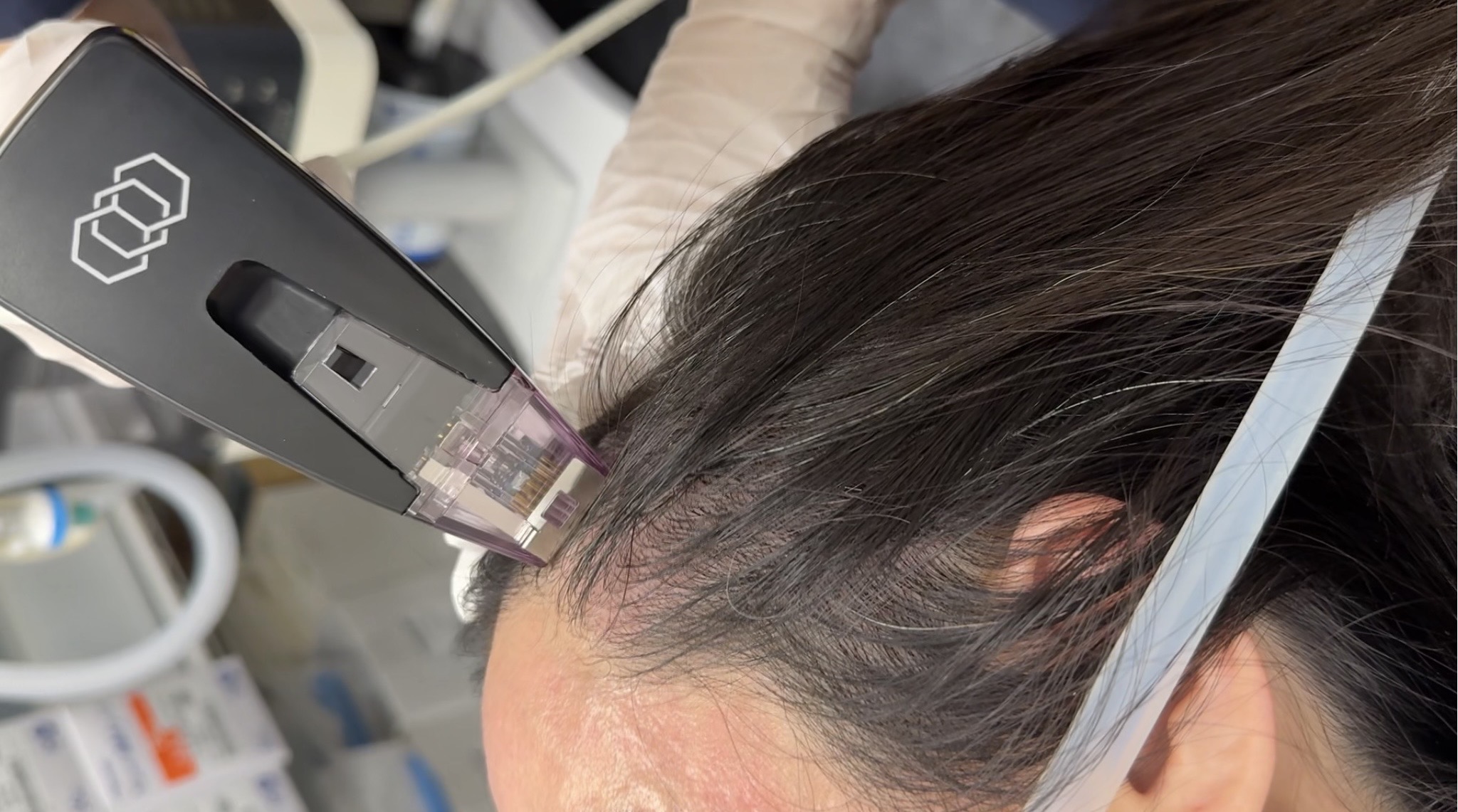
Even with the same conditioned media, outcomes shift with injection depth, dose, interval, combined treatments such as Morpheus8, and how consistently aftercare is followed. Rather than worrying only about lot variability, choosing a clinic with stable technique and evaluation protocol produces more reproducible overall results. See our hair regenerative medicine column list for further reading on evaluation design and induction-phase thinking.
How to Recognize Trustworthy Products and Manufacturing
Lot variability itself cannot be reduced to zero, but “whether it is being kept within an acceptable range” is verifiable from the patient side. Does the CoA (Certificate of Analysis) clearly list results and specifications for sterility, mycoplasma, and endotoxin? Is it manufactured at a licensed specified cell-processing facility? Are third-party laboratory results attached? These are items you can check via inquiry or at initial consultation. Conversely, claims like “zero lot variability” or “identical effect guaranteed every time” call for caution, given the fundamental nature of biologics. For overarching guidance on hair loss including AGA, consulting information from the Japanese Dermatological Association alongside your clinician helps place conditioned media in its proper context.
Frequently Asked Questions
Q. Does the effect completely change when the lot changes?
Usually the difference is not that extreme. With well-controlled products, growth factor concentrations stay within a defined range, and clinical responses roughly align. That said, manufacturers cannot guarantee zero perceptible difference. Please evaluate over months of trajectory rather than by a single session.
Q. If I feel a difference in response, can I attribute it to lot variability?
No. Patient-side factors — physical condition, sleep, stress, seasonal shedding, hair-cycle phase — are often the larger contributors. Lot variability is only one factor and shouldn’t be blamed in isolation. Reviewing your course together with your physician is the more grounded approach.
Q. Is there anything I can do to reduce the impact of lot variability?
Continuing at the same clinic, having your treatment record and lot number preserved, and using fixed-point self-photography for objective tracking — these three habits make lot variability effectively less visible. Rather than chasing individual lots, improving the overall protocol stability is the practical path.
Q. Are products advertising “no lot variability” trustworthy?
Given the nature of biologics, “zero lot variability” cannot honestly be claimed on scientific grounds. In fact, products that explain honestly — “we control within a defined specification range” or “we disclose our CoA” — tend to reflect a more trustworthy quality management system. Please be cautious of overstated claims of uniformity.
──────────────
Supervising Physician: Dr. Shin Moriwaki
Member of the Japan Society of Aesthetic Surgery (JSAS)
Member of the American Academy of Aesthetic Medicine
ECFMG Certificate
──────────────
📍AVAN TOKYO Ginza Hair Regenerative Medicine
English / 中文 / Tiếng Việt supported
Inquiries via DM / LINE / Website / Phone are welcome.