


Trichotillomania (Compulsive Hair Pulling): Can Stem Cell Conditioned Media Actually Help a Scalp That Has Been Pulled at for Years? Dr. Moriwaki on the Reversibility of Trichotillomania Follicular Damage and the Need to Run Psychiatric Care in Parallel2026.07.27
When someone repeatedly pulls out their own hair from the same area — sometimes without noticing, sometimes deliberately as a way to soothe tension — a diagnosis of trichotillomania (compulsive hair pulling) belongs on the table. Trichotillomania follicular damage exists on a spectrum: at one end, the damage is reversible once the pulling stops; at the other, years of repeated pulling in the same spot can leave permanent, scarring alopecia. Because the pathology is fundamentally different from androgenetic alopecia (AGA) or alopecia areata, the treatment design has to be built on a completely different axis. In this article, Dr. Shin Moriwaki, supervising physician at AVAN TOKYO Ginza, outlines the scalp damage that trichotillomania produces and where stem cell conditioned media (culture supernatant) fits — with the premise that psychiatric care must run in parallel.
Key Points
・Trichotillomania is a behavior-driven form of hair loss and is a fundamentally different disease from AGA or alopecia areata.
・Trichotillomania follicular damage is reversible in the short term, but pulling the same spot for years can leave irreversible, scarring alopecia.
・The foundation of care is habit reversal training and cognitive behavioral therapy provided by psychiatry or psychosomatic medicine — hair treatment alone will not resolve it.
・Stem cell conditioned media is best positioned as a parallel step that helps restore the inflammatory and microenvironmental balance of a scalp that has stopped being pulled.
・Where scarring has already set in, regenerative medicine has clear limits, and follicular unit hair transplantation may need to be considered as a separate option.
What Kind of Hair Loss Is Trichotillomania?
Trichotillomania describes a state in which a person cannot control the urge to repeatedly pull out their own scalp hair, eyebrows, or eyelashes. It is grouped with obsessive-compulsive and related disorders in the DSM-5. The onset peak is in adolescent girls, but adult men also present in clinical settings. Two patterns are recognized: automatic pulling, where the hand moves without conscious awareness, and focused pulling, done intentionally to relieve tension or anxiety.
How It Differs Fundamentally from AGA and Alopecia Areata
AGA is driven by androgen-receptor-mediated follicular miniaturization, and alopecia areata by autoimmune inflammation around the follicle — both start inside the body. Trichotillomania, by contrast, is exogenous and behavioral: the hair is physically pulled out by the person’s own hand. Because the cause is behavior rather than biology, oral or injectable hair treatments alone will not solve it. On close inspection of the scalp, one typically sees an uneven, geographically limited patch matching the pulling habit, mixed with broken shafts of different lengths.
Is Trichotillomania Follicular Damage Reversible? A Timeline
Whether trichotillomania follicular damage recovers depends heavily on how long the same area has been pulled. Clinically, damage from a few months to a year usually recovers well once the behavior stops, while a decade or two of pulling in one spot often leaves patches that will not grow back.
Short-Term Pulling Tends to Spare the Follicle
Each pull damages the anagen hair bulb, but as long as the bulge region deeper in the follicle — the niche of follicular stem cells — is preserved, the next hair cycle can produce a new shaft. When the pulling history is short, fine vellus hairs usually reappear within a few months of stopping, and density often recovers over six months to a year.
Long-Term Pulling Risks Follicular Fibrosis
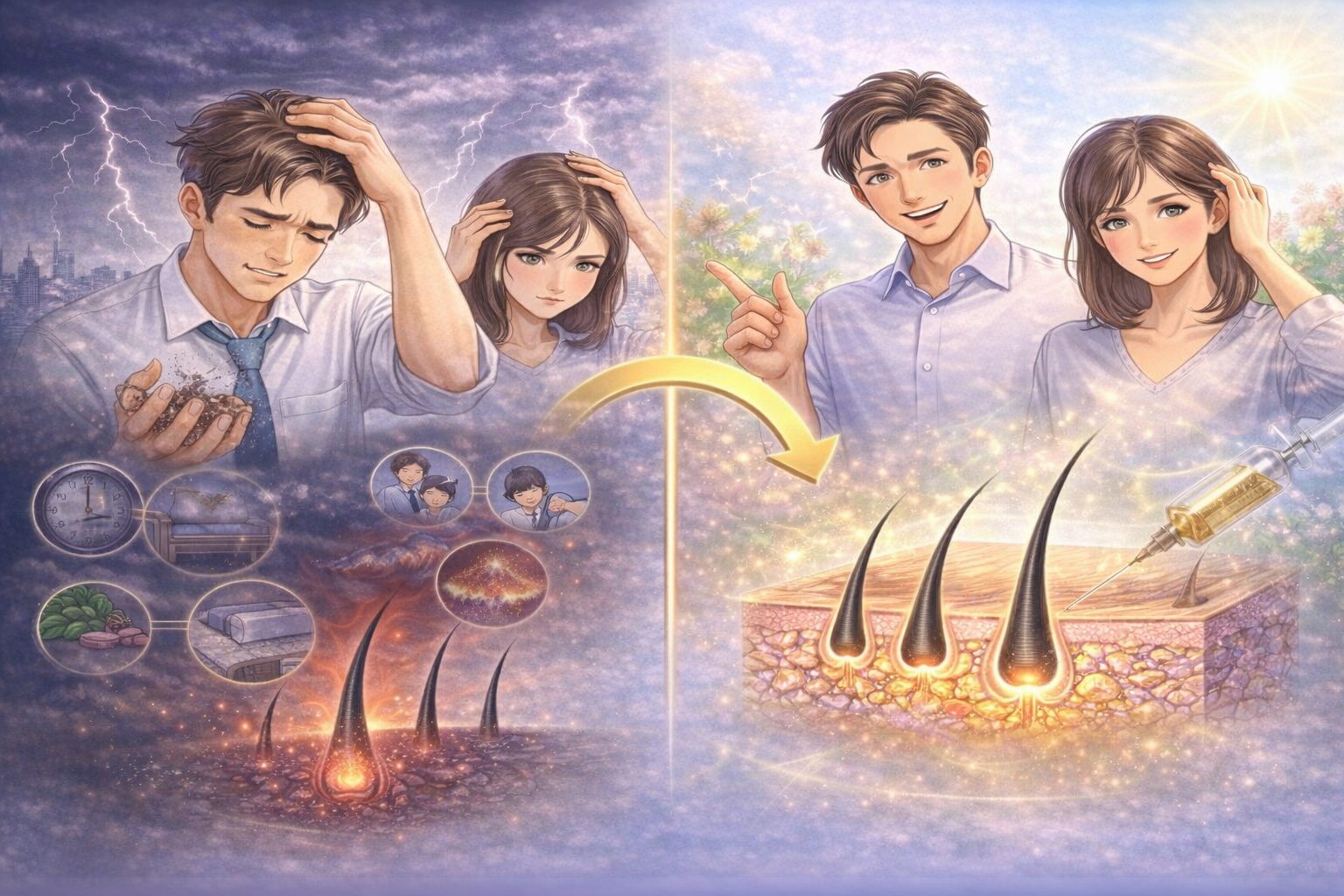
The difficult scenario is repeated, year-after-year pulling of the same site. Chronic mechanical trauma drives peri-follicular inflammation and fibrosis, and eventually the follicles themselves are lost and the scalp scars over. At that point, stopping the behavior no longer brings hair back. Skin biopsy typically shows a reduced follicle count with collagen replacing the surrounding tissue. Whether trichotillomania follicular damage will end up irreversible depends most on how many years the pulling has continued and whether visible follicular openings (ostia) can still be seen on the scalp surface.
The Foundation of Treatment Is Stopping the Pulling
Before hair-focused treatment is even considered, the intervention that has to happen is on the behavior itself. This is not something that dermatology or aesthetic medicine can complete alone — coordination with psychiatry or psychosomatic medicine is the foundation.
Habit Reversal Training (HRT) and Cognitive Behavioral Therapy
The strongest evidence base sits with the behavioral technique known as Habit Reversal Training. Triggers that precede pulling — boredom, anxiety, specific postures, moments before sleep — are made visible, and a competing response (making a fist, another physical action) is trained to replace the pulling. Combining this with cognitive behavioral therapy (CBT) is reported to lower relapse rates.
Where Pharmacotherapy Fits
When anxiety or comorbid depression is significant, SSRIs or clomipramine may be prescribed. Some reports also suggest a role for N-acetylcysteine. However, no drug in Japan is officially indicated for trichotillomania itself; medication remains an adjunct under the judgment of the treating psychiatrist.
How Stem Cell Conditioned Media Runs in Parallel
Alongside behavioral therapy, conditioned media can be considered as a step for restoring the scalp environment once the pulling has been curbed. The important framing is that the media is not used as a stand-alone “magic injection to grow hair,” but as a treatment that softens scalp inflammation and supports the recovery capacity of the follicles that remain.
Calming a Scalp Environment Disturbed by Repeated Trauma
After long-term pulling, the scalp often carries chronic low-grade inflammation and peri-follicular changes that can distort the hair cycle of any surviving follicles. Growth factors in stem cell conditioned media — TGF-β, IGF-1, HGF — anti-inflammatory cytokines, and exosome-borne intercellular signals are thought, in preclinical work, to help slow this inflammatory cycle. That said, no human study guarantees hair regrowth; the honest positioning is “preparing a scalp on which follicles find it easier to recover.” Rather than directly repairing trichotillomania follicular damage itself, the goal is to make it easier for new shafts to emerge once the pulling has stopped.
When to Introduce It
Starting conditioned media while the pulling continues does not work — hair will not grow as long as it is being extracted. The reasonable moment is once behavioral or pharmacological therapy has reduced pulling frequency, and the target area has gone at least several months untouched. For further reading on related scalp damage and hair regenerative options, see our collection of columns on hair regenerative medicine.
Limits of Regenerative Medicine and What Comes After
Where Scarring Alopecia Has Set In
In a region where follicles have already fibrosed and been lost, no amount of stem cell conditioned media will build new follicles from zero. Conditioned media supports the environment around existing follicles; it is not a cell-transplant therapy that generates new ones. When the differential between trichotillomania-related scarring alopecia and other inflammatory alopecias (such as lichen planopilaris) is unclear, we recommend a parallel dermatologic evaluation and refer to the alopecia guidelines published by the Japanese Dermatological Association.
Where Follicular Unit Hair Transplantation Comes In
Where scarring is localized and pulling behavior has been stable for a long time, follicular unit hair transplantation becomes a possibility. But trichotillomania is a relapse-prone condition — the chance of resuming pulling at the transplanted area is not zero — so a sustained period of behavioral stability must be verified before that step is chosen. The premise is that “not pulling” has become durable.
Frequently Asked Questions
Q. If I have been pulling at the same spot for years, can conditioned media bring the hair back?
The outlook depends on how many years you have been pulling and, on close inspection, whether visible follicular openings (pores) still remain. If pores are still present and the pulling has stopped, conditioned media may support recovery of the hair cycle. Where the pores themselves have disappeared and the area has scarred, conditioned media alone cannot create new follicles.
Q. Can I do scalp treatment while still under psychiatric care for trichotillomania?
Yes, running them in parallel is generally fine. However, as long as active pulling continues, the hair will not grow no matter what is applied, so it is more realistic to introduce conditioned media once pulling frequency has settled. Please share your psychiatric status and current prescriptions so we can coordinate with your treating physician.
Q. Should AGA drugs such as finasteride also be used for trichotillomania-related loss?
Trichotillomania hair loss is not caused by androgen-driven follicular miniaturization, so finasteride and dutasteride are basically not indicated for it. If AGA coexists as a separate diagnosis, oral treatment may be considered on that axis. The essential point is not to blur the diagnoses.
Q. When I try to stop pulling, an intense urge builds up. Will conditioned media relieve it?
That sensation is not skin-derived; it is largely a psychological drive rooted in obsessive-compulsive and impulsive components. Conditioned media acts on scalp inflammation and the follicular environment but does not intervene in the urge itself. Behavioral therapy or medication under a psychiatrist takes priority for that dimension.
Q. Can a minor with trichotillomania receive stem cell conditioned media scalp treatment?
Course and prognosis in minors differ from adults, so evaluation by pediatric or child-and-adolescent psychiatry is the first step. Growing-age follicles have strong natural recovery; when the behavior stops, hair frequently returns on its own. Rather than moving to injection treatment prematurely, we assess carefully whether the age and clinical state allow for injection therapy to run alongside behavioral care.
──────────────
Supervising Physician: Shin Moriwaki, MD
Member, Japan Society of Aesthetic Surgery (JSAS) / Member, American Academy of Aesthetic Medicine
ECFMG Certificate
──────────────
📍AVAN TOKYO Ginza Hair Regenerative Medicine
AVAN TOKYO Ginza Hair Regenerative Medicine
English / 中文 / Tiếng Việt available
Inquiries welcome via DM / LINE / Website / Phone.