


Breast Reduction and Mastopexy in Tokyo: Treating Breast Ptosis After Implant Augmentation2026.09.06
“Can sagging breasts be lifted without surgery?”
“Can I downsize my breast implants and improve the shape at the same time?”
“My breasts became larger after augmentation, but now they also look droopy.”
For patients with these concerns, breast reduction and mastopexy may be appropriate treatment options.
At AVAN TOKYO, breast surgery is not only about making the breasts larger. We also treat patients who want to make overly large breasts more compact, improve breast ptosis, reposition the nipple-areola complex, or exchange existing breast implants for a smaller size.
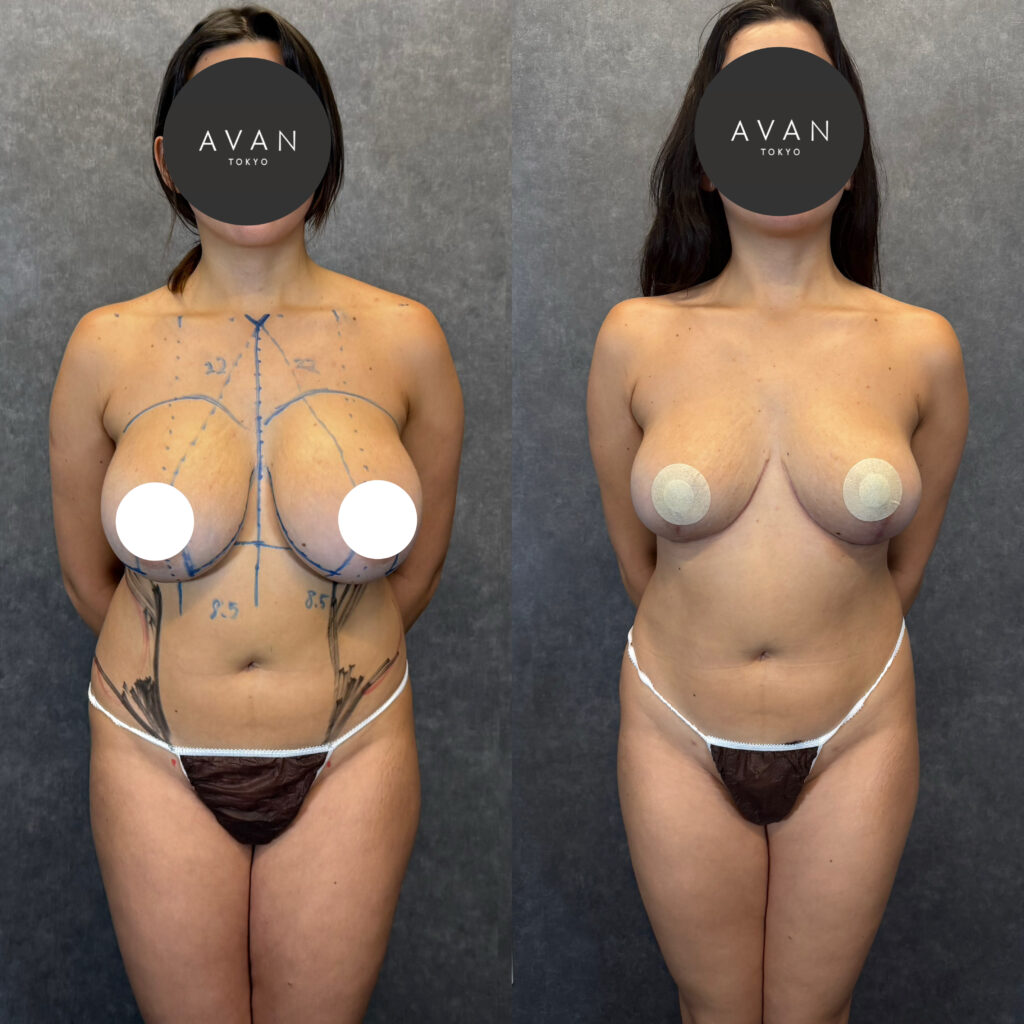
In this case, we present a 26-year-old woman who had previously undergone breast augmentation overseas with 320 cc silicone implants. She developed breast ptosis and wanted a smaller, more refined breast shape.
She underwent:
● Breast reduction
● Mastopexy
● Silicone implant exchange
● Inverted-T incision
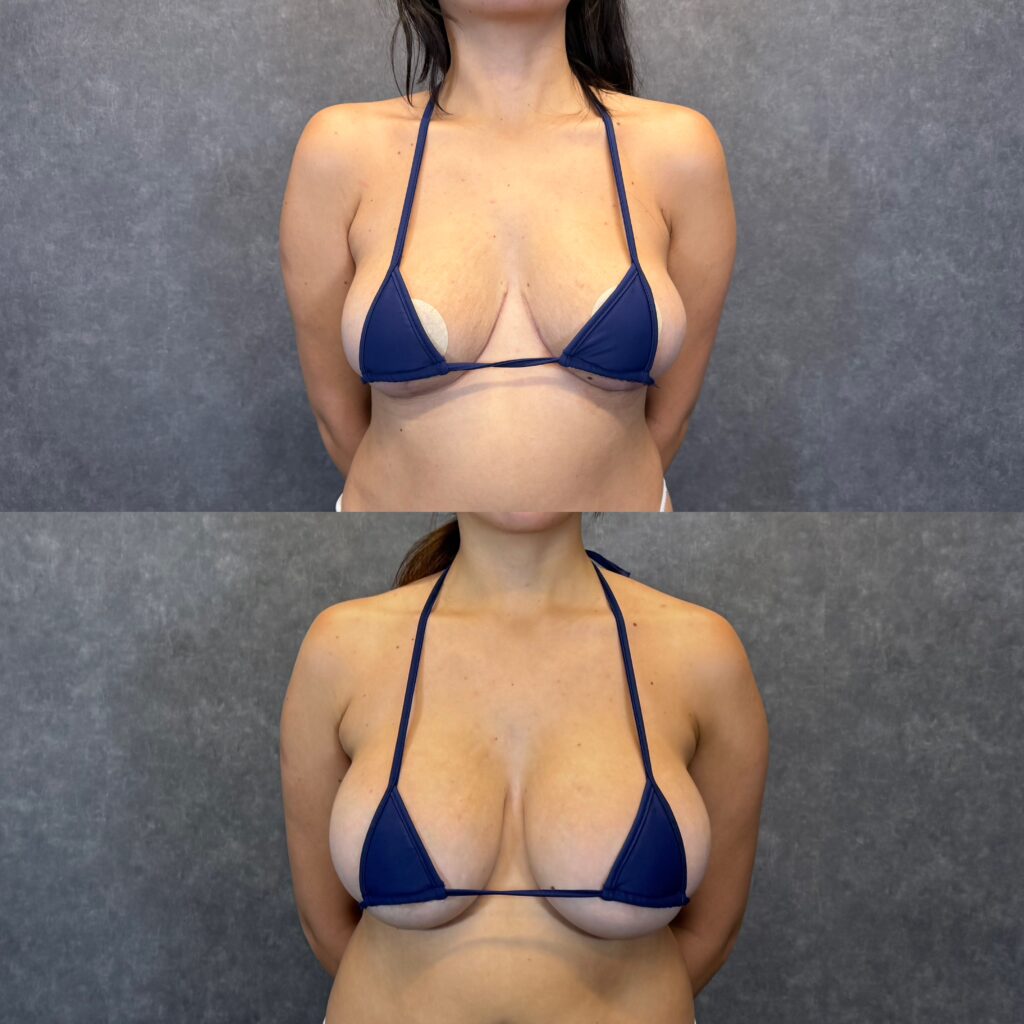
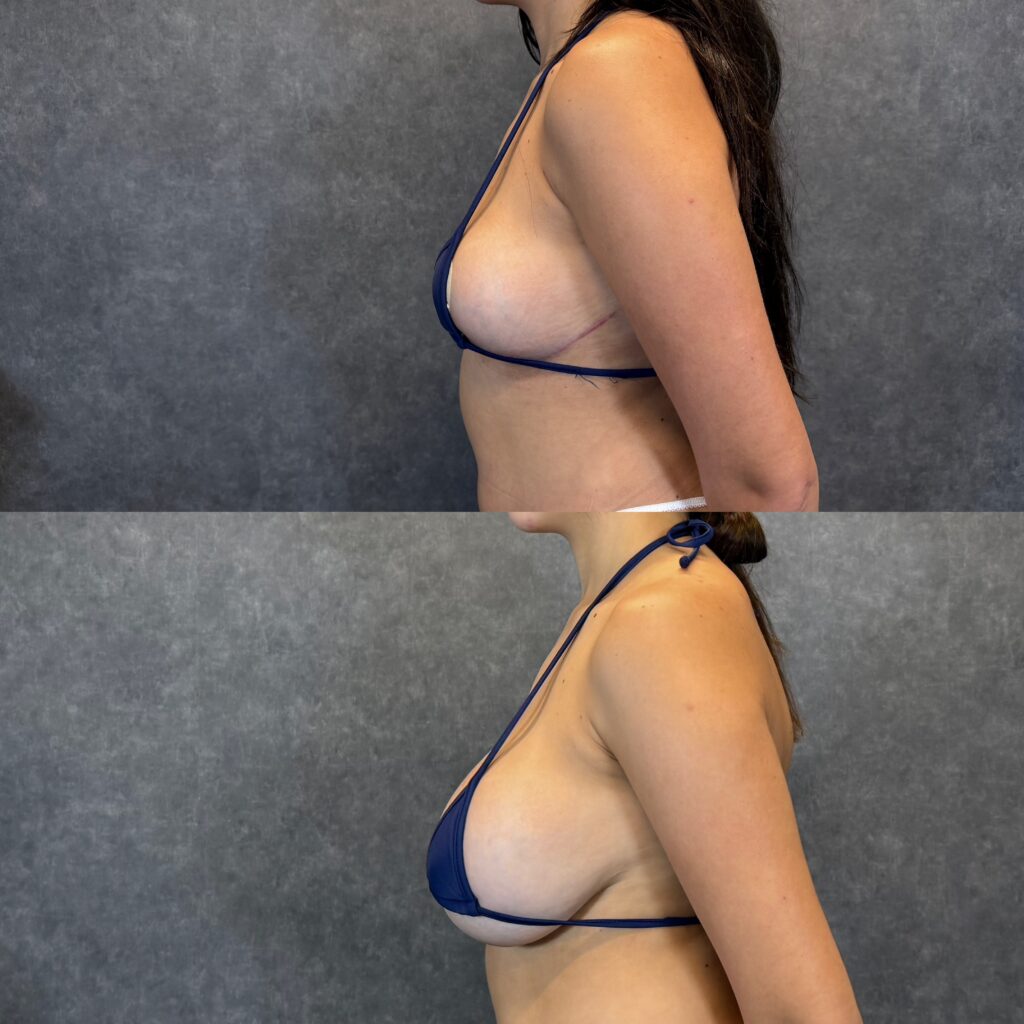
Her implants were downsized from 320 cc to 220 cc, and this case is shown at 3 months after surgery.
Surgeon: Dr. Avelino
The key point: excess skin cannot simply be removed with energy-based treatment
The treatment of skin laxity depends on its severity.
This principle applies to the face, body, and breasts.
For mild skin laxity, radiofrequency or other energy-based devices may improve subtle skin looseness or fine crepey texture.
However, when there is significant excess skin, marked breast ptosis, or downward displacement of the nipple and breast tissue, energy-based treatment alone cannot physically remove that excess skin.
In such cases, surgical excision of the redundant skin may be necessary.
This is an important distinction.
Energy-based treatment, thread lifting, and surgical lifting are not interchangeable treatments. Each has a different role depending on the severity and anatomy of the patient.
What is breast ptosis?
Breast ptosis refers to downward displacement or sagging of the breast.
It may occur due to:
● Aging
● Pregnancy and breastfeeding
● Significant weight changes
● Naturally large breasts
● Loss of skin elasticity
● Previous breast augmentation
● Long-term weight from large breast implants
In patients with implants, particularly larger implants, the weight of the implant may contribute to stretching of the skin and supporting tissues over time.
As a result, the breast tissue and nipple position may gradually descend.
In these cases, simply exchanging the implant may not fully correct the breast shape.
What is a mastopexy?
A mastopexy, also known as a breast lift, is a surgical procedure designed to reshape and reposition a sagging breast.
The procedure may involve:
● Removing excess skin
● Repositioning the nipple and areola
● Reshaping the breast tissue
● Improving the relationship between the upper and lower breast
● Reducing excessive lower-pole skin
● Creating a more compact breast shape
A mastopexy is not simply a procedure that “pulls the breast upward.”
It is better understood as a surgical reshaping of the breast envelope and internal tissue.
What is the difference between breast reduction and mastopexy?
A mastopexy primarily focuses on improving breast position and shape.
A breast reduction, on the other hand, may also remove breast tissue, fat, and skin to reduce overall breast volume.
Many patients do not have only one problem.
For example, a patient may have both:
● Excessive breast volume
● Breast ptosis
In these cases, breast reduction and mastopexy may be combined.
Can mastopexy be performed if breast implants are already in place?
Yes.
However, the surgical plan depends on several factors, including:
● Existing implant size
● Implant position
● Thickness of the breast tissue
● Amount of excess skin
● Nipple position
● Position of the inframammary fold
● Degree of breast ptosis
● Desired final breast size and shape
In this case, the patient previously had 320 cc silicone implants placed overseas.
She wanted a smaller breast size and improvement in breast ptosis.
The implants were therefore exchanged for smaller 220 cc implants, and mastopexy with breast reduction was performed at the same time.
Why downsizing the implant alone may not be enough
When a large implant is replaced with a smaller implant, the implant volume decreases immediately.
The skin, however, does not necessarily shrink back to its original size.
If the breast skin has already been stretched, downsizing the implant alone may result in:
● Loose skin
● A deflated appearance
● Persistent breast ptosis
● Excess lower-pole skin
This is why patients considering implant downsizing should not focus only on the number of cubic centimeters.
The surgeon must also assess what will happen to the breast skin after the implant volume is reduced.
In some patients, implant exchange alone may be sufficient.
In others, a mastopexy is needed at the same time.
Case: 26-year-old woman, 160 cm, 57 kg
This patient was 26 years old, 160 cm tall, and weighed 57 kg.
She had previously undergone breast augmentation overseas with 320 cc silicone implants.
Over time, she developed breast ptosis and felt that her breasts were larger than she wanted.
Her treatment plan included:
Breast reduction
Mastopexy
Silicone implant exchange
Inverted-T incision
The implants were downsized from:
320 cc → 220 cc
At 3 months after surgery, the breast shape is more compact, and the relationship between the breast, nipple position, and lower breast contour has changed significantly compared with the preoperative condition.
Individual results vary.
Surgeon: Dr. Avelino
Why was an inverted-T incision used?
There are several common incision patterns used for mastopexy.
These include:
1. Periareolar incision
2. Vertical incision
3. Inverted-T incision, also called an anchor or Wise-pattern incision
Not every patient requires an inverted-T incision.
When the amount of excess skin is relatively limited, a shorter incision may be appropriate.
However, when there is significant skin excess in both the vertical and horizontal dimensions, an inverted-T incision can allow greater control over breast reshaping.
In this case, the patient had both breast ptosis and stretched skin after previous augmentation, so an inverted-T pattern was selected.
The goal is not simply to make the scar as short as possible.
The more important question is:
Which incision pattern allows the breast to be reshaped appropriately while minimizing unnecessary scarring?
RF treatment, thread lifting, or surgical lift: how do we choose?
Treatment should be selected according to the severity of the laxity.
Mild laxity: RF treatment
Radiofrequency treatments deliver controlled thermal energy into the tissue.
They may be useful for:
● Mild skin looseness
● Fine crepey skin texture
● Early-stage laxity
However, RF treatment cannot remove large amounts of redundant skin.
Mild to moderate laxity: thread-based treatment
Thread lifting may be considered in selected areas and selected patients.
However, when there is significant breast ptosis or substantial excess skin, thread lifting alone has limitations.
Moderate to severe laxity: surgical mastopexy
When the nipple has descended significantly or the breast skin is clearly excessive, surgery may be the more appropriate option.
This is why treatment should not begin with the question, “Which device should I use?”
The better starting point is:
How much excess skin is actually present?
What about scars?
Scarring is one of the most important considerations in mastopexy and breast reduction.
Because excess skin is surgically removed, scars cannot be completely avoided.
Depending on the incision pattern, scars may be located:
● Around the areola
● Vertically from the areola toward the breast fold
● Along the inframammary fold
Patients with Asian skin, including many Japanese patients, may have a greater tendency toward prolonged redness, pigmentation, or hypertrophic scarring depending on individual skin characteristics and the surgical site.
Possible scar-related concerns include:
● Prolonged redness
● Hyperpigmentation
● Hypertrophic scars
● Visible scar widening
● Differences in scar maturation between the left and right sides
For this reason, scar design and postoperative scar management are important parts of the treatment plan.
At AVAN TOKYO, the goal is not simply to make the incision as short as possible.
The objective is to balance:
scar length, skin removal, nipple position, breast shape, and long-term stability.
Breast surgery is not only about making the breasts larger
Many patients assume that breast surgery means breast augmentation.
However, some patients want exactly the opposite.
They may want to:
● Reduce breast size
● Downsize breast implants
● Lift sagging breasts
● Improve nipple position
● Create a more compact silhouette
● Correct breast shape after previous augmentation
● Remove excess skin after pregnancy or weight loss
At AVAN TOKYO, treatment planning is based on the patient’s current anatomy and desired breast shape.
Depending on the case, treatment may include:
● Fat grafting
● Silicone breast augmentation
● Hybrid breast augmentation
● Implant exchange
● Implant downsizing
● Mastopexy
● Breast reduction
● A combination of these procedures
The most important point is to design the entire breast, rather than focusing only on implant size.
Who may be a candidate for mastopexy?
Mastopexy may be considered for patients who are concerned about:
● Sagging breasts
● Low nipple position
● Loose breast skin after pregnancy or breastfeeding
● Breast deflation after weight loss
● Large breasts that feel heavy or low
● Breast ptosis after implant augmentation
● Downsizing large breast implants
● Excess skin after implant downsizing
● Breast shape that cannot be adequately improved with non-surgical treatment
The appropriate procedure depends on the severity of ptosis and the amount of excess skin.
Frequently Asked Questions
Is mastopexy the same as breast reduction?
No.
A mastopexy primarily lifts and reshapes the breast.
Breast reduction also reduces breast volume by removing skin and, when necessary, breast tissue and fat.
The two procedures may be combined.
Can I have a breast lift if I already have implants?
Yes.
Depending on the condition of the breast, the implants may be kept, exchanged, downsized, or removed.
Can I simply replace my large implants with smaller ones?
Sometimes.
However, if the breast skin has already stretched significantly, downsizing the implant alone may leave excess skin.
In those cases, mastopexy may be recommended at the same time.
Can RF treatment correct breast sagging?
RF treatment may improve mild skin laxity or skin texture.
However, it cannot physically remove substantial excess skin.
For significant breast ptosis, surgical treatment may be necessary.
Will there be scars after mastopexy?
Yes.
Any surgical breast lift that removes skin will leave scars.
The location and length of the scars depend on the degree of ptosis and the incision pattern required.
Does every patient need an inverted-T incision?
No.
Some patients may be treated with a periareolar or vertical incision.
An inverted-T incision is generally considered when there is more significant skin excess and greater reshaping is required.
Our approach at AVAN TOKYO
When evaluating breast ptosis, we do not begin by asking which machine or device should be used.
We first evaluate:
● The amount of excess skin
● Nipple position
● Breast volume
● Implant size
● Implant position
● Breast tissue thickness
● Breast fold position
● Desired final size
● Desired breast shape
From there, we determine whether the patient may benefit from:
● Non-surgical tightening
● Implant exchange
● Implant downsizing
● Mastopexy
● Breast reduction
● A combination procedure
For patients who previously underwent breast augmentation overseas, revision surgery can be more complex because the original implant type, implant pocket, scar tissue, and breast anatomy must all be evaluated carefully.
If you are considering breast implant downsizing, breast reduction, or mastopexy in Tokyo, we recommend an individualized consultation to determine the most appropriate surgical plan.
Case Summary
Patient: 26-year-old woman
Height: 160 cm
Weight: 57 kg
Previous surgery:
Breast augmentation overseas with 320 cc silicone implants
Procedure:
Breast reduction
Mastopexy
Silicone implant exchange
Inverted-T incision
Implant change:
320 cc → 220 cc
Follow-up:
3 months after surgery
Surgeon:
Dr. Avelino
Individual results vary.
Potential Risks and Complications
Possible risks include:
● Scarring
● Hematoma
● Infection
● Wound dehiscence
● Asymmetry
● Hypertrophic scarring
● Pigmentation changes
● Changes in nipple or areola sensation
● Blood-flow impairment of the nipple-areola complex
● Breast shape asymmetry
● Recurrent ptosis
● Capsular contracture
● Implant displacement
● Implant rupture or damage
● Need for revision surgery
A detailed consultation is necessary to determine whether breast reduction, mastopexy, implant exchange, or a combination of procedures is appropriate for each patient.