


Does Saw Palmetto Really Work for AGA? Supplement Evidence and the Medical Choice of Stem Cell Conditioned Media2026.06.24
“Finasteride sounds scary because of the side effects, but I still want to do something” — driven by that feeling, many people have tried saw palmetto supplements. Easy to buy at the drugstore or online and frequently marketed as a “natural ingredient that works on AGA,” the real question patients keep asking is whether it actually delivers clinically meaningful results. In this column, we first lay out the medical evidence on saw palmetto, then explain hair regenerative medicine using stem cell conditioned media as a more proactive option.
Saw palmetto is an extract from the fruit of a palm-family plant native to North America, originally used as a natural remedy for benign prostatic hyperplasia. Its application to AGA (androgenetic alopecia) attracted attention because it was reported to weakly inhibit 5α-reductase, the enzyme that converts testosterone into the hair-loss hormone DHT. That very “weakness,” however, defines both its niche and its limits as a supplement.
Saw Palmetto’s Effect on AGA — How Far Does the Evidence Go?
Let us soberly review saw palmetto’s mechanism of action and its clinical data. While it is widely sold as a supplement, it is almost never a first-line choice in clinical practice.
The 5α-Reductase Inhibition Is “Weak”
The main components of saw palmetto (β-sitosterol, fatty-acid esters, and others) do show 5α-reductase inhibition. But the inhibitory potency is only one tenth to several hundredths that of pharmaceutical finasteride or dutasteride. Even when in vitro reactions look promising, the clinical reduction of DHT after oral intake — given realistic blood and intra-follicular concentrations — is limited. “Natural ingredient, therefore safe” and “strong enough to actually halt AGA” are two completely different conversations.
Variability in Trial Quality and Outcomes
Several randomized controlled trials of saw palmetto for AGA have been published, but most have small sample sizes and short follow-up periods. Some conclude that it is “weaker than finasteride but improves hair volume over placebo,” yet the magnitude of improvement is small, and photographic assessment often fails to show a clear difference. Reviewing the guidelines of the Japanese Dermatological Association for AGA treatment, saw palmetto carries a low recommendation grade in clinical settings and remains a supplementary option at best.
“Fewer Side Effects” Sits Back-to-Back With “Less Effect”
The biggest reason saw palmetto is chosen is the lower reported rate of sexual side effects compared with finasteride or dutasteride. But the flip side is that it likely fails to suppress DHT enough — its action is weak. Reassured by “no side effects,” many people watch and wait for years on saw palmetto alone, only for AGA to quietly progress in the meantime — a pattern we see often in clinic. AGA is a battle against time; once the follicle has fully atrophied, recovery becomes difficult no matter what treatment is brought in.
Stem Cell Conditioned Media — The Medical Option Beyond Supplements
For those who feel the limits of the “barely suppress DHT” approach of supplements like saw palmetto, hair regenerative medicine using stem cell conditioned media is the option worth knowing. Supplements and regenerative medicine target fundamentally different layers.
Not Blocking DHT — Regenerating the Follicle Itself
The essence of AGA is that DHT causes the follicle to atrophy and shortens the anagen phase of the hair cycle. Saw palmetto and finasteride treat by “reducing DHT” — essentially stepping on the brake — but they cannot directly restore follicles that have already miniaturized. Stem cell conditioned media, by contrast, is rich in growth factors and cytokines such as VEGF, IGF-1, KGF, and HGF, along with exosomes. It can act on follicular stem cells and dermal papilla cells, extending the anagen phase and reactivating the follicle itself. A supplement that “presses the brake” and regenerative medicine that “restarts the engine” operate on fundamentally different layers.
As Low-Invasive as a Supplement — Drug Delivery via Morpheus8
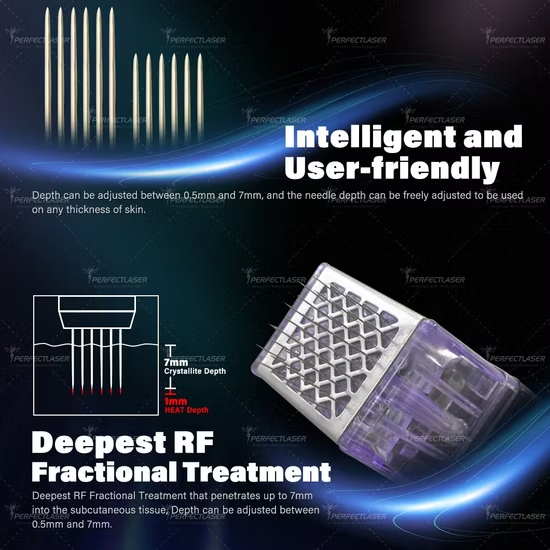
Many people imagine regenerative medicine as painful injections, but at AVAN TOKYO we use Morpheus8, an RF microneedling device, to drug-deliver stem cell conditioned media directly to the dermal-to-perifollicular layer of the scalp. With topical anesthetic cream, pain is dramatically reduced and downtime is minimal. For patients who feel that “supplements are not enough, but strong oral medications and injections are scary,” this is a realistic and medically meaningful choice.
Compatible With Supplements and Oral Medications
Another major advantage of regenerative medicine with stem cell conditioned media is that it can be combined with saw palmetto supplements or oral finasteride without stopping them. Lightly easing off the DHT accelerator with a supplement while using stem cell conditioned media to regenerate the follicle itself — this combination strategy delivers tangible clinical results, particularly for progressive AGA in patients in their 40s and beyond and for diffuse hair loss in women.
Summary — Ask Not “Does It Work?” but “What Layer Does It Target?”
Saw palmetto is not entirely meaningless for AGA. But its effect is limited, and the current medical consensus is that it lacks the strength to fully halt AGA progression. The risk that patients spend years feeling reassured by “natural and low side effects” while the follicle atrophies past the point of recovery is greater than most realize.
The time spent treading water on supplements is, for the follicular stem cells, the most precious window for regeneration. Hair regenerative medicine with stem cell conditioned media not only suppresses DHT but works as a medical approach that revives the follicle itself, reaching layers saw palmetto cannot.
For more topics, please visit our collection of hair regenerative medicine columns.
──────────────
Supervising Physician: Shin Moriwaki, MD
Member, Japan Society of Aesthetic Surgery (JSAS)
Member, American Academy of Aesthetic Medicine
ECFMG Certificate
──────────────
📍AVAN TOKYO Ginza Hair Regenerative Medicine
English / 中文 / Tiếng Việt available
Inquiries welcomed via DM / LINE / Website / Phone.