


Why Beards Thicken While Scalp Hair Thins: The Hair Paradox and Stem Cell Conditioned Media2026.07.02
“My beard and body hair keep getting thicker, yet the crown and hairline just keep receding.” This is one of the most common frustrations we hear at the clinic.
The same body, the same blood, the same hormones — and yet, hair follicles behave in opposite directions depending on where they sit. In clinical dermatology this phenomenon is called the hair paradox, and it is essential for understanding androgenetic alopecia (AGA).
In this column, we outline why the same androgens act opposite on the beard and scalp, and where stem cell conditioned media (SCCM) fits into modern hair regenerative medicine — from the perspective of Dr. Moriwaki.
Why the same androgens produce opposite results on beard and scalp
The main driver of AGA is dihydrotestosterone (DHT), converted from testosterone by 5α-reductase. The molecule that reaches follicles through the bloodstream is identical, but the way each follicle responds differs by location — which is why the visible outcome is reversed.
Same receptor, different downstream signaling
Beard, chest, and scalp follicles all express androgen receptors. What differs is the downstream gene expression, proliferation and differentiation signals, and cross-talk with surrounding vessels and fibroblasts.
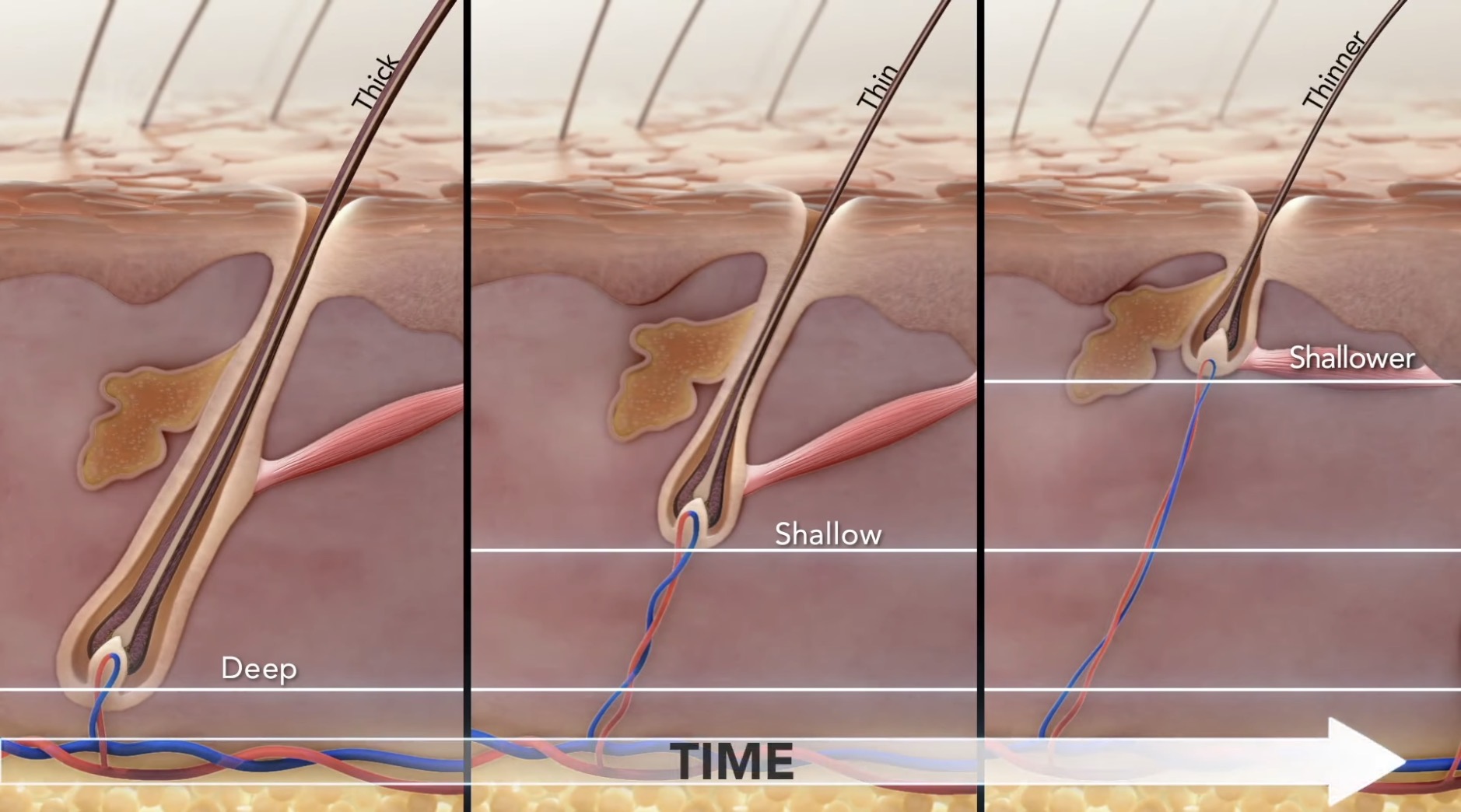
In beard follicles, DHT binding prolongs anagen and pushes hair to become thicker and darker. In frontal and vertex scalp follicles, the same DHT binding raises inflammatory cytokines and shortens the hair cycle, so hair becomes gradually thinner and shorter.
Regional variation makes treatment design harder
Because of this regional difference, simply “lowering androgens” is not a complete answer. Suppressing them too much affects systemic sexual function, bone density and mood, and it does not necessarily restore the local follicular microenvironment.
This is exactly why hair regenerative medicine — and stem cell conditioned media as its core — has become an increasingly important pillar of AGA care.
The molecular mechanism that turns DHT into a “villain” on the scalp
Digging deeper into the hair paradox, we arrive at chronic micro-inflammation in scalp follicles and the distribution difference of 5α-reductase.
Type II 5α-reductase dominates the frontal and vertex scalp
5α-reductase has two main isoforms; type II — strongly expressed in the frontal and vertex scalp — is the one implicated in AGA. In these follicles testosterone is efficiently converted to DHT, and the DHT signal reaches the dermal papilla cells strongly.
The papilla then releases signals that shut down anagen, such as TGF-β1, DKK-1 and IL-6. The hair cycle shortens and hairs progressively miniaturize — the very process that thins the crown and hairline.
Beard follicles respond to DHT with growth-promoting signals
The same DHT signal, in the beard dermal papilla, activates growth factors such as IGF-1 and VEGF that extend anagen. That is why testosterone- and DHT-rich environments make beard and body hair thicker with age.
Even when total testosterone is “within normal range” on blood tests, AGA can still progress — because circulating hormone levels and follicle-level sensitivity are not the same thing.
Chronic micro-inflammation, another leading actor
Another factor drawing attention is silent chronic micro-inflammation in the scalp. Malassezia, oxidized sebum, UV damage and glycation together keep IL-1α, IL-6 and TNF-α smoldering around follicles, exhausting the follicular stem cell niche.
DHT signaling × micro-inflammation × reduced perfusion — this triple burden is what miniaturizes follicles first in AGA.
What stem cell conditioned media can do given the hair paradox
Seen from this angle, the role of stem cell conditioned media becomes clearer.
Redesigning the follicular microenvironment
Stem cell conditioned media contains a wide range of cytokines, growth factors and exosomes secreted by mesenchymal stem cells. VEGF and HGF support peri-follicular perfusion and angiogenesis; IGF-1 and FGF-7 are considered to help hair matrix proliferation and anagen maintenance. Anti-inflammatory factors such as IL-10 may also help calm scalp micro-inflammation.
Stem cell conditioned media is not a drug that lowers androgens. Instead of blocking DHT itself, it aims to restore the scalp-side environment that DHT keeps damaging, so that the follicular niche can recover.
For background on AGA guidelines, see also the Japanese Dermatological Association.
How SCCM shares roles with oral and topical anti-androgens
Finasteride and dutasteride suppress DHT production, blocking AGA at the “upstream.” Topical minoxidil pushes perfusion and anagen forward. Stem cell conditioned media sits alongside them, tuning the soil — inflammation, vasculature and stem cell niche — around each follicle.
Stop the upstream, push the growth, tune the soil: this three-layer design is a strength of current AGA care.
For a broader view of hair regenerative medicine, see also our hair regenerative medicine column index.
Summary
The hair paradox — beards thickening while scalp hair thins — reflects the opposite responses of follicles to the same androgen. In the frontal and vertex scalp, type II 5α-reductase dominates, DHT shortens the hair cycle, and chronic micro-inflammation accelerates miniaturization.
Stem cell conditioned media acts on that scalp-side soil — inflammation, vasculature and stem cell niche — and, combined with oral anti-androgens and topical minoxidil, allows a multi-layered approach to AGA.
Understanding at the molecular level why your hair is thinning is directly tied to accepting and sustaining treatment. If any of this resonates, please consult a specialist to review your scalp condition and treatment options.
──────────────
Supervising physician: Dr. Shin Moriwaki
Member, Japan Society of Aesthetic Surgery (JSAS) / Member, American Academy of Aesthetic Medicine
ECFMG certificate
──────────────
📍AVAN TOKYO 銀座 毛髪再生医療
AVAN TOKYO Ginza Hair Regenerative Medicine
English / 中文 / Tiếng Việt supported.
Inquiries via DM / LINE / Website / Phone.