


Why Stem Cell Conditioned Media Suits Female Diffuse Hair Loss — A World Beyond Hormones2026.05.11
“There’s more hair in the drain after washing.” “My part line looks wider than before.” “My hair has lost its overall body and resilience.” — When women notice changes in their own hair, the anxiety they feel carries a depth that is different from what men experience.
While male pattern baldness (AGA) progresses in concentrated areas of the frontal and crown regions, female diffuse hair loss is characterized — quite literally — by thinning that spreads across the entire scalp.
And this diffuse hair loss has a complex background that can never be fully explained by declining female hormones alone.
In recent years, more and more cases of female diffuse hair loss are showing meaningful response to stem cell conditioned media.
This is not a coincidence. It is precisely because the mechanism of female hair loss and the action of conditioned media align so well with each other.
What Is Female Diffuse Hair Loss — The “Overall Thinning” Pattern
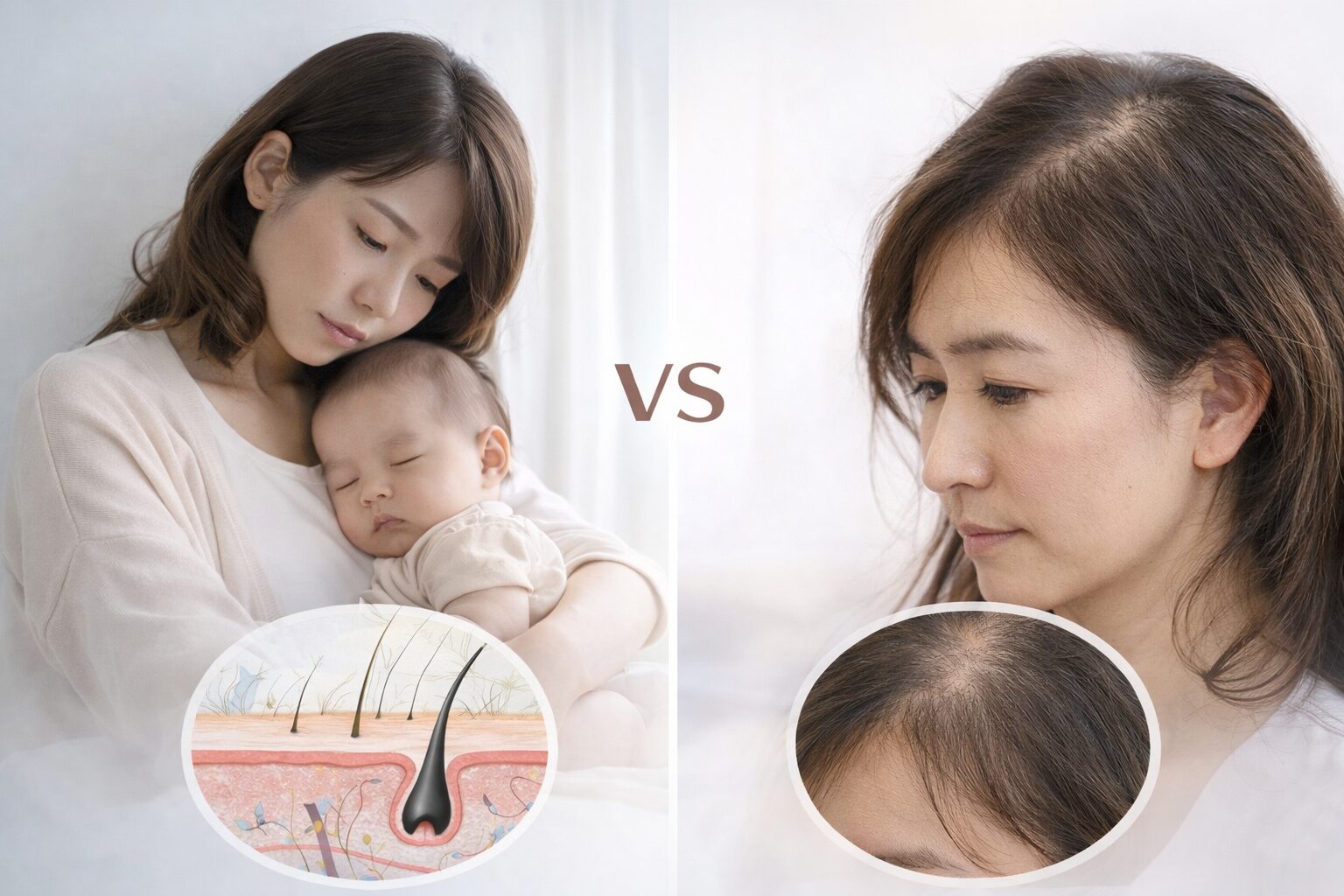
Female diffuse hair loss is characterized not by localized bald spots at the crown or hairline, but by hair across the entire scalp becoming uniformly thinner with reduced density.
It becomes more common from the 40s onward, but it is no longer rare to see it in women in their 20s and 30s.
How It Differs from the Male Pattern
Male AGA is a condition in which hair follicles in areas strongly affected by the male hormone DHT selectively atrophy.
For this reason, only the frontal and crown regions thin out, while the hair on the back and sides of the head remains until the very end.
Female diffuse hair loss has a different distribution: follicles across the entire scalp tend to thin out gradually and simultaneously.
This difference dramatically changes the “entry point” of treatment.
Unlike men, where suppressing DHT is the central pillar of treatment, women cannot always be addressed with hormone-suppressing therapy. A different angle of approach is required instead.
Multifactorial Hair Loss That Hormones Alone Cannot Explain
The causes of female diffuse hair loss are never just one thing.
Declining estrogen is, of course, one factor, but it often fails to explain everything we see in clinical practice.
Iron deficiency, fluctuations in thyroid function, chronic stress, nutritional deficits from excessive dieting, chronic micro-inflammation of the scalp, damage from excessive hair coloring or bleaching — these multiple factors stack up and gradually wear down the function of the hair follicles.
This is precisely why treatments that target only one cause so often fail to produce results.
Why Conditioned Media Suits Female Diffuse Hair Loss
Stem cell conditioned media contains dozens of growth factors and cytokines, including EGF, FGF, VEGF, KGF, and IGF-1.
This “multi-component” nature is the single biggest reason it pairs so well with female diffuse hair loss, where multiple factors are intertwined.
Many Growth Factors Addressing “Multiple Causes” Simultaneously
VEGF rebuilds the capillaries of the scalp and restores the diminished blood flow.
KGF (FGF-7) promotes the proliferation of matrix cells and sends a renewed “enter the growth phase” signal to dormant follicles.
IGF-1 supports follicle survival and firmly anchors hairs that had become prone to shedding.
Unlike conventional treatments where one drug targets one receptor, conditioned media works on the scalp environment through multiple factors at once, like an orchestra.
For female hair loss — where “the cause is never just one” — this multidimensional approach carries enormous meaning.
Restoring the Scalp Environment and Halting Follicle Miniaturization
Another essential aspect of diffuse hair loss is “miniaturization,” the gradual shrinking of the follicles themselves.
Hair that should naturally grow thick and long instead falls out as short, thin, vellus-like strands, locking the cycle into decline.
Conditioned media also contains cytokines with anti-inflammatory action, which can calm chronic scalp inflammation and is expected to help suppress the progression of miniaturization.
At AVAN TOKYO, for female diffuse hair loss, we evaluate not only scalp environment reset through conditioned media but also lifestyle background, nutritional status, and hair care habits in a comprehensive way.
Not “adding more drugs” but “restoring the foundation” — in the treatment of female hair loss, this mindset is what separates results.
Summary
Female diffuse hair loss is not just a hormone problem, not just a nutrition problem, and not just a stress problem.
Multiple factors slowly overlap, and the function of follicles across the entire scalp gradually declines — this is the reality of female hair loss.
That is why, rather than treatments that rely on a single drug, stem cell conditioned media — which acts on the scalp through multiple growth factors from multiple angles — is so well suited to female diffuse hair loss.
Before giving up with thoughts like “it’s just my age” or “maybe a different shampoo will fix it,” we strongly recommend consulting a specialist familiar with female hair loss first.
The earlier you intervene in diffuse hair loss, the more clearly you can map a recovery path while follicle function still remains.
Understanding correctly what is happening on your own scalp is the first solid step toward change.
📍AVAN TOKYO Ginza Stem Cell & Regenerative Medicine Clinic
AVAN TOKYO GINZA STEM CELL CLINIC
English / 中文 / Tiếng Việt available
Reservations and consultations are accepted via
DM / LINE / Website / Phone.