


Do Hats, Helmets and Tight Caps Really Cause Hair Loss? ── A Medical Look at How Heat, Sweat and Pressure Burden the Scalp, and Where Stem Cell Conditioned Media Fits In2026.06.27
Many people who wear hats, helmets or tight caps almost every day have at some point worried that their headwear might be making their hair loss worse. The internet is full of claims that “hats cause baldness” or “helmets accelerate hair shedding,” but it is not easy to tell what is true and what is myth. In this article, we organize the medical evidence on how hats, helmets and tight caps affect the scalp environment, and discuss the real risks created by heat, humidity and mechanical pressure. We then look at how the regenerative-medicine approach used at AVAN TOKYO — stem cell conditioned media — can become a realistic option for the scalp burden caused by these daily habits, drawing on Dr. Moriwaki’s clinical experience.
How Hats, Helmets and Tight Caps Physically Burden the Scalp Environment
The hair follicle is a metabolically active tissue that lives inside the limited environment of the scalp, and it has long been known that the surrounding temperature, humidity, blood flow and microbial balance influence the hair cycle. Wearing headwear for many hours every day intervenes, little by little, in every one of these factors. Before considering treatment with stem cell conditioned media, it is important to understand how heavily our daily habits can weigh on the scalp.
Heat and Humidity Disturb the Scalp Microbiome and Sebum Balance
The inside of a hat tends to trap humidity, and the less breathable the fabric, the more this happens. The surface temperature of the scalp can stay 2 to 4°C higher than the surrounding air for hours at a time. A simultaneous rise in humidity and temperature is exactly the condition under which fungi such as Malassezia, a member of the normal scalp flora, proliferate. This is one reason why seborrheic dermatitis and dandruff are more common in people who regularly wear hats, and chronic perifollicular inflammation has been reported as a factor that lowers the activity of follicular stem cells. In addition, oxidized lipid peroxides derived from sebum can clog the follicular exit, creating a vicious cycle in which hair becomes thinner and falls out before it can fully mature.
Pressure-Induced Reduction in Blood Flow and Micro-Traction
When a tight cap or helmet is worn for long periods, the capillaries of the scalp are compressed and nutrient delivery to the scalp is temporarily reduced. Short bouts of pressure pose almost no risk to the follicle, but tightening the same area day after day continuously imposes a “mild traction load” on the follicles at the hairline and temples. Over the long term this can become a hotbed for traction alopecia, and the temples where a helmet’s chin strap presses, as well as caps that tighten across the forehead, deserve particular attention.
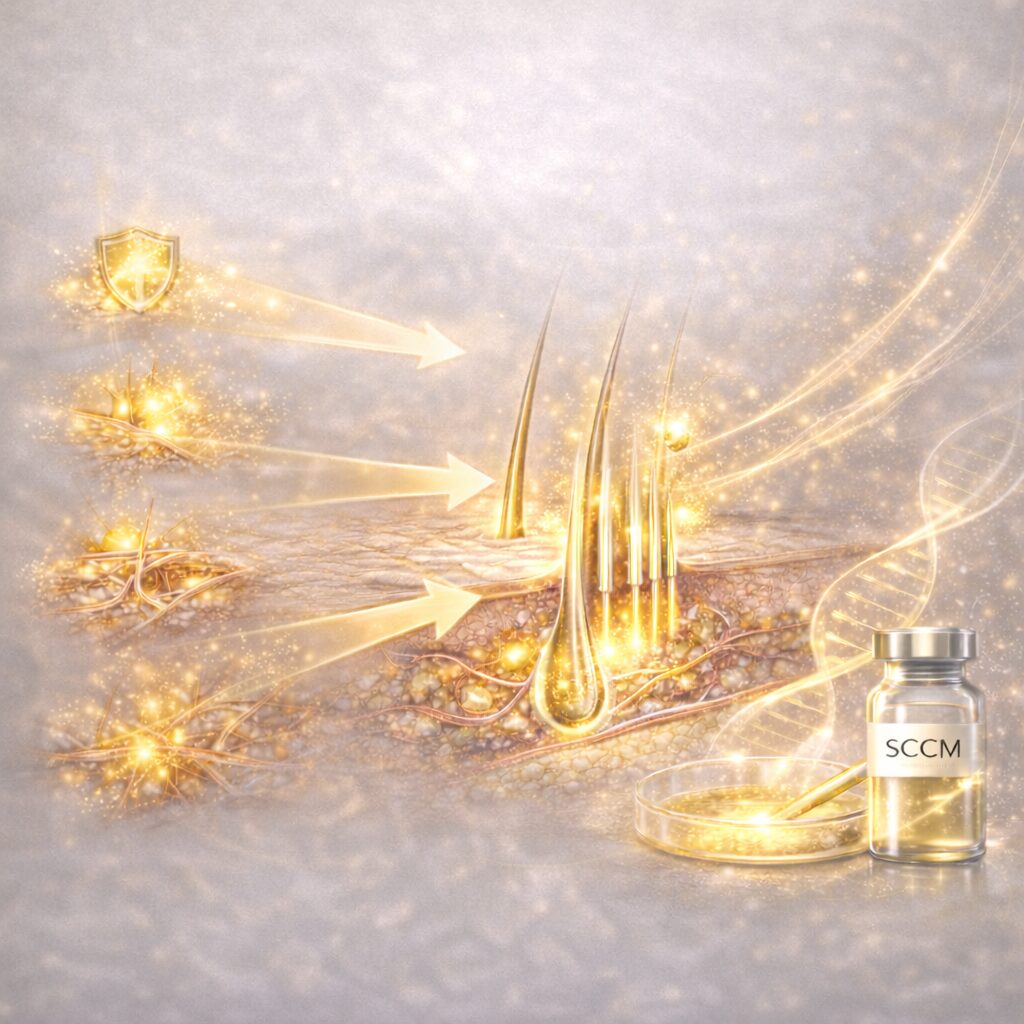
“Hats Cause Baldness” — Is It True? The Limits of the Medical Evidence and Where Stem Cell Conditioned Media Comes In
The key point here is that, at present, there is no clear medical evidence that headwear by itself directly causes AGA. AGA is driven mainly by genetic susceptibility and male-hormone metabolism, and is not a disease that arises from wearing hats. However, in people who already have AGA or female-pattern hair loss (FAGA), an added burden of poor scalp environment caused by hats may very well accelerate progression. When thinking about treatment with stem cell conditioned media, understanding this double structure of “genetic predisposition + environmental load” is essential.
“Pressure-Type” Hair Loss That Can Be Confused with Traction Alopecia
Traction alopecia, well known from tight partings and ponytails, develops when persistent mechanical stimulation is applied to the anchoring zone of the follicle. When a helmet’s chin strap or a hat’s rim presses the same spot day after day for years, miniaturization of follicles at the hairline can be observed clinically. The condition is essentially reversible in its early stages, but if left untreated for many years the follicle itself may become scarred and the change may no longer be reversible — which is why early intervention is preferable when symptoms are noticed.
The Vicious Cycle Between Folliculitis, Seborrheic Dermatitis and a Damaged Scalp Environment
Folliculitis and seborrheic dermatitis that recur in a hot, humid scalp drive chronic perifollicular inflammation, shortening the hair cycle and producing hairs that grow only “thin” and “short.” This is not a “more shedding therefore thinner” pattern but a “hair cannot grow thick and long, so it stops being visible” type — and clinically it very often coexists with AGA. The clinical guidelines published by the Japanese Dermatological Association medically organize the relationship between such inflammatory factors and the hair cycle, supporting the importance of improving the scalp environment.
Protecting the Scalp Environment in Daily Life, and Stem Cell Conditioned Media as a Regenerative-Medicine Option
The scalp burden imposed by hats and helmets cannot be completely avoided by everyone in daily life. Workers who must wear a helmet on the job, athletes who never skip a cap, women who wear hats for UV protection — in each of these situations, what matters is to combine a realistic approach to protect the scalp environment with a regenerative-medicine approach that works directly on the follicle. The starting point of practical hair-loss prevention is not “never wear a hat again,” but “how to protect the scalp while still wearing one.”
Daily Scalp-Environment Management You Can Actually Do
Choose breathable fabrics, avoid wearing the same headwear for too many consecutive hours, wash your hair promptly after sweating, and leave some room in the sizing to reduce pressure — even these basic measures can meaningfully reduce scalp heat and compression. For people prone to seborrheic dermatitis, using an antifungal shampoo a few times per week can also help. Keeping the inside of the hat itself clean is another point that should not be forgotten, because a cap that continues to be worn with sweat and sebum soaked into the lining becomes a perfect substrate for Malassezia.
Stem Cell Conditioned Media That Acts Directly on the Follicle
For hair loss that progresses despite these measures, or for follicles whose scalp environment has been chronically damaged by years of headwear, a regenerative-medicine approach becomes an option. The stem cell conditioned media used at AVAN TOKYO contains hundreds of growth factors, cytokines and exosomes secreted by mesenchymal stem cells, and is expected to act directly on the follicular microenvironment. It contains signaling molecules involved in follicular angiogenesis and anagen prolongation such as VEGF, IGF-1 and HGF, which is one reason it can give exhausted follicular stem cells a trigger for regeneration. Combined with Morpheus8 drug delivery, it is also possible to design a treatment that delivers the stem cell conditioned media into the deeper dermis of the scalp.
You do not have to give up hats and helmets entirely. Rather, by combining daily care that protects the scalp environment with regenerative medicine that acts directly on the follicle, it is possible to design a realistic strategy that protects the hair without changing your lifestyle. If you have concerns about your scalp or hair, the best starting point is to consult a specialist and obtain an objective assessment of your scalp environment and follicular state. You can also find more perspectives in the related columns on hair regenerative medicine here.
──────────────
【監修】森脇 進 / Shin Moriwaki (Supervising Physician)
Member, Japan Society of Aesthetic Surgery (JSAS) / Member, American Academy of Aesthetic Medicine
U.S. Medical Licensure Qualification (ECFMG Certificate)
──────────────
📍AVAN TOKYO Ginza Hair Regenerative Medicine
English / 中文 / Tiếng Việt available
Please feel free to contact us via DM / LINE / Website / Phone.