


Restarting Hair Regenerative Treatment with Stem Cell Conditioned Media After a Few Months’ Gap — From Scratch or From Where You Left Off? A Hair-Cycle Perspective2026.07.10
“I couldn’t come in for two or three months because work was busy.” “Six months passed after I moved.” — Patients who have started hair regenerative medicine with stem cell conditioned media often ask about how to come back. When restarting an interrupted course, most people wonder whether the effect so far has “reset to zero,” and whether they must begin all over again from the induction phase. The honest answer is that, depending on how long the gap was and the current state of the scalp, some cases can be picked up “from where you left off,” while others need something closer to a “fresh start.” In this article, Dr. Moriwaki organizes what happens to the hair environment during the gap from the perspective of the hair cycle, and offers a medical framework for deciding how to resume.
Key Points of This Article
・The effect of stem cell conditioned media may linger for several months after treatment stops, but it gradually fades.
・If the gap is within three months, a “pick up from where you left off” design is realistic; a six-month to one-year gap leans toward “rebuilding.”
・The hair cycle turns over roughly every two to six years, so the impact on anagen shortening also returns gradually during the gap.
・On restart, begin with an objective status check — micro-scope, standardized photos, and self-reported symptoms — to identify “which point” you have returned to.
・The combination status of oral and topical medications and overall systemic condition should be reviewed at the same time; both influence how efficiently the restart goes.
What Happens to the Hair Environment When Treatment Is Interrupted
Stem cell conditioned media is considered to work by having growth factors, cytokines, and small vesicles (exosomes) administered to the scalp act on the microenvironment around hair follicles, supporting maintenance of the anagen phase through effects on dermal papilla cell metabolism, angiogenesis, and anti-inflammatory action. However, this action does not “continue forever from the moment of injection”; the administered growth factors are metabolized over several days to a few weeks and leave indirect ripples on the hair-cycle rhythm.
Different “Ways of Returning” at 3 Months, 6 Months, and 1 Year
If only about three months have passed since interruption, in many patients the improvement of the scalp environment achieved by the most recent sessions still lingers as an “after-effect.” Even under the microscope, it is not common to see abrupt worsening of indicators such as hair diameter or the number of hairs per follicular unit. Beyond six months, however, hairs that had been pushed into a prolonged anagen phase begin to shift into catagen and telogen, and thin, short hairs can again become noticeable. When the gap exceeds a year, it is not unusual to have returned to a state close to before treatment began. Individual differences are large, and the way you return varies with AGA progression speed, age, and lifestyle.
The Hair-Cycle Reset That Begins the Moment You Stop
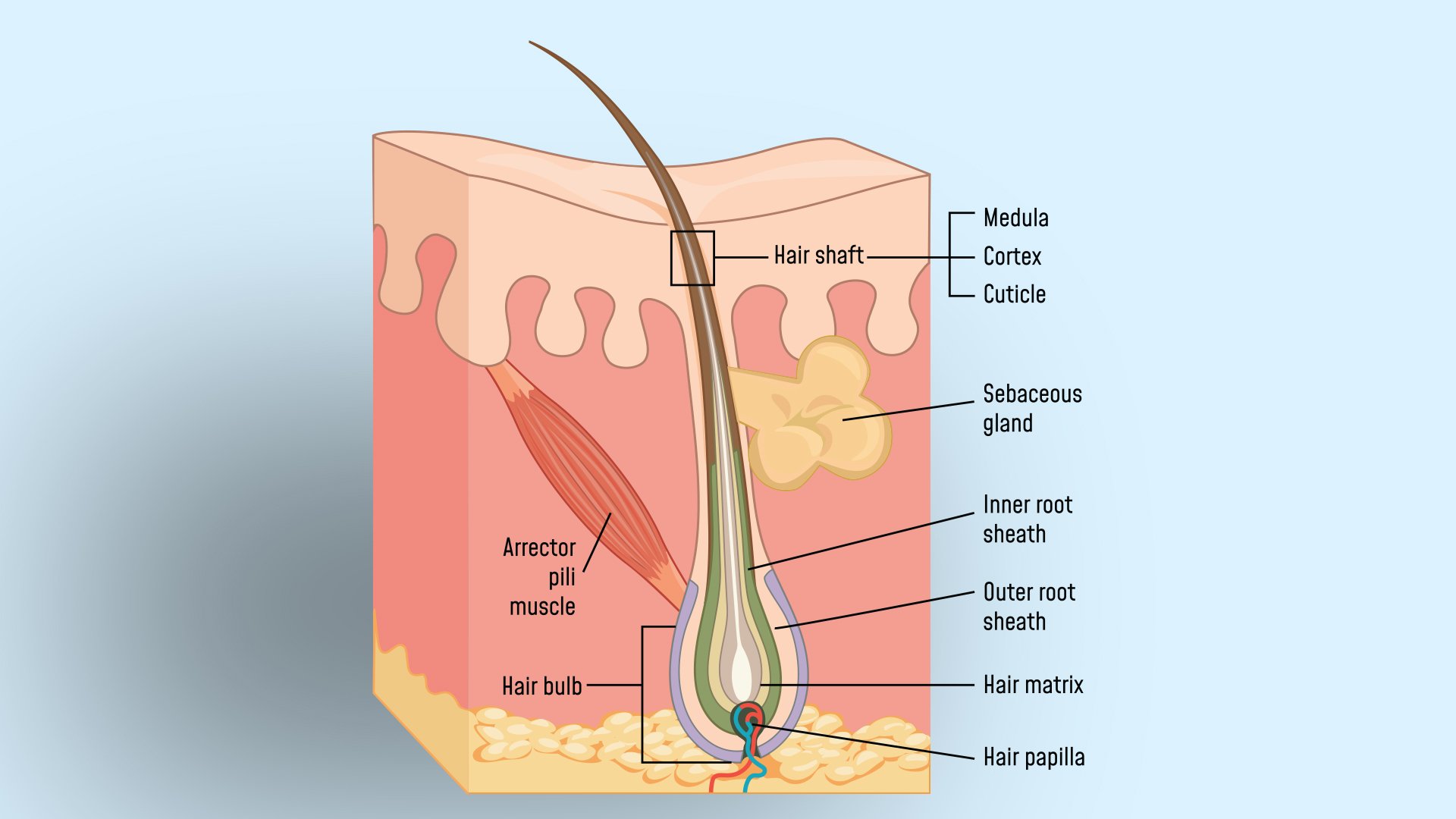
Hair grows in a cycle of anagen, catagen, and telogen, and administration is thought to act in the direction of prolonging the anagen phase. When treatment is stopped, this prolongation effect is gradually lost and the hair cycle returns to its “original pace” — the anagen shortening driven by AGA. In other words, stopping treatment does not suddenly cause everything to collapse; changes appear little by little, along the rhythm of the hair cycle. Understanding this time lag helps you avoid panic when resuming.
Restarting Stem Cell Conditioned Media Treatment Is Not “From Zero”
What we want to convey to those anxious about restarting is that the previous administrations are not entirely wasted. The follicles themselves remain, and the scalp — the “soil” — carries the history of having been cultivated once. When stem cell conditioned media is delivered again here, some patients see the response return relatively smoothly compared with the very first course. That said, this does not apply to everyone; it varies with individual differences, the length of the gap, and lifestyle during that period. On the premise that no guarantee of effect is offered, we design realistically.
The Idea That Follicles Carry a “Memory of Treatment”
In the field of basic research, it is suggested that stimulation by growth factors may leave changes lasting for a certain period in the cells surrounding hair follicles. Clinically as well, patients who responded well before often show a similar tendency after restart. However, this is not a guarantee of “always coming back.” In those whose AGA has clearly progressed during the gap, or whose scalp environment has become significantly disturbed, the previous protocol alone may not be enough.
Protocol Design and Evaluation Axes at Restart
When restarting, we begin by objectifying the current state. Standardized photographs, hair-diameter measurement under the micro-scope, self-perceived shedding count, and subjective sense of frontline or crown recession — combining these, we check how far you have returned compared with “the point at which treatment was stopped.” If the gap is short and status is largely maintained, the design can be an extension of the previous maintenance protocol. If a marked return is present, it is realistic to re-administer at intervals close to the initial induction phase and to assess the response at three to four months. You can also refer to our hair regenerative medicine column list for how we think about evaluation and combined therapies.
What to Check Before Restarting
During the gap, the scalp is not the only thing that has changed. Here are points we want to check at the moment of restart.
Scalp Status and Overall Body Condition
If the scalp is disturbed by inflammation, seborrhea, or folliculitis, calming the skin comes first. In terms of lifestyle, we check whether iron deficiency, thyroid changes, weight fluctuation, or chronic sleep debt have been added during this period. For guidelines on AGA treatment and information on skin diseases, the general-audience resources of the Japanese Dermatological Association are also useful references. When the systemic condition remains disturbed, the response we would normally expect becomes harder to draw out.
Reviewing the Combination with Oral and Topical Treatments
If finasteride and topical minoxidil were also stopped during the gap, the pace of AGA progression will have moved closer to the pre-treatment state. In such a case, restructuring “progression suppression” via oral and topical medications together with “lifting the hair-follicle environment” via stem cell conditioned media helps to smooth the restart. Conversely, those who kept only the oral medication often maintained overall hair volume, and the restart tends to be smooth. We design a sustainable combination tailored to your goals and endpoint.
Interrupting treatment is neither unusual nor a failure. As the phase of your life changes, the pace of visits naturally changes with it. What matters is that at restart, we rebuild not from “the same place as before” but from “a starting point that fits your scalp today.” Rather than rushing, measure the current state first and then decide the next move — that, we believe, is the realistic way to stay engaged with hair treatment over the long term.
Frequently Asked Questions
Q. I interrupted the treatment for about a year. Can I still expect effects?
With an interruption of around one year, the follicles themselves often remain, and there are cases where a response is obtained after restart. However, because there is individual variation depending on AGA progression and the scalp environment, it is realistic to first perform a status assessment and then re-introduce at intervals close to the initial course. Effects cannot be guaranteed, but there is no need to give up either.
Q. Should the protocol on restart be the same as at the beginning?
If the gap is within three months, the previous maintenance protocol can often simply be extended. If the gap is six months to one year, a realistic approach is several sessions at intervals close to the induction phase before shifting to maintenance. We adjust to each patient’s scalp findings and lifestyle.
Q. I feel AGA has progressed during my break. Is it too late?
As long as the follicles remain, there is room to again suppress progression with a combination of stem cell conditioned media, oral and topical medications, and to lift the hair-follicle environment. However, growing new hair in areas that have been fully scarred or where follicles have been lost is difficult. Suitability is judged at examination.
Q. I kept only the oral medication. Is restarting the conditioned media necessary?
For patients who have suppressed progression with oral medication, restarting the conditioned media adds a layer of “not only protecting but also actively conditioning the hair-follicle environment.” If you are aiming for higher density or improved hair quality, restart is worth considering. We design in line with your goals and endpoint.
Q. Are blood tests always necessary before restarting?
They are not mandatory, but when the interruption exceeds six months we recommend checking ferritin, thyroid function, and general blood status. When systemic metabolic status is disturbed, the expected response is harder to draw out. Judgment is made at consultation.
──────────────
Supervising Physician: Shin Moriwaki, M.D.
Member, Japan Society of Aesthetic Surgery (JSAS) / Member, American Academy of Aesthetic Medicine
ECFMG Certificate
──────────────
📍AVAN TOKYO Ginza Hair Regenerative Medicine
English / 中文 / Tiếng Việt Available
Inquiries welcome via DM / LINE / Website / Phone.