


Where Does Normal Hair Shedding End and Hair Loss Begin? Rethinking the 100-Hairs-a-Day Rule with Stem Cell Conditioned Media2026.06.15
Many people feel uneasy every time they see hair collecting in the shower drain or scattered on their pillow, wondering whether the amount is normal or an early sign of thinning. A well-known guideline says that losing up to 100 hairs a day is normal, but this number is widely misunderstood. In hair regenerative medicine, the real boundary is not the number of shed hairs but the qualitative change in those hairs. Misreading this can mean quietly letting hair loss progress for years. This article reviews how to distinguish normal shedding from pathological hair loss and explains why stem cell conditioned media has become an important option in our field.
Where the “100 hairs a day” rule actually comes from
An adult scalp carries roughly 100,000 hairs, and about 10–15% of them are in the resting (telogen) phase at any time. Because hairs naturally shed at the end of this phase, losing 50–100 hairs per day is a physiological event, not a disease.
Why the number alone is misleading
That figure is only an average. It can rise sharply with season, postpartum changes, rapid dieting, or several months after a high fever. In autumn, daily shedding can temporarily increase by around 1.5 times. What truly matters is not how many hairs fell out but what kind of hair is growing back. If thick, long hairs are being replaced by thin, short ones, miniaturisation of the follicle is already in motion — and that signal is invisible if you only count.
The qualitative boundary
In our clinic, we ask patients to look at the root of the shed hairs. If many of them have a tapered tip and a tiny, irregular bulb, the anagen phase is shortening and the proportion of telogen hairs is increasing. Treatment guidelines for AGA are organised by the Japanese Dermatological Association, and they recommend assessing hair diameter distribution, scalp findings, and cycle imbalance — not just the raw daily count. The clinical question is not “how many hairs?” but “what kind of hairs?”
Recognising abnormal shedding and where stem cell conditioned media fits in
Once certain signs converge, the situation is no longer simple physiological shedding. This is the inflection point where stem cell conditioned media starts to play a real clinical role.
Signs of progressive hair loss
The following changes, lasting longer than three to six months, suggest declining follicular function:
・The part line or crown looks more see-through than before
・Short, thin, vellus-like hairs are increasing on the front and top
・Many short hairs are found on the pillow each morning
・The volume when you tie up the hair feels about half of what it used to be
・Styling no longer holds, with loss of body and resilience
These are signs that signalling to follicular stem cells has weakened, and that anagen-phase hairs are shedding before they can re-enter the next cycle.
Diffuse hair loss vs AGA
Diffuse hair loss, more common in women, causes an even loss of volume across the crown and is multifactorial — hormonal changes, iron deficiency, undernutrition, thyroid dysfunction. AGA, more typical in men, progresses locally from the hairline or vertex. In both cases, daily shedding numbers cannot tell you how far it has gone — only an intervention at the follicle itself can.
Stem cell conditioned media as a regenerative option
Once the qualitative warning signs appear, oral DHT blockers or topical minoxidil alone are often not enough. The follicular environment itself needs to be rebuilt. This is why stem cell conditioned media has drawn so much attention in the last few years.
Restoring signalling to follicular stem cells
Stem cell conditioned media is the secretome released by cultured mesenchymal stem cells, containing growth factors, cytokines, and exosomes. Delivering signals such as VEGF, IGF-1, HGF, and FGF-7 to the bulge region — where follicular stem cells reside — supports the return of miniaturised follicles to the anagen phase. This is not simply “growing hair”; it is redesigning the environment in which hair grows.
Combination with drug delivery
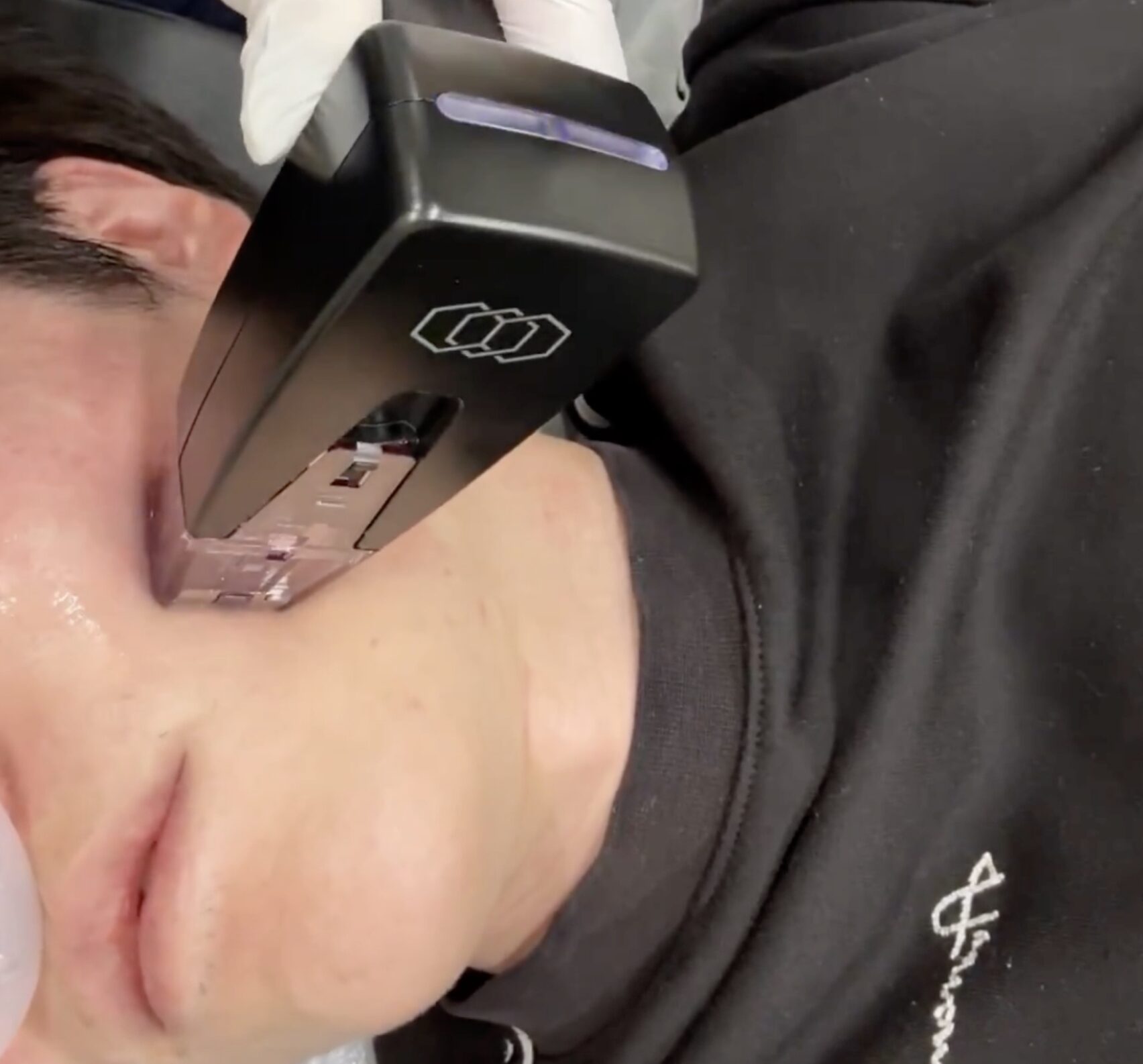
The scalp has a thick keratin barrier, so topical application alone does not reach the deeper layers. At our clinic we combine stem cell conditioned media with Morpheus8 microchannels to deliver it from the dermis down around the follicle. This approach improves the scalp environment in a way that oral medication cannot, and it halts the qualitative deterioration of shedding. Stem cell conditioned media is most realistic not as a standalone therapy but as a foundational treatment that rebuilds the hair cycle and the scalp environment together.
Summary
The “100 hairs a day” rule is a reassuring benchmark, but it can hide the real signs of progressive hair loss. What matters is not the number but the thickness, length, and root shape of the shed hairs, along with see-through scalp, body, and resilience. When these qualitative signs align, that is the moment to consider regenerative options including stem cell conditioned media. Acting before follicles are permanently lost dramatically widens the range of treatment choices.
See related columns on hair regenerative medicine
──────────────
Supervising Physician: Shin Moriwaki, MD
Member of the Japan Society of Aesthetic Surgery (JSAS) / Member of the American Academy of Aesthetic Medicine
ECFMG Certificate
──────────────
📍AVAN TOKYO Ginza Hair Regenerative Medicine
English / 中文 / Tiếng Việt supported
Consultations available via DM / LINE / Website / Phone.