


What Are Hair Follicle Stem Cells? — The True Protagonists of Hair Growth2026.05.10
“Even with minoxidil, my hair isn’t getting any thicker.” “I’ve kept up with oral medication, but the volume on top hasn’t come back.” These are voices we hear in the consultation room more often than you might think.
Behind such concerns lies a critical actor that has long been overlooked in the world of hair-loss treatment.
That actor is the hair follicle stem cell.
It is no exaggeration to call hair follicle stem cells the true protagonists of hair growth.
If you want to understand the mechanism of hair growth at its root, you simply cannot bypass these cells and the role they play.
What Exactly Are Hair Follicle Stem Cells?
A hair follicle is a tiny, factory-like structure inside the scalp that produces a single strand of hair.
Near the upper portion of this follicle lies a small population of specialized cells, quietly waiting for their cue. These are the hair follicle stem cells.
The “Command Center” Inside the Follicle
Hair follicle stem cells reside in a region known as the “bulge” — located just below the sebaceous gland.
This area is well protected from UV exposure and physical irritation, functioning as a kind of safe zone within the scalp.
Most of the time these stem cells stay dormant. But when the signal to begin a new growth phase arrives, they wake up, multiply, and differentiate into the matrix cells that actually build the hair shaft.
In other words, hair follicle stem cells do far more than “grow hair.” They act as a command center that decides when and how much hair the follicle should produce.
Only when these cells function properly can thick, long hairs continue to be generated cycle after cycle.
How They Differ from Matrix Cells
A common point of confusion is the difference between hair follicle stem cells and matrix cells.
Matrix cells sit at the very base of the follicle and divide rapidly, physically constructing the hair shaft itself. They are, in effect, the workers on the construction site.
Hair follicle stem cells, by contrast, are the upstream source that gives rise to those workers.
If the stem cell pool becomes depleted or loses its function, matrix cells stop being replenished.
The follicle itself shrinks, and only fine, vellus-like hairs are able to grow.
The progressive thinning seen in AGA (androgenetic alopecia) is, at its core, deeply connected to this decline in hair follicle stem cell function.
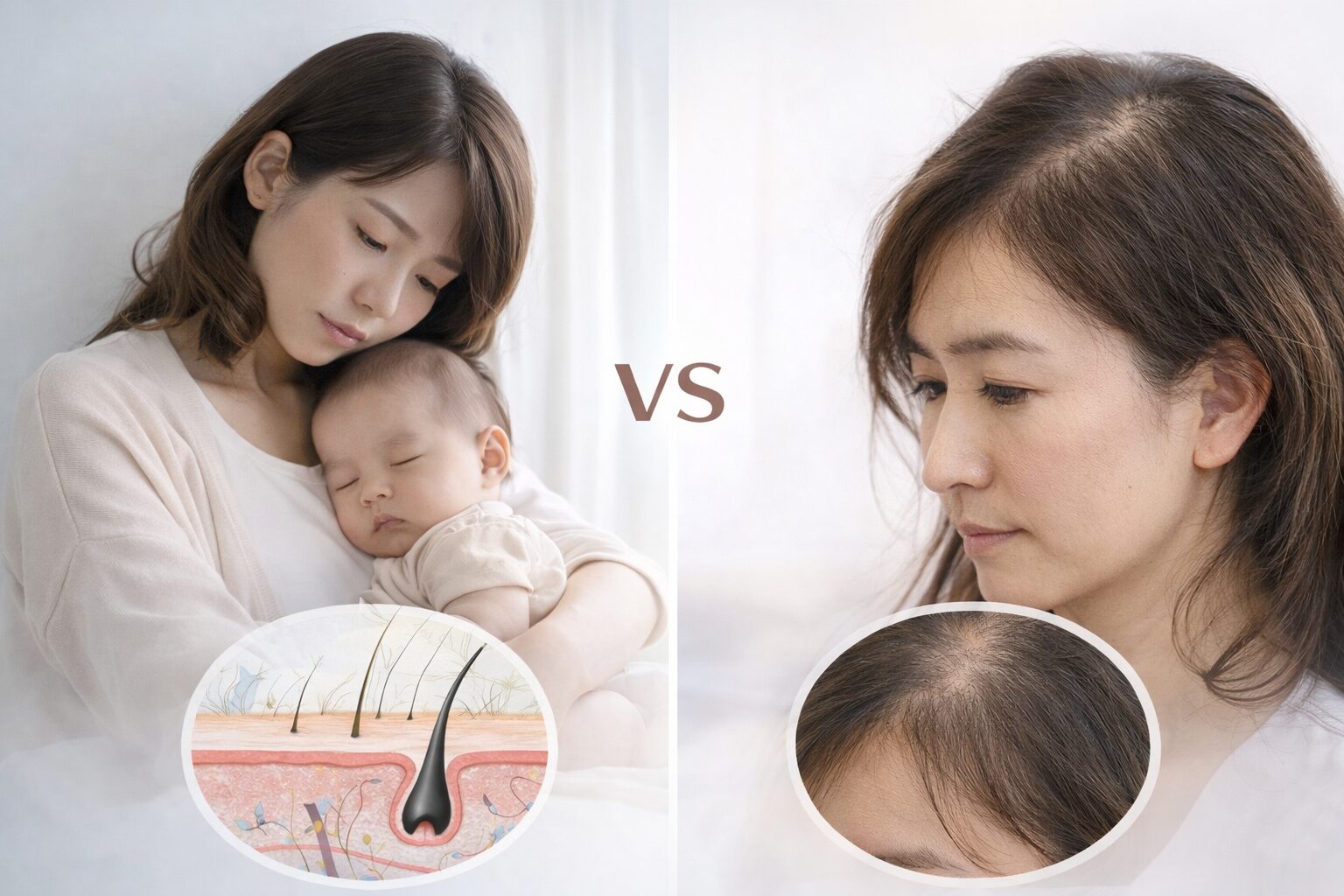
Why Hair Follicle Stem Cells Are the Key to Hair Growth
Conventional AGA treatment has centered on suppressing male hormones and improving scalp blood flow.
These approaches absolutely have their place — but they do not act on the hair follicle stem cells directly.
This is precisely why, in recent years, regenerative medicine has shifted its focus toward how to protect and reactivate these cells.
How Do You Wake a Dormant Stem Cell?
Hair follicle stem cells gradually become harder to wake due to aging, chronic micro-inflammation, oxidative stress, and poor scalp circulation.
When dormancy drags on, the anagen (growth) phase shortens, and hairs are shed before they can fully mature.
Over time, this is what people experience as “my hair has thinned overall” or “my hair has lost its body.”
This is where the growth factors and cytokines contained in stem cell conditioned medium come into focus.
Factors such as EGF, FGF, and VEGF are believed to promote angiogenesis around the follicle and send a clear “wake-up signal” to dormant hair follicle stem cells.
Rather than suppressing biology with drugs, regenerative medicine seeks to reawaken capacity that the body already possesses — that is its essence.
The Idea of “Protecting” Hair Follicle Stem Cells
Equally important is the perspective of not depleting these cells in the first place.
Leaving severe inflammation or itching untreated for long periods, or aggressively scrubbing the scalp, gradually damages the bulge stem cell population.
Extreme nutritional deficits, sleep deprivation, and chronic stress also degrade the quality of the stem cell niche — the microenvironment that houses them.
At AVAN TOKYO, alongside direct approaches with conditioned medium, we place equal weight on controlling scalp inflammation and carefully reviewing each patient’s lifestyle.
Once hair follicle stem cells are significantly lost, restoring them is extremely difficult.
Combining “treatments that grow hair” with “treatments that prevent further loss” is the true key to long-term maintenance of hair growth.
Conclusion
Hair follicle stem cells are the true protagonists supporting the entire process of hair growth.
As long as these cells remain dormant or diminished in number, no amount of stacked treatments will deliver the results patients are hoping for.
Conversely, if the stem cells can be restored to healthy function, hair has the potential to recover the thickness and length it once had.
The age of treating hair loss only by “suppressing hormones” and “improving blood flow” is coming to an end.
How well we can protect the hair follicle stem cell — and how well we can wake it from dormancy — will define the next generation of regenerative-medicine-based hair growth therapy.
Understanding what is actually happening on your own scalp is the first step toward effective treatment.
We encourage you to consult with a specialist and revisit your hair loss through the lens of hair follicle stem cell biology.
📍AVAN TOKYO Ginza Stem Cell & Regenerative Medicine Clinic
AVAN TOKYO Ginza Hair Regenerative Medicine
English / 中文 / Tiếng Việt Available
For reservations and consultations:
DM / LINE / Website / Phone