


Hair Quality and Resilience Change Before Density Does — Incorporating the “Order in Which Change Appears” as an Evaluation Metric in Stem Cell Conditioned Media Hair Treatment2026.07.13
“I started hair treatment, but I can’t see any change in the mirror.” — many patients who tell us this are actually missing the earliest signs that treatment is beginning to take hold. The effects of hair treatment do not first appear as increased density; they emerge earlier as changes in hair quality and resilience. Even with hair treatment using stem cell conditioned media, understanding this “order” is an important perspective that helps prevent premature discontinuation. In this article, Dr. Moriwaki focuses on the quality and resilience changes that appear before density, and outlines how to evaluate the treatment course.
Key Points of This Article
・In hair treatment with stem cell conditioned media, qualitative changes such as “texture,” “resilience,” and “lift at the root” tend to appear before density increases
・Anagen (growth phase) extension and reversal of follicle miniaturization occur first; there is a time lag equal to one hair cycle before the change is recognized as visible density
・The premature judgment of “density hasn’t increased, so it isn’t working” leads to interrupting treatment that should be continued
・It is important to evaluate progress by combining multiple indicators: fixed-point photographs, hair diameter, hair count per follicle, and more
・Subjective changes noticed by the patient — photos, tactile feel, ease of styling — are also medically meaningful signs
Why Hair “Quality” Changes Before Density
Most hair thinning always passes through a stage of becoming “thinner, shorter, and weaker” before the hair disappears completely. “Follicle miniaturization,” central to AGA (male pattern baldness) and FAGA (female pattern baldness), is the phenomenon in which thick, robust terminal hairs regress into thin, short, vellus-like hairs. Within the hair cycle, the anagen phase — which should normally last several years — shortens progressively to several months to about one year as the condition advances.
When treatment improves the follicular microenvironment, this process slowly begins to move in reverse. However, thick terminal hairs do not suddenly grow anew. Change begins where existing hairs, in their next cycle, become a little thicker, a little longer, and a little more resilient. As a result, what patients themselves first notice are qualitative changes in hair texture and resilience — “the lift at the root feels different,” “the flat feeling along my part is gone.”
Visible Density Appears Only After One Full Hair Cycle
Before hair becomes visibly “denser,” it must pass through catagen and telogen phases, and the next anagen-phase hair must grow out to a certain length. This one round of the hair cycle takes several months. The “3-6 month” evaluation guideline often mentioned in hair treatment reflects this timeline. Understanding that there is a time lag before density becomes recognizable allows patients to accept early qualitative changes as genuine treatment signs.
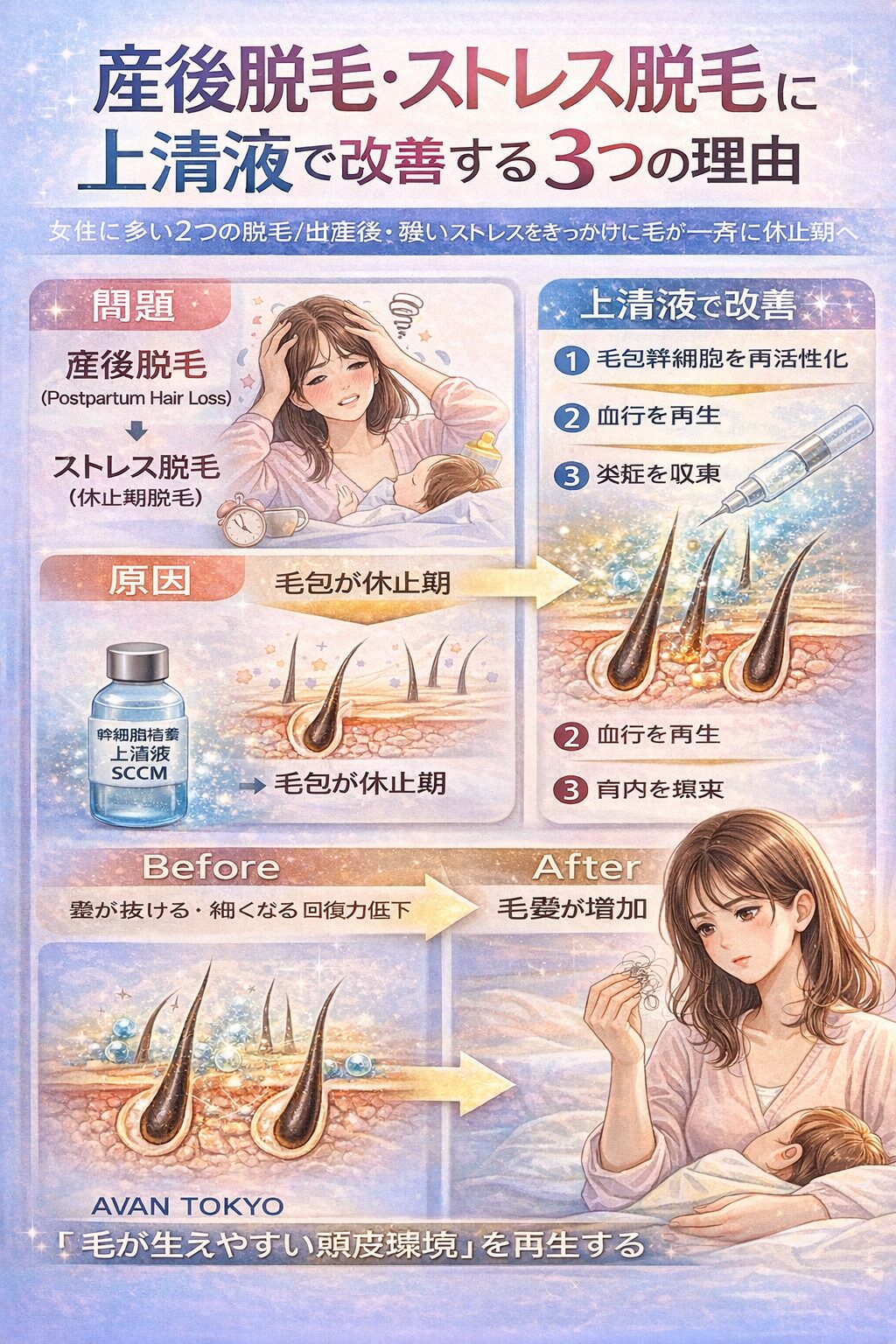
How Stem Cell Conditioned Media Acts on Hair Quality and Resilience
Stem cell conditioned media contains various growth factors (VEGF, IGF-1, HGF, FGF, etc.), cytokines, and exosomes secreted by stem cells during culture. When these components reach the area around the follicle, they are thought to send simultaneous, multi-target signals to dermal papilla cells, follicle stem cells, and microvasculature.
Action on the Dermal Papilla and Changes in Hair Diameter
Dermal papilla cells are the command center that determines hair thickness and the length of the anagen phase. When growth-factor signaling activates the dermal papilla cells, there is room for the hair produced in the next cycle to become slightly thicker and slightly longer than before. Under microscopy, hair count per follicle and variability in hair diameter gradually become more uniform — this is an objective, early sign of “hair quality improvement.”
Scalp Microcirculation and Oxygen/Nutrient Supply to Follicles
Angiogenic factors such as VEGF are thought to act by regulating the microvascular environment around the follicles. If blood flow improves, more oxygen and nutrients reach the follicles, and more hairs may be able to complete a full anagen phase. That said, this is not the simplistic story that “increasing blood flow will definitely grow hair”; it only carries meaning when a corresponding response occurs on the follicular side — a nuance we want to include honestly.
The Condition of the Scalp Environment Itself
Chronic microinflammation and oxidative stress are thought to promote follicles entering the telogen phase. The anti-inflammatory signals contained in stem cell conditioned media may act to normalize a “hard-to-heal inflammatory environment” on the scalp. Changes the patient can feel — softness of the scalp on touch, sebum balance, reduction in itching — also carry meaning.
How to Incorporate the “Order of Change” Into Your Evaluation Metrics
When hair treatment evaluation relies only on the impression from the mirror, it tends to drift toward the subjective sense that “nothing seems to have changed.” Especially with stem cell conditioned media — because change begins from qualitative shifts — it is important to follow progress with multi-layered indicators.
First, we take fixed-point photographs. Photographing 3-4 angles of the crown, hairline, and side of the head at the same angle, lighting, and distance once a month allows for comparison that does not rely on memory. Next, receiving periodic microscopic measurement of hair diameter and count per follicle at a medical facility allows patients to capture invisible micro-level changes.
Subjective indicators the patient can notice are also important. Sensations such as “the morning lift feels different,” “it’s easier to give volume when styling,” and “there seems to be less hair loss when I shampoo” can be treated as signs that capture qualitative change. By combining numerical data, photographs, and subjective sense, we can prevent the failure of prematurely stopping treatment before density visibly changes. Related explanations on hair regenerative medicine can be found at our hair regeneration column archive.
Avoiding Excessive Expectations, and Being Honest About Limits
On the other hand, stem cell conditioned media is not a cure-all. In areas where follicles have already become scarred, or in cases of very advanced AGA, qualitative improvement itself may not occur. Additionally, the degree of change varies between individuals, and progression stage, age, lifestyle, and the presence or absence of combined treatments significantly affect outcomes. For general guidance on AGA treatment, please also refer to the guidelines of the Japanese Dermatological Association.
That is exactly why sharing with your physician at the first visit “which indicators, by when, and to what extent you are aiming for change” is the first step toward hair treatment you will not regret. When you know the order of change, you will not miss the qualitative signs, and you can quietly wait for the next density-level shift.
Frequently Asked Questions
Q. When can I feel changes in hair quality with stem cell conditioned media hair treatment?
It varies between individuals, but many patients notice qualitative changes — the way hair lifts at the root, the impression of the parting, ease of styling — within about 2-3 months from the start of treatment. It generally takes several additional months for change to be recognized as increased density.
Q. Is it meaningful if only hair quality changes without an increase in density?
Qualitative change is considered a sign that follicles are beginning to respond in a favorable direction. The process by which thinning hairs gradually regain thickness is an important preparatory stage before density change. It is worth continuing to observe rather than judging “it isn’t working” too early.
Q. Should I have microscopic evaluation every visit?
It does not need to be every visit, but observing at fixed points before starting treatment and then every few months allows objective confirmation of invisible changes in hair diameter and count per follicle. Combining photographs, numerical data, and subjective sense is important.
Q. My hair quality has changed, but I don’t feel a reduction in hair loss. Why?
Qualitative improvement and reduction in hair loss do not necessarily occur at the same time. Telogen hairs that cycle out midway through the hair cycle may even temporarily increase in the early phase of treatment (initial shedding). Please follow progress over a few months.
Q. Any tips for continuing treatment without excessive expectations?
At your first visit, decide together with your physician “which order of changes to watch for” and “the frequency of evaluation.” Rather than watching change per single session, record photographs, numerical data, and subjective sense on the premise of following progress across multiple sessions — this enables calmer judgment.
──────────────
[Supervising Physician] Shin Moriwaki, MD (Supervising Physician)
Member, Japan Society of Aesthetic Surgery (JSAS) / Member, American Academy of Aesthetic Medicine
ECFMG Certificate
──────────────
📍AVAN TOKYO 銀座 毛髪再生医療
AVAN TOKYO Ginza Hair Regenerative Medicine
English / 中文 / Tiếng Việt available
Inquiries welcome via DM / LINE / Website / Phone.