


When postpartum hair loss won’t stop even after a year, it may be “postpartum thyroiditis” — the thyroid pitfall to check before writing it off as ordinary shedding, and where stem cell conditioned media fits in2026.07.08
Sudden shedding that begins three to four months after childbirth is usually explained as “postpartum hair loss” and settles on its own. However, if postpartum hair loss continues beyond one year and is accompanied by palpitations, profound fatigue, weight fluctuations, or a low mood, an underlying autoimmune inflammation called postpartum thyroiditis may be hidden behind it. Postpartum hair loss itself is a reversible phenomenon explained by pregnancy hormone changes and hair-cycle synchronization, but when thyroid inflammation is layered on top, simply waiting rarely puts recovery back on track. In this article, we honestly outline how to distinguish postpartum hair loss from postpartum thyroiditis, and how stem cell conditioned media is positioned as an option when rebuilding the scalp environment, from the perspective of the supervising physician.
Key points of this article
・Ordinary postpartum hair loss usually resolves within 6 to 12 months; if it continues past that point, postpartum thyroiditis is worth suspecting
・Postpartum thyroiditis develops 3 to 12 months after delivery and typically follows a biphasic course of hyperthyroid → hypothyroid → recovery
・Evaluating TSH, FT4, FT3 plus anti-thyroid peroxidase antibody (TPOAb) helps separate postpartum hair loss from a thyroid cause
・When thyroid dysfunction overlaps with postpartum hair loss, the hair-cycle disturbance drags on, and combining internal medicine with scalp environment care is preferable
・Stem cell conditioned media can be considered as a supportive option that acts on scalp blood flow, growth-factor signaling, and micro-inflammation
Before writing it off as “postpartum hair loss” — the blind spot of postpartum thyroiditis
Postpartum shedding is not rare; roughly 40 to 50 percent of women who have given birth experience it. Estrogen, which was maintained at high levels during pregnancy, drops sharply after delivery, and many hairs that were in the growth (anagen) phase enter the resting (telogen) phase together, only to shed en masse two to four months later. Yet in our clinic we often hear, “Even one year after delivery, my shedding hasn’t decreased,” or “I’ve finished breastfeeding, but my hair volume hasn’t come back.”
What to suspect when postpartum hair loss that should resolve on its own does not
Ordinary postpartum hair loss (postpartum telogen effluvium) usually peaks 6 to 9 months after delivery, gradually calms down, and approaches its former volume within about a year — a reversible phenomenon. When there is little sign of improvement past this window, it is not merely a “matter of time.” Internal causes such as iron deficiency, vitamin D insufficiency, and thyroid dysfunction need to be considered. Postpartum thyroiditis, in particular, presents with vague symptoms that are easily dismissed as “exhaustion from childcare” or “postpartum depression,” and it is often missed as a hidden reason why the shedding drags on.
Why postpartum thyroiditis gets missed
Postpartum thyroiditis is an autoimmune thyroiditis that develops between 3 and 12 months after delivery, occurring in roughly 5 to 10 percent of postpartum women. In many cases, it first passes through a transient hyperthyroid phase, then shifts to a hypothyroid phase, and finally resolves on its own — a biphasic course. Symptoms such as palpitations, sweating, fatigue, weight change, edema, insomnia, and low mood are often shrugged off by mothers as “just part of being postpartum,” and end up buried.
Postpartum hair loss and the thyroid — why the hair cycle gets disrupted
Thyroid hormones are deeply involved in the proliferation of hair matrix cells and in maintaining the hair cycle. Basic research shows that T3 and T4 prolong the anagen phase and are also involved in hair matrix metabolism and pigment stem cell activity. When thyroid function is disturbed, the hair cycle itself becomes unstable, and postpartum hair loss can miss its “window to settle down.”
How shedding differs between the hyperthyroid and hypothyroid phases
During the hyperthyroid phase, hypermetabolism tends to make shed hairs fine and soft; during the hypothyroid phase, hair often becomes dry, loses body, and shows an overall drop in volume. In the clinic, these features frequently mix, and patients describe it as, “My hair quality has just changed somehow, and the shedding keeps going.” Identifying the cause is impossible without blood tests.
When to suspect it, and which tests to order
When shedding does not decrease beyond 6 months postpartum, or when it comes with fatigue, palpitations, or mood changes, we recommend evaluating not only TSH, FT4, and FT3 but also anti-thyroid peroxidase antibody (TPOAb) and anti-thyroglobulin antibody (TgAb). Even when TSH is within the reference range, latent autoimmunity may be progressing with positive antibodies, so it is essential to look at the hidden nutritional background — ferritin, vitamin D — in tandem.
After stabilizing thyroid function, how to rebuild the scalp environment — where stem cell conditioned media fits in
Postpartum thyroiditis is, in principle, managed through observation at an endocrinology clinic, with hormone supplementation or beta-blockers used as needed. The important point is that stabilizing thyroid function and getting the disturbed hair cycle back on a recovery track are separate layers of care.
A supportive approach that acts on the follicular environment
Even once thyroid function improves, the “share of follicles skewed toward the resting phase” persists for a while, so there is a lag before hair volume returns. During this transitional period, tending to environmental factors — scalp blood flow, growth-factor signaling, micro-inflammation — is something that can influence both the speed of recovery and the final goal line. Please also see our list of related columns on hair regenerative medicine here.
The role stem cell conditioned media is expected to play
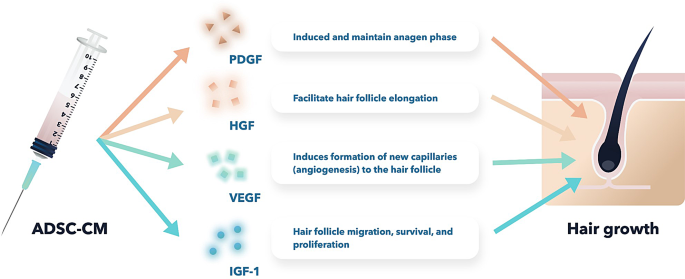
Stem cell conditioned media contains multiple growth factors such as VEGF, IGF-1, HGF, and KGF, along with miRNAs contained in extracellular vesicles (exosomes). Basic and clinical research suggests these may act on the niche environment of follicular stem cells and support the transition from telogen to anagen. However, direct efficacy for shedding associated with postpartum thyroiditis has not been established. In the clinic we carefully explain that this remains a supportive option, positioned only after prioritizing internal-medicine treatment of the thyroid. Confirmation of breastfeeding status, allergy history, and overall condition is essential; the same framework as ordinary adult AGA treatment cannot simply be applied. For guidance on general hair-loss care, publications from the Japanese Dermatological Association can also be a useful reference.
Frequently Asked Questions
Q. How long should I wait and see with postpartum hair loss?
Ordinary postpartum hair loss typically peaks 6 to 9 months after delivery and approaches its former volume by around one year for most women. If little improvement is seen past one year, or if it comes with palpitations, strong fatigue, or weight changes, we recommend seeing a physician to evaluate for internal-medicine causes such as postpartum thyroiditis.
Q. How common is postpartum thyroiditis?
It is estimated to occur in about 5 to 10 percent of women during the postpartum period — by no means rare. Because the symptoms are mild and often overlooked, however, shedding and fatigue frequently get dismissed as “just part of being postpartum.”
Q. Can scalp treatment with stem cell conditioned media be performed during breastfeeding?
Because safety during breastfeeding is not fully established, we generally recommend starting after breastfeeding has ended. Since the judgment depends on individual circumstances, timing, and health status, please discuss this frankly at the first visit.
Q. What if my thyroid function is normal but postpartum hair loss continues?
Multiple factors — iron deficiency, vitamin D insufficiency, postpartum sleep deprivation, stress — can combine and prolong hair-cycle disturbance. Stem cell conditioned media can be considered as an option to improve the scalp environment, but making the decision only after sorting out the underlying cause is the safer path.
Q. Where should I first go for care regarding postpartum hair loss?
Start with obstetrics or internal medicine for a check of thyroid function, anemia, and nutritional status. Considering scalp environment or hair-loss treatment options after that may look like a detour, but it is actually the most reliable way to move forward.
──────────────
Supervised by: Shin Moriwaki, MD (Supervising Physician)
Member, Japan Society of Aesthetic Surgery (JSAS) / Member, American Academy of Aesthetic Medicine
ECFMG Certificate
──────────────
📍AVAN TOKYO 銀座 毛髪再生医療
AVAN TOKYO Ginza Hair Regenerative Medicine
English / 中文 / Tiếng Việt available
Inquiries via DM / LINE / Website / Phone are welcome.