


Sleep Quality and Hair Loss — Growth Hormone, Hair Cycle, and the Nighttime Hair Growth Strategy with Stem Cell Conditioned Media2026.06.02
“I don’t feel rested even after sleeping,” “I keep waking up in the middle of the night” — do these sleep concerns sound familiar? In fact, there is a close medical relationship between sleep quality and hair loss. Hair is most actively produced while we sleep at night, so when sleep becomes disturbed the hair cycle itself is thrown off, leading to shedding and miniaturization. Among those who feel little benefit from AGA medication or topical hair tonics, the “nighttime hair regeneration mechanism” is often the missing piece. This article organizes the medical relationship between sleep and hair loss, and explains how regenerative medicine using stem cell conditioned media supports your nighttime hair growth strategy.
How Stem Cell Conditioned Media Supports “Nighttime Hair Regeneration” and Its Medical Link to Sleep
Hair grows from the follicle, an appendage of the epidermis. The follicle performs its most active cell division during deep non-REM sleep. In other words, “when you sleep” and “how deeply you sleep” greatly influence the thickness and density of your hair.
Growth hormone and follicular repair
Growth hormone, which peaks within the first 90 minutes after falling asleep, strongly promotes matrix cell division, protein synthesis including keratin, and tissue repair. When chronic sleep deprivation and mid-sleep awakenings continue, this secretion rhythm collapses and the follicle enters the next growth cycle without being adequately repaired and regenerated. As a result, hair becomes thinner and weaker, and shedding increases.
Autonomic nervous system, cortisol, and scalp blood flow
When sleep quality drops, the sympathetic nervous system takes the lead and cortisol, the stress hormone, remains chronically elevated. Excess cortisol constricts the capillaries of the scalp and reduces oxygen and nutrient supply to the follicle. It also induces microinflammation and is known to impair the function of hair follicle stem cells (the bulge region — the command center of hair growth).
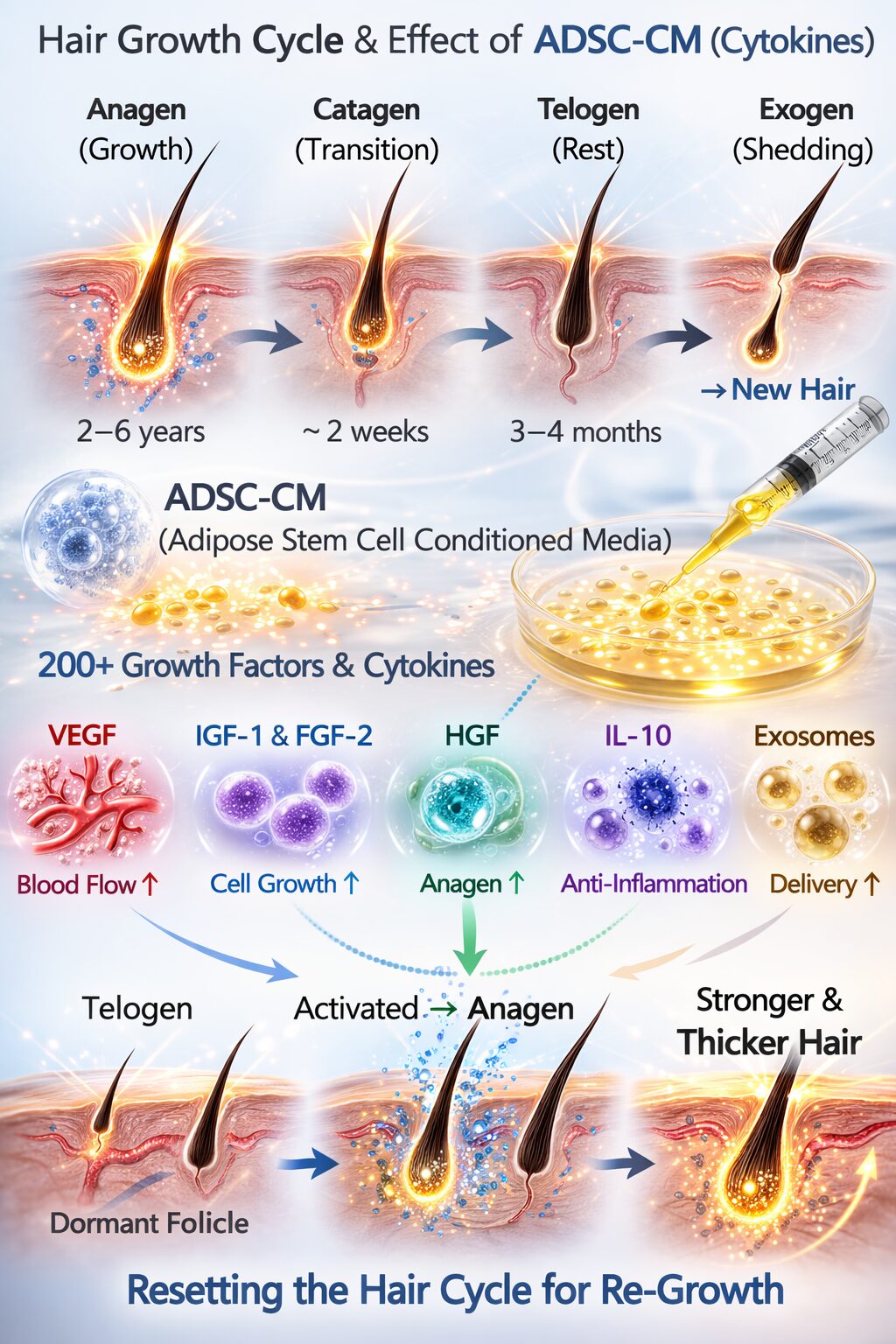
How sleep deprivation disrupts the hair cycle
Hair has a clear cycle of “anagen,” “catagen,” and “telogen.” In a healthy state the anagen phase lasts 2–6 years, growing thick, long hair. However, disturbed sleep steadily shortens this cycle.
Shortened anagen and prolonged telogen
Chronic sleep deprivation is known to push follicles in the anagen phase prematurely into catagen. Hair that should have kept growing falls out partway through. At the same time, the timing for telogen follicles to re-enter anagen tends to be delayed, and total hair volume gradually decreases. This is one of the hidden contributors to diffuse hair loss and miniaturization.
Oxidative stress and exhaustion of hair follicle stem cells
Melatonin, secreted during sleep, has powerful antioxidant action and neutralizes reactive oxygen species within the follicle. Sleep deprivation breaks down this antioxidant system and exposes hair follicle stem cells to chronic oxidative stress. When bulge stem cells age and decrease, no matter how much topical or oral medication you use, the very “source” of hair growth weakens and treatment responsiveness drops. For guidance on AGA treatment you can refer to the guidelines of the Japanese Dermatological Association.
Stem Cell Conditioned Media as a “Nighttime Hair Growth Strategy”
Improving lifestyle is fundamental, but the reality is that once follicles are already exhausted, lifestyle changes alone often cannot catch up. This is why AVAN TOKYO positions regenerative medicine using stem cell conditioned media as a way to medically reinforce “nighttime hair regeneration.”
A direct approach to the follicle via growth factors
Stem cell conditioned media contains hundreds of cytokines and growth factors directly linked to follicular activation, including VEGF (angiogenesis), IGF-1 (cell proliferation), KGF (follicle growth), and HGF (tissue regeneration). These act similarly to signaling molecules originally secreted in the body during deep sleep, making it possible to “supplement from the outside” the regenerative signals that sleep cannot fully provide. The major advantage is the ability to medically flip a direct regenerative switch on follicles exhausted by years of sleep debt.
Combination with Morpheus8 and treatment design
For stem cell conditioned media to function at its best, reliable penetration into the scalp is indispensable. At AVAN TOKYO we adopt a treatment design that combines Morpheus8 drug delivery, conveying active ingredients down to the follicle level. The micro thermal stimulation from RF improves blood flow around the follicle, increases the penetration efficiency of the conditioned media, and further draws out the regenerative response via the scalp’s wound-healing mechanisms. The strength of this combination is reaching a level of regeneration that sleep improvement alone cannot.
Summary
Sleep quality and hair loss are deeply connected through three axes: growth hormone, the autonomic nervous system, and hair follicle stem cells. “Hair grows while you sleep” is no metaphor — it is a medical fact. With lifestyle improvement as the foundation, regenerative medicine using stem cell conditioned media is a powerful option for hair loss that has already progressed. Advancing nighttime care and the medical approach as two wheels of the same vehicle, the future of your hair can certainly be changed.
View related columns on hair regenerative medicine here
──────────────
【監修】森脇 進 / Shin Moriwaki(監修医師)
日本美容外科学会(JSAS)会員 / American Academy of Aesthetic Medicine 会員
ECFMG Certificate
──────────────
📍AVAN TOKYO 銀座 毛髪再生医療
AVAN TOKYO Ginza Hair Regenerative Medicine
English / 中文 / Tiếng Việt 対応可能
ご相談は DM / LINE / Website / Phone より承っております。