


Does a Forehead Thread Lift Really Raise the Hairline? Dr. Moriwaki on Temple Tension, Insertion Points, and Timing of Stem Cell Conditioned Media Scalp Treatment2026.07.14
Thread lifts are a popular procedure for lifting sagging cheeks and foreheads, but after threads are placed to raise the forehead, we often receive consultations such as “my hairline looks higher” or “my temples feel pulled.” The hairline frames the face and largely determines overall impression. Once it is shifted, it is not easy to put back, so how a forehead thread lift is combined with a scalp treatment using stem cell conditioned media becomes central to treatment design. In this article, Dr. Moriwaki at AVAN TOKYO Ginza explains the physical influence a forehead thread lift may have on the hairline, the burden of the insertion points on the scalp, and when it is appropriate to resume stem cell conditioned media scalp treatment.
Key points of this article
・A forehead thread lift pulls subcutaneous tissue from insertion points on the temples and lateral scalp, and it can change how the hairline is perceived.
・Immediately after threads are placed, subcutaneous swelling and adhesion are ongoing; as a general guide, wait at least 2–4 weeks before resuming scalp injections of stem cell conditioned media.
・Stem cell conditioned media scalp treatment acts on the follicular environment. It is not a treatment that restores skin displacement caused by a thread lift.
・The position of the hairline is determined by scalp tension and follicular distribution, and once discomfort appears it is difficult to correct.
・When combining both, decide the order after judging whether the main issue is skin laxity or reduced hair density.
Physical influence of a forehead thread lift on the hairline
Skin displacement caused by forehead lifting
A forehead thread lift creates insertion points inside the hair on the temples and lateral scalp, then passes cogged threads along the subcutaneous tissue toward the face and pulls upward. Because the vector runs superolaterally, the forehead skin shifts slightly up and outward. This shift can produce impressions such as “the forehead looks wider” or “the hairline seems to have been pulled upward.” The hairline can descend with skin laxity and ascend with a lift; when it is intentionally raised by threads, the vertical-to-horizontal proportions of the face change and impression shifts easily.
Temple tension and the follicular environment of the lateral scalp
Within the scalp, the temples and lateral scalp are tension points where cheek, forehead, and occipital regions meet. When strong tension is applied here, the skin along the lateral hairline is pulled sideways, and the position of the sideburn and the curve of the hairline can shift subtly. In people whose temporal and lateral scalp thinning is already progressing, changes in skin tension may also influence the microcirculation around follicles, so evaluating the scalp condition before a thread lift is essential.
Where the insertion points sit on the scalp — burden on nerves and vessels
The insertion path, the layers it crosses, and nearby nerves
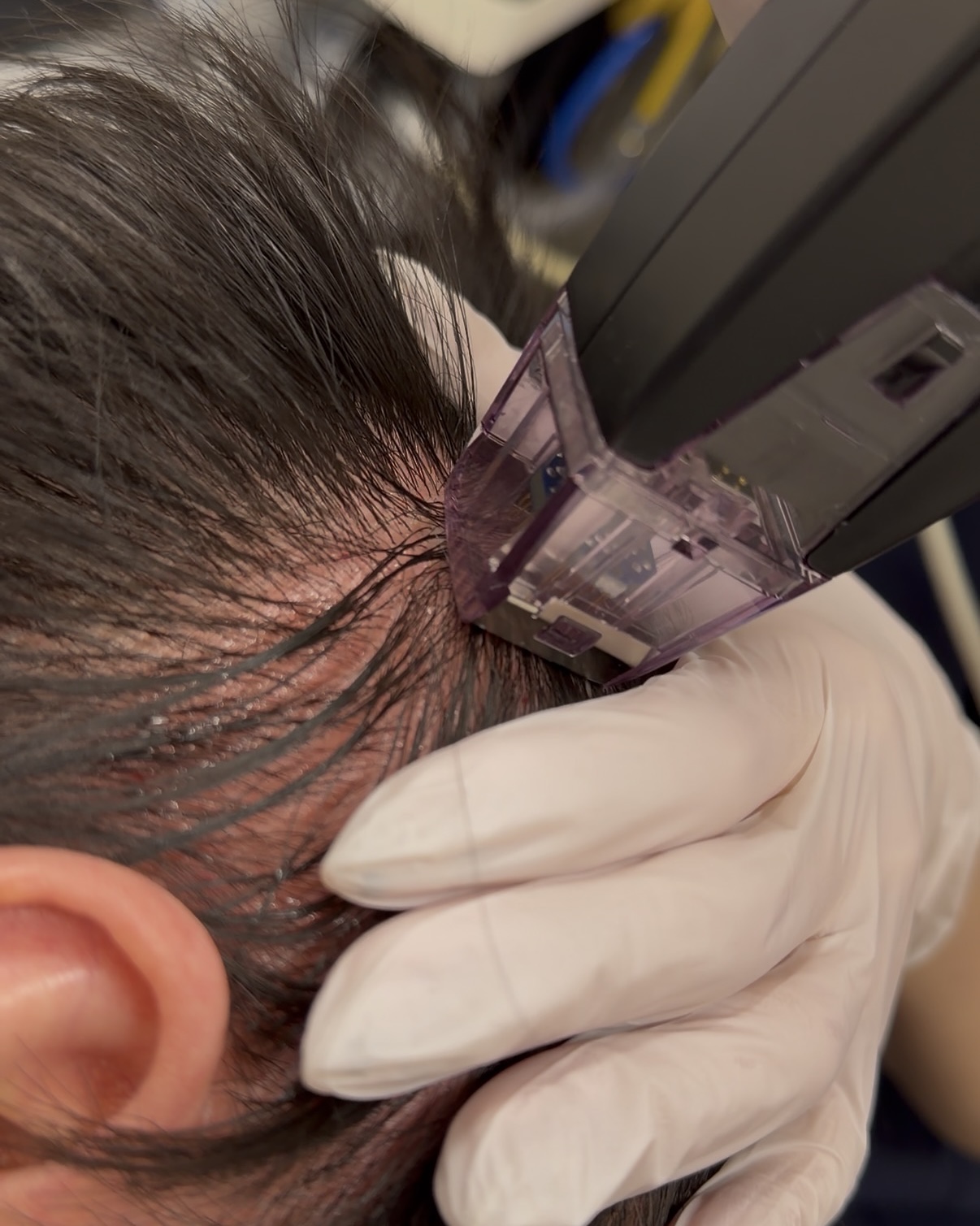
For a forehead thread lift, an insertion point of about 1–2 mm is made inside the hair on the temple, and the thread is passed along the subcutaneous fat and superficial SMAS. Branches of the superficial temporal artery, the auriculotemporal nerve, and the supraorbital nerve run in this path, so localized swelling, bruising, and transient numbness can occur immediately after the procedure. Because the insertion point sits within the scalp, it is reasonable to assume that mild inflammation may extend to the follicles near the hairline.
Scalp wound healing and stem cell conditioned media scalp treatment
Although not visible to the eye, the insertion points on the lateral scalp are in a repair phase in which subcutaneous fibrosis and adhesion progress. Adding scalp injections or microneedling procedures during this period may prolong inflammation or lead to unexpected adhesion. Whether subcutaneous wound healing has settled is an important indicator when delivering stem cell conditioned media to the scalp. For general dermatologic guidance on AGA and scalp management, we also reference information from the Japanese Dermatological Association while individualizing decisions based on each patient’s history.
Timing design with stem cell conditioned media scalp treatment
Advancing scalp treatment before threads are placed
For patients concerned about thinning around the hairline and temples, even when a thread lift is planned, it often makes sense to first improve the follicular environment with stem cell conditioned media scalp treatment before placing the threads. The various growth factors contained in the conditioned media are thought to calm microinflammation around follicles and support the microcirculation, but this is not a promise of “growing new hair” — it is an approach to condition the environment of existing follicles. When the scalp is in good condition at the time threads are placed, postoperative swelling and discomfort tend not to linger.
When to resume scalp treatment after threads are placed
Right after a thread lift, subcutaneous swelling and bruising remain, so stimulating procedures such as scalp injections and microneedle RF should be avoided for a general guide of at least 2–4 weeks. Scalp treatment while swelling and tenderness remain is prone to combining infection risk with unpredictable inflammation. Related information on hair regenerative medicine including past columns is compiled at our list of hair regenerative medicine columns, so please compare it with your own condition when considering treatment.
Once the hairline is “moved,” it cannot be put back — decide the order first
The position of the hairline is determined by the tension of the scalp skin overall and by the distribution of follicles. When a forehead thread lift is performed, the hairline may appear to rise slightly, but this is the result of moving the skin — not of relocating the follicles themselves. If the concern is that the hairline looks broad, it may be difficult to fully resolve with stem cell conditioned media scalp treatment alone, and in some cases combining a thread lift can actually amplify the sense of discomfort. To decide the order of a forehead lift and hair regenerative treatment, one must judge whether what bothers you in the mirror is skin laxity or reduced hair volume as the main cause.
If the main cause of thinning is on the follicular side, prioritize scalp treatment with stem cell conditioned media; if skin laxity dominates, consider the thread lift first. Judging in this order helps avoid poor synergy between the two. Precisely because the hairline frames the face and is difficult to correct once discomfort appears, careful design before the procedure is essential. Because effects and indications vary between individuals, and because the optimal combination of thread lifts and regenerative medicine is not the same for everyone, we recommend sufficient consultation and examination before making a decision.
Frequently Asked Questions
Q. Is it safe to receive stem cell conditioned media scalp treatment the day after a thread lift?
Subcutaneous swelling and bruising continue immediately after a thread lift, and adding scalp injections or microneedle procedures may raise the risk of infection and inflammation. As a general guide, wait at least 2–4 weeks and confirm that swelling and tenderness have resolved before resuming. Because responses vary, please follow the judgment of the physician who performed the procedure.
Q. Does a forehead thread lift actually raise the hairline?
Rather than moving the position of the follicles themselves, the impression that “the hairline looks higher” can arise because the skin is lifted. The impression varies with the original hairline shape and the degree of skin laxity, so it is important to carefully share simulation and goals before the procedure.
Q. Which should be prioritized: hairline recession or forehead laxity?
The starting point is to judge whether your concern is a change in hair volume or skin laxity. If reduced volume is the main cause, prioritize stem cell conditioned media scalp treatment; if skin laxity is the main cause, consider a thread lift. Even when both are pursued in the same period, share the order and interval design with your physician.
Q. Can hair thin around the insertion points of a thread lift?
The possibility of transient local inflammation disrupting the hair cycle and producing telogen effluvium is not zero. In most cases it recovers over several months, but for those whose lateral scalp is already sparse, we recommend careful observation of the scalp before and after the thread lift.
Q. Does stem cell conditioned media put back skin that a thread lift has moved?
It does not. Stem cell conditioned media scalp treatment acts on inflammation and the microcirculation around follicles; it is not a treatment that changes subcutaneous tension structures or the position of threads. Because their roles differ, a realistic approach is not “using the conditioned media to add to the effect of threads” but “combining them for separate purposes.”
──────────────
Medical Supervisor: Dr. Shin Moriwaki (Supervising Physician)
Member, Japan Society of Aesthetic Surgery (JSAS) / Member, American Academy of Aesthetic Medicine
ECFMG Certificate (US Medical Licensure Qualification)
──────────────
📍AVAN TOKYO Ginza Hair Regenerative Medicine
AVAN TOKYO Ginza Hair Regenerative Medicine
English / 中文 / Tiếng Việt available
Inquiries via DM / LINE / Website / Phone.