


Hair Transplant and Stem Cell Conditioned Media — The Medical Case for Combined Treatment2026.05.27
“Once I get a hair transplant, will my hair loss worries be over?” This is one of the most common questions we hear in consultations. It is true that a hair transplant relocates follicles from AGA-resistant donor areas, making it a well-established procedure whose results tend to last. But a transplant alone does not guarantee a lifetime free of hair concerns.
In recent years, combining stem cell conditioned media with a hair transplant — before and after surgery — has been spreading rapidly among leading hair restoration clinics in Europe and the United States. In this article, we will organize the essential benefits and limits of the hair transplant, and then explain from a medical standpoint why this combination is becoming the next-generation standard.
What a hair transplant can and cannot solve
A hair transplant is a surgical procedure in which follicular units harvested from AGA-resistant areas — typically the back and sides of the scalp — are relocated to thinning regions. FUE (follicular unit extraction) and FUT (strip method) are the two leading techniques. Transplanted hairs generally retain their resistance to male hormones and continue to grow for many years.
What “transplanted hair does not fall out” actually means
Transplanted hairs tend to last because the donor follicles carry their original AGA resistance with them. However, this does not mean that AGA itself stops progressing after a hair transplant. Native hairs surrounding the transplanted area remain subject to AGA, and several years later it is not uncommon for patients to see that “the transplanted zone is intact, but the surrounding area has receded further.”
The wall called “shock loss”
Another drawback of a hair transplant is shock loss — the temporary shedding of native hairs around the transplanted area during the first weeks to months after surgery. This is caused by mechanical trauma and micro-inflammation that push existing follicles into a temporary resting phase. Most cases recover in six to twelve months, but the psychological burden during this period can be significant.
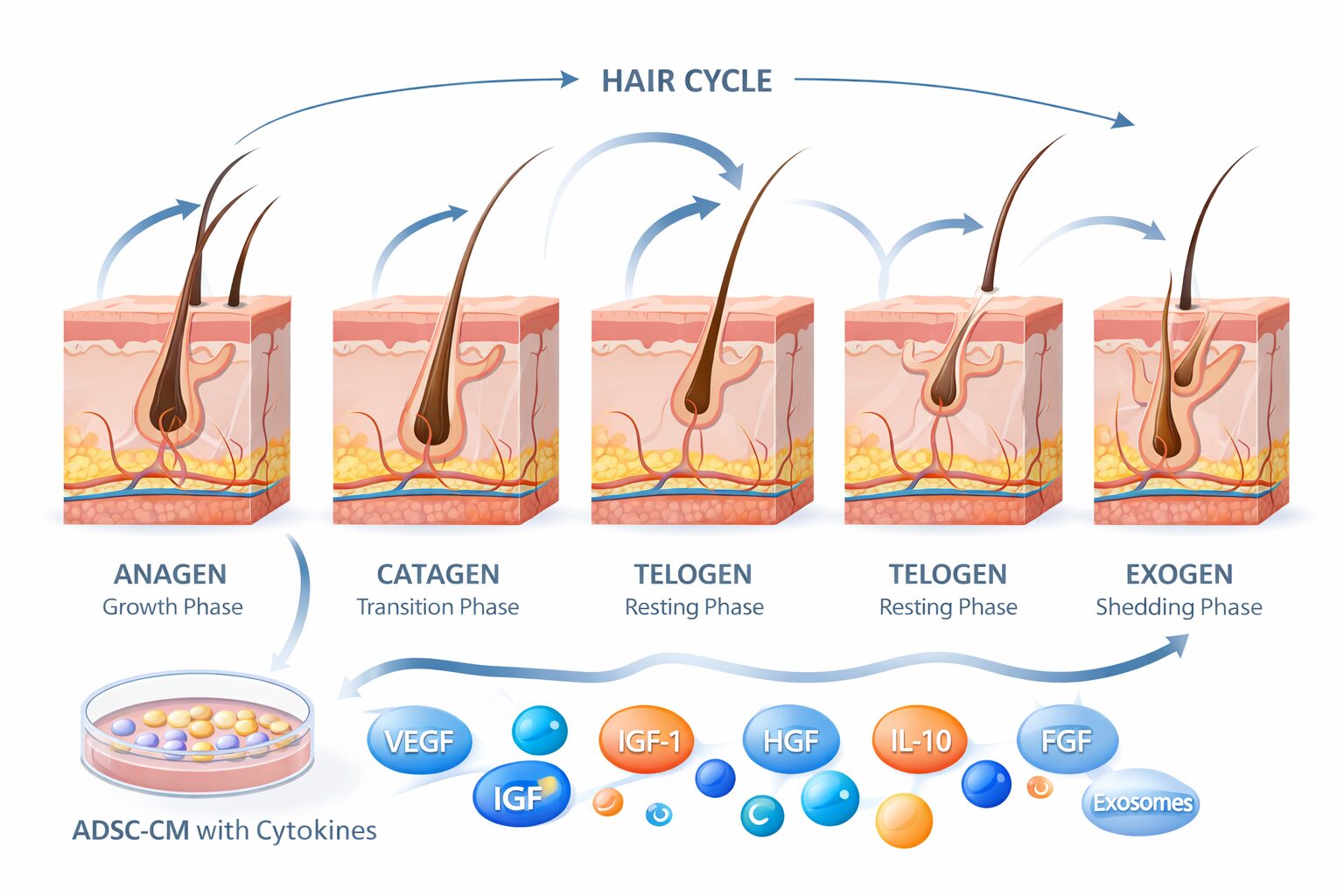
The medical rationale for adding stem cell conditioned media to a hair transplant
Stem cell conditioned media is rich in cytokines and growth factors involved in tissue regeneration — including VEGF (vascular endothelial growth factor), FGF (fibroblast growth factor), IGF-1 (insulin-like growth factor), and HGF (hepatocyte growth factor). These are the key to addressing the weak points of a hair transplant.
Boosting graft survival through angiogenesis
For relocated follicles to take root in their new environment, blood supply from surrounding tissues must be re-established quickly after surgery. VEGF-driven angiogenesis supports this rebuilding process. Delivering conditioned media after a hair transplant reduces follicular necrosis and improves final graft survival. International clinical reports have described improvements of 10 to 15% in survival rates when conditioned media is added.
Reducing shock loss and accelerating recovery
Shock loss is essentially the result of surgical inflammation and temporary follicular damage. The anti-inflammatory cytokines in conditioned media help resolve this inflammation gently and bring follicles forced into resting phase back to activity sooner. Starting conditioned media therapy before surgery can also prepare the scalp environment to better withstand the surgical insult itself.
Who benefits most from combining a hair transplant with conditioned media
A hair transplant is not the optimal answer for every patient. The combined approach shows its true value in cases such as the following.
Younger men with rapidly progressing AGA
For men in their 20s and 30s with fast-progressing AGA, a hair transplant alone often leaves the design unbalanced within a few years as surrounding native hair continues to recede. Ongoing conditioned media therapy maintains existing hair and suppresses progression, preserving the transplant design over the long term.
Women with diffuse hair loss
In female diffuse hair loss, the donor area itself often lacks sufficient density, which limits the indication for a stand-alone hair transplant. The realistic strategy here is to first improve scalp environment and reactivate follicles with stem cell conditioned media, and then add partial transplantation only where truly needed.
Patients struggling after a previous transplant
Many patients who underwent a hair transplant in the past are now troubled again by ongoing AGA progression. Because re-transplantation is constrained by limited donor reserves, the preferred design is to maintain both native and transplanted hair with conditioned media, while keeping any additional surgery to the absolute minimum.
Conclusion — From “surgically planting” to “designing the regenerative environment”
A hair transplant will remain a foundational pillar of hair regenerative medicine for years to come. However, with the progressive backdrop of AGA still in place, surgery alone cannot deliver true freedom from hair concerns. Combining a hair transplant with stem cell conditioned media is becoming the next-generation standard — maximizing the procedure’s results through three mechanisms: improved graft survival, reduced shock loss, and preservation of existing hair.
The first step toward finding the treatment design that fits you best is an objective evaluation of your scalp environment and donor conditions with a specialist.
──────────────
Medical Supervisor: Shin Moriwaki, MD
Member of the Japan Society of Aesthetic Surgery (JSAS)
Member of the American Academy of Aesthetic Medicine
ECFMG Certificate
──────────────
📍AVAN TOKYO Ginza Hair Regenerative Medicine
English / 中文 / Tiếng Việt supported
Consultations available via DM / LINE / Website / Phone.