


The New Standard in Hair Loss Treatment: Why Oral Medication Alone Isn’t Enough — The Importance of “Scalp Environment”2026.05.12
“I’ve been taking both finasteride and minoxidil, but I’m not seeing the regrowth I expected.” “The first six months looked great, but lately progress has stalled.” — These are remarks we often hear from patients who have been on hair loss therapy for some time.
Oral medications are, without question, a cornerstone of modern hair loss treatment. Yet it is also a clinical reality that some patients hit a ceiling beyond which medication alone struggles to deliver further results.
What lies behind this plateau is a concept that has been gaining renewed attention in recent years: the “scalp environment.”
Hair loss treatment has entered an era in which an “inside-out” approach—suppressing hormones or improving systemic blood flow—is no longer sufficient on its own.
The site where hair regrowth actually happens, the follicle itself, must be supported by a healthy local environment. Conditioning that environment is the key to unlocking the full potential of oral medications and sustaining results over the long term.
Why oral medication alone has its limits
For many years, AGA treatment has revolved around 5α-reductase inhibitors such as finasteride and dutasteride, combined with oral minoxidil.
These drugs have well-established efficacy, but they do not work equally well in every patient.
“Reaching” the follicle and “working” at the follicle are two different things
Oral medications circulate through the bloodstream and reach the follicles in the scalp. However, if the follicle is surrounded by chronic micro-inflammation, or if its outlet is clogged by sebum and keratin debris, the drug struggles to exert its full effect.
Suppressing DHT alone is not enough if the follicle itself is not “primed to grow.”
Minoxidil, for its part, dilates vessels to deliver nutrients to the hair matrix cells, but if scalp circulation is impaired, those nutrients never quite reach the deeper layers of the follicle.
The efficacy of any medication is heavily shaped by the condition of the field in which it acts.
When we look closely at patients who “don’t respond well,” the bottleneck is often not the dose or the choice of drug, but a scalp that simply cannot translate the medication into a biological response.
Hair is like a plant growing in soil
A useful way to think about hair growth is to imagine the follicle as a plant and the scalp as the soil.
No matter how excellent the fertilizer (oral medication), a plant cannot flourish if the soil is parched, overly acidic, or infested at the roots.
In hair loss treatment, the “soil” is the scalp environment. Chronic micro-inflammation, reduced blood flow, oxidative stress, and excessive oxidized sebum quietly accumulate and gradually wear down follicular function.
If you keep supplying fertilizer to depleted soil, your gains will eventually plateau.
A new strategy: treating the scalp environment itself
Recent hair loss treatment increasingly emphasizes intervening directly on the scalp environment in parallel with oral medication.
At the center of this strategy are regenerative medicine options, most notably stem cell-conditioned media (cell culture supernatant).
Calming chronic micro-inflammation and restoring follicular function
In patients with progressive hair loss, the scalp often harbors chronic micro-inflammation at the tissue level, even when nothing appears wrong on the surface.
This low-grade inflammation gradually erodes the activity of follicular stem cells and accelerates follicular miniaturization—the process by which hairs become thinner and shorter over time.
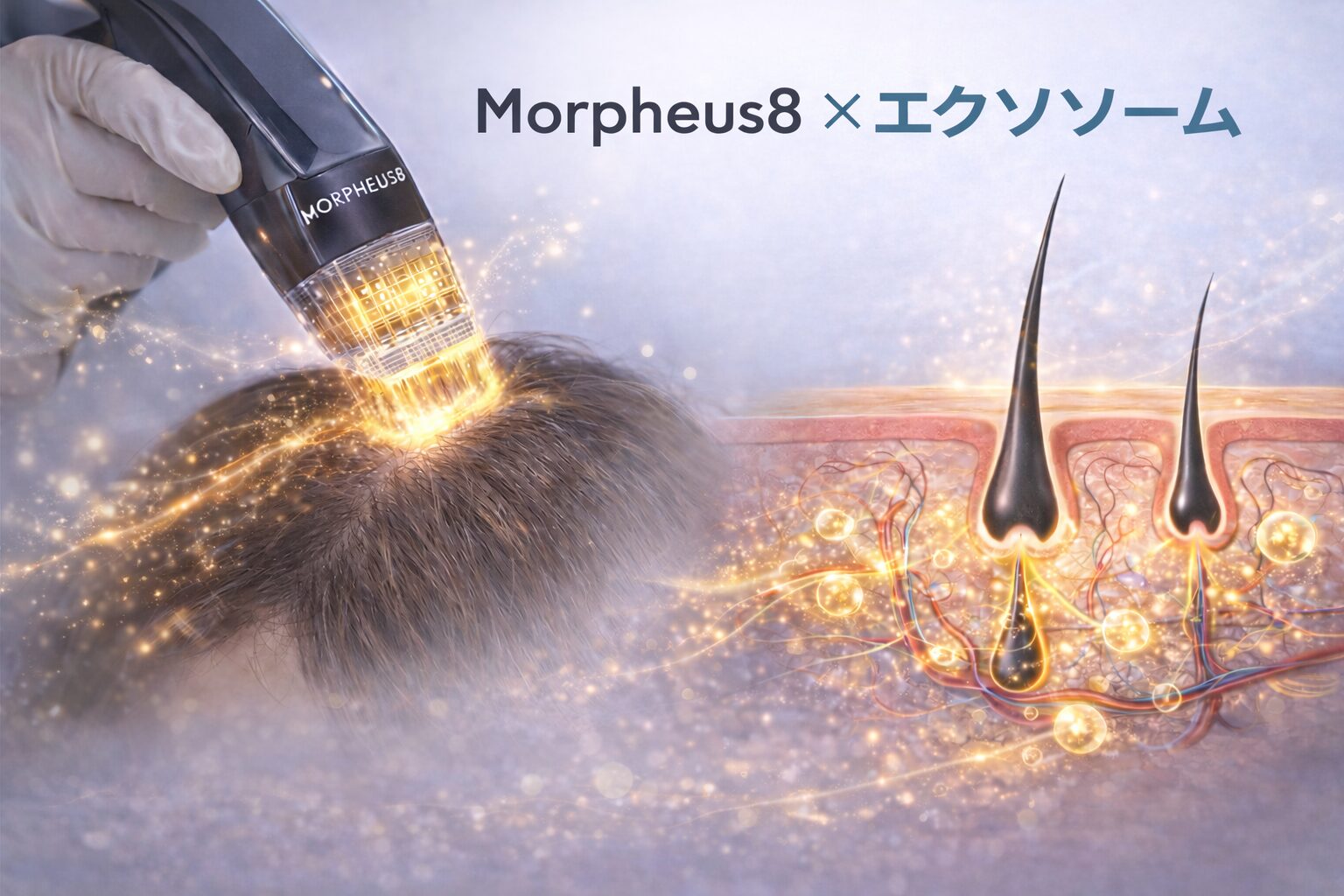
Stem cell-conditioned media contains dozens of growth factors and cytokines: anti-inflammatory cytokines, KGF and IGF-1 that promote proliferation of hair matrix cells, and VEGF that improves microcirculation.
Delivered to the scalp, these factors calm inflammation while restoring perfusion and nutrient supply, effectively rebuilding the very “field” in which oral medications act.
In other words, supernatant therapy does not only act on the follicle itself; it rewrites the environment around the follicle into one where hair regrowth can actually take place. This is the essence of the treatment.
The true value emerges when combined with oral therapy
What matters is that supernatant therapy is not a replacement for oral medication, but a foundation that lets it perform.
To extract the maximum benefit from DHT suppression and vasodilation, the scalp should be prepared so that the medication can do its job.
This is the core philosophy behind treatment planning at AVAN TOKYO.
Patients who have plateaued on oral therapy, who cannot tolerate higher doses, or whose follicles are already miniaturizing benefit most clearly from interventions targeting the scalp environment.
Combining this with Morpheus8 RF stimulation and appropriate at-home care allows us to address the “soil” from multiple angles.
Conclusion
Hair loss treatment is no longer defined by “what you take” alone.
To bring out the full power of oral medications, the field in which they act—the scalp environment—must be properly conditioned.
Calming chronic micro-inflammation, restoring blood flow, and delivering growth factors directly to the follicle: this groundwork is what allows oral medication to reach its full potential and sustain results over time.
If you feel stuck on your current regimen, or hesitant to add another medication, it may be worth having a specialist assess your scalp environment.
Hair regrowth never completes from inside alone, nor from outside alone.
Flip the “regrowth switch” from within, and prepare the “stage on which regrowth happens” from without.
A strategy that integrates both is the new standard in hair loss treatment.
📍AVAN TOKYO Ginza Stem Cell & Regenerative Medicine Clinic
AVAN TOKYO GINZA STEM CELL CLINIC
English / 中文 / Tiếng Việt available
For reservations and consultations,
please reach out via DM / LINE / Website / Phone.