


What Is Actually Happening in Young-Onset Hair Loss in Teens and Early 20s — Avoiding the Trap of Panic-Driven Over-Treatment and Positioning Stem Cell Conditioned Media Honestly2026.07.11
“My hair has gotten noticeably thinner and I’m only in my twenties.” “Since my late teens I’ve been shedding much more than before.” — In recent years, we have seen a clear increase in visits from patients concerned about young-onset hair loss. Being young makes it easier to panic, and it is easy to be pushed by SNS or advertising into stacking one treatment on another. But hair loss at a young age is neither a condition that “heals naturally because you are young,” nor a problem that “will inevitably improve if you try every drug on the shelf.” From the perspective of Dr. Moriwaki, who oversees hair regenerative medicine in Ginza, let us organize medically what is happening in the follicles of teens and those in their early 20s, and how far young-onset hair loss can be honestly addressed by stem cell conditioned media.
Key Points of This Article
・Young-onset hair loss is a condition in which, from the late teens into the early 20s, the anagen phase of the hair cycle shortens and follicles progressively miniaturize; most cases overlap with the early presentation of AGA or FAGA.
・The core risk is not that being young makes healing certain, but that being young makes it easier to be pushed into panic-driven over-treatment.
・The more treatments are layered on without a proper diagnosis, the harder it becomes to identify the cause of any side effect.
・Stem cell conditioned media can be positioned as an approach that supports the follicular microenvironment, combined alongside oral and topical treatments with distinct roles.
・For young patients especially, defining an “exit design” from the very start is directly linked to long-term satisfaction.
What Is Happening in Young-Onset Hair Loss — Inside the Follicles of Teens and Early 20s
Shortening of the Anagen Phase and Rapid Miniaturization
What stands out in hair loss among young patients is not so much the raw number of shed hairs, but the change in “hair becoming thinner.” Under a microscope, the diameters of hairs emerging from the same follicular opening become uneven, and the proportion of thin hairs increases. This reflects a shortening of the anagen phase within the hair cycle and a progressive miniaturization of follicles — a process that in younger patients can advance relatively quickly. It typically begins at the hormone-sensitive frontal and vertex areas, appearing as receding hairline or visible scalp at the crown.
Overlap With AGA and FAGA, and Background Factors Unique to Youth
Most hair thinning at a young age can be seen as an early presentation of AGA (male-pattern hair loss) or FAGA (female-pattern hair loss). Yet in young patients, background factors — chronic sleep deprivation, unbalanced diet, excessive dieting, intense stress, iron deficiency — tend to stack on top. The phrase “nothing abnormal on thyroid, iron or hormone tests” does not mean “cause unknown”: it is closer to the truth that multiple loads that shorten the hair cycle are overlapping.
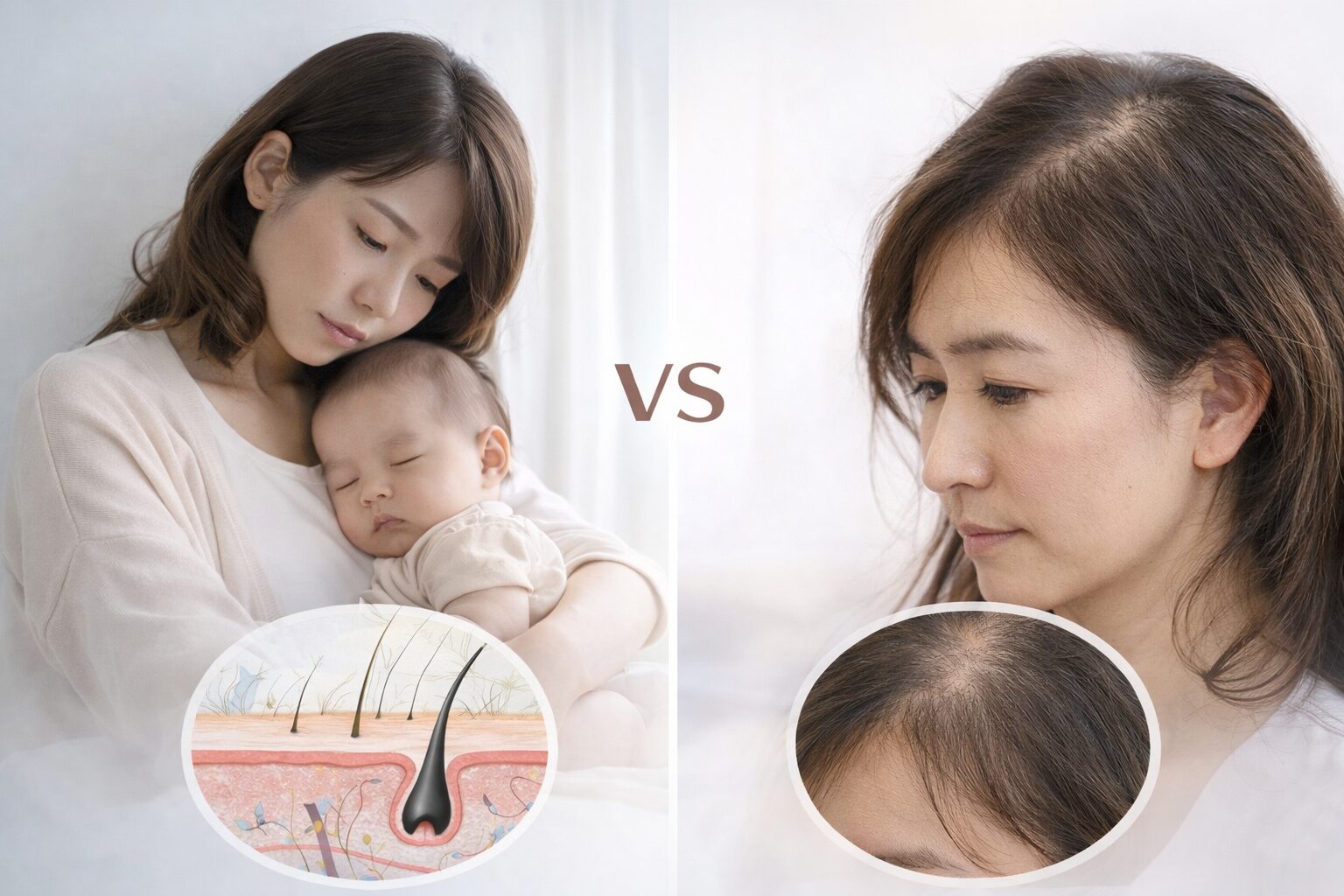
Not “You’ll Heal Because You’re Young” — But “You’re Easier to Panic Because You’re Young”
Over-Treatment Risk Driven by SNS and Advertising
The greatest risk in young-onset hair loss is not the shedding itself, but panic-driven over-treatment. On SNS and in advertising, dramatic before-and-afters, short-term change, and definitive efficacy guarantees are everywhere. But the hair cycle unfolds over months, so meaningful change judged in a few weeks is fundamentally limited. Younger patients, wanting fast results, tend to layer multiple oral, topical, and self-pay treatments at once. When a side effect appears, identifying its cause becomes clinically far harder.
The Pitfall of Stacking Drugs Without a Diagnosis
What is often missed in hair loss among teens and those in their early 20s is the differential diagnosis from non-AGA hair loss such as alopecia areata, traction alopecia, and telogen effluvium. Starting finasteride or minoxidil first tends to push evaluation of these conditions to the back. The most important step in young cases is first evaluating “what is actually happening” through history, inspection, trichoscopy, and — when needed — blood tests. Treatment then follows a clear order: separate “what to stop” from “what to add.”
Stem Cell Conditioned Media as an Option in Young-Onset Hair Loss
Supporting the Follicular Microenvironment
Stem cell conditioned media contains growth factors such as VEGF, IGF-1, HGF, and FGF, as well as miRNA carried in extracellular vesicles (exosomes) — components that can act on the follicular microenvironment. In young patients, follicles are often not yet fully lost, and approaches that address inflammation, blood flow, and growth signaling within the follicular microenvironment can be meaningful. That said, it is honest to present this treatment not as a stand-alone cure for young-onset hair loss, but as one component sharing the load with oral therapy, topical therapy, and lifestyle correction.
Designing the Combination With Oral and Topical Treatment
When integrating stem cell conditioned media, a realistic design is a two-phase model: shorter intervals in an induction phase aligned with the hair cycle, and longer intervals in a maintenance phase. When combined with oral or topical treatments such as finasteride, dutasteride, or minoxidil, side-effect monitoring and efficacy assessment for each should be tracked on separate timelines. Efficacy is judged across three axes — standardized photography, hair diameter measurement, and subjective symptoms — with continuation, modification, or discontinuation reviewed every three to six months. For young patients especially, sharing an “exit design” — when we would consider stopping — from day one raises long-term satisfaction. For related columns please also see our hair regenerative medicine column list, and for general guidelines on AGA treatment, the Japanese Dermatological Association is a useful reference.
Frequently Asked Questions
Q. Is young-onset hair loss the same disease as adult AGA?
In most cases it overlaps with the early presentation of AGA or FAGA. However, in young patients, background factors and other alopecias (alopecia areata, traction alopecia) may be involved, so the same treatment cannot simply be applied. Differential diagnosis and cause evaluation come first.
Q. Can teens and those in their early 20s receive stem cell conditioned media treatment?
It is not decided by age alone, but based on the pattern of hair loss, degree of progression, systemic condition, and desired treatment design. In young patients, follicular reserve is often preserved and there is room to consider it as an option, but positioning it clearly within an overall plan — including diagnosis and oral/topical treatment — is a prerequisite.
Q. Should I start with oral medication first?
The order shifts by progression, constitution, and preference. Finasteride and dutasteride are valid options once their indications and side effects are understood, but in young cases, a realistic design separates “stopping progression” from “protecting the follicular microenvironment.” We build the plan on cause evaluation, not on a fixed order.
Q. When can changes from stem cell conditioned media be felt?
From the timing of the hair cycle, perceptible change typically requires at least three to four months, though changes in scalp environment and hair texture may be felt earlier. It cannot be judged effective in weeks; standardized photography and hair diameter measurement provide objective follow-up. Individual variation exists, and when response is poor, the plan needs to be reassessed.
Q. What happens if treatment is stopped?
After discontinuation, factors that had been holding progression back are removed, so the hair cycle can gradually return toward its prior state. It does not have to be assumed as “lifelong,” but keeping the exit design in mind from the start allows for sustainable continuation and a considered decision to stop.
──────────────
Supervising Physician: Shin Moriwaki, M.D.
Member, Japan Society of Aesthetic Surgery (JSAS) / Member, American Academy of Aesthetic Medicine
ECFMG Certificate
──────────────
📍AVAN TOKYO 銀座 毛髪再生医療
AVAN TOKYO Ginza Hair Regenerative Medicine
English / 中文 / Tiếng Việt supported
Please reach out via DM / LINE / Website / Phone.