


AGA in Men in Their 30s Is a Mid-Game That Separates “Density Already Lost” from “Density You Can Still Protect” — Dr. Moriwaki Organizes How to Fit Stem Cell Conditioned Media into AGA Treatment According to Progression2026.07.19
“I thought I was still fine in my twenties, but when I looked back at photos after entering my thirties, both the hairline and the crown had progressed more than I expected.” More and more men speak these words in the consultation room every year. Male pattern hair loss (AGA) in one’s thirties is neither the earliest stage nor the terminal stage. It is the “mid-game” of hair loss, and if AGA treatment is designed poorly for this decade, it is easy to end up spending time and money on areas that cannot be brought back. In this article, from the clinical viewpoint of Dr. Moriwaki, we organize the idea of separating “density already lost” from “density you can still protect,” and how to fit stem cell conditioned media into AGA treatment based on that framework.
Key Points of This Article
・AGA treatment in the thirties is a mid-game — neither early nor terminal — and the most important thing is to design it by separating density already lost from density you can still protect.
・The foundation that halts progression is a 5α-reductase inhibitor (oral); stem cell conditioned media is a “tool that conditions the follicular environment” added on top of that foundation.
・Whether to add minoxidil or Morpheus8 is decided by progression speed, the hairline/crown ratio, and how much the lifestyle side can tolerate.
・Precisely because this decade lies between “too late” and “still fine,” it is essential to sketch an evaluation plan at 6 and 12 months in advance.
・Instead of being swayed by before/after photos and advertising language, the starting point is calmly grasping what remains in your follicles and what has already been lost.
Why Hair Loss in Your Thirties Turns Out to Have “Progressed More Than Expected”
The Moment Slow Loss Becomes Visible
AGA often begins little by little from the early twenties. However, the miniaturization of hair diameter (softening) advances so gradually that everyday mirrors rarely catch it. Once the thirties arrive, follicular miniaturization crosses a certain threshold and “visible changes” appear all at once — the scalp shows through, the hairline becomes uneven, the center of the whorl widens. Even when it feels like it “suddenly progressed,” physiologically most cases are simply the visualization of a process that has advanced over years to a decade.
Life Events Delay Awareness
In one’s thirties, work responsibility increases and life changes such as marriage, childbirth, and moving overlap. Chronic sleep deprivation and disrupted eating work against the follicle, but the greater issue is that “you can no longer take calm time to observe your own head.” As a result, a typical pattern is to notice progression only after seeing photos taken at events like a wedding — and by then the pattern is often already Norwood III or III vertex.
The Framework of Separating “Density Already Lost” from “Density You Can Still Protect”
How Far Can Lost Density Be Brought Back?
The first thing to accept in AGA treatment in the thirties is that “follicles that have miniaturized and regressed over the long term to the point of scarring cannot be brought back to their original state by current medicine.” At the very front of the hairline and in regions that have been softened for a long time, the follicle itself has shrunk and regressed. Piling on treatment with excessive expectations for these regions only inflates cost and clinic-visit burden without restoring the density hoped for. For part of the lost density, follicular unit hair transplantation enters the discussion as a separate, realistic option.
Why Protectable Density Comes First
On the other hand, “follicles that are softening but still alive” and “the transitional zone that may soften from here” are the targets where intervention in one’s thirties carries the most meaning. Whether you can protect this zone determines how the forties and fifties will look. The mid-game of AGA treatment is not about flashy “increase,” but about rebuilding the environment before follicles in this transitional zone disappear — and once you set this as the axis, the roles of oral drugs, topicals, stem cell conditioned media, and needling-type devices fall into place naturally.
The Mid-Game AGA Treatment Protocol — Where to Place Stem Cell Conditioned Media
The Foundation Is a 5α-Reductase Inhibitor — a “Halting Treatment”
The first thing considered in AGA treatment in the thirties is an oral 5α-reductase inhibitor — finasteride or dutasteride. These suppress the production of dihydrotestosterone (DHT) and slow follicular miniaturization itself — a “halting treatment.” If this foundation is not in place, no matter how well stem cell conditioned media conditions the follicular environment, progression continues in the background. Because concerns about sexual function and how side effects are perceived vary by individual, the side-effect profile and rebound after discontinuation should be shared with the physician before starting.
Stem Cell Conditioned Media Is a “Tool That Conditions the Follicular Environment”
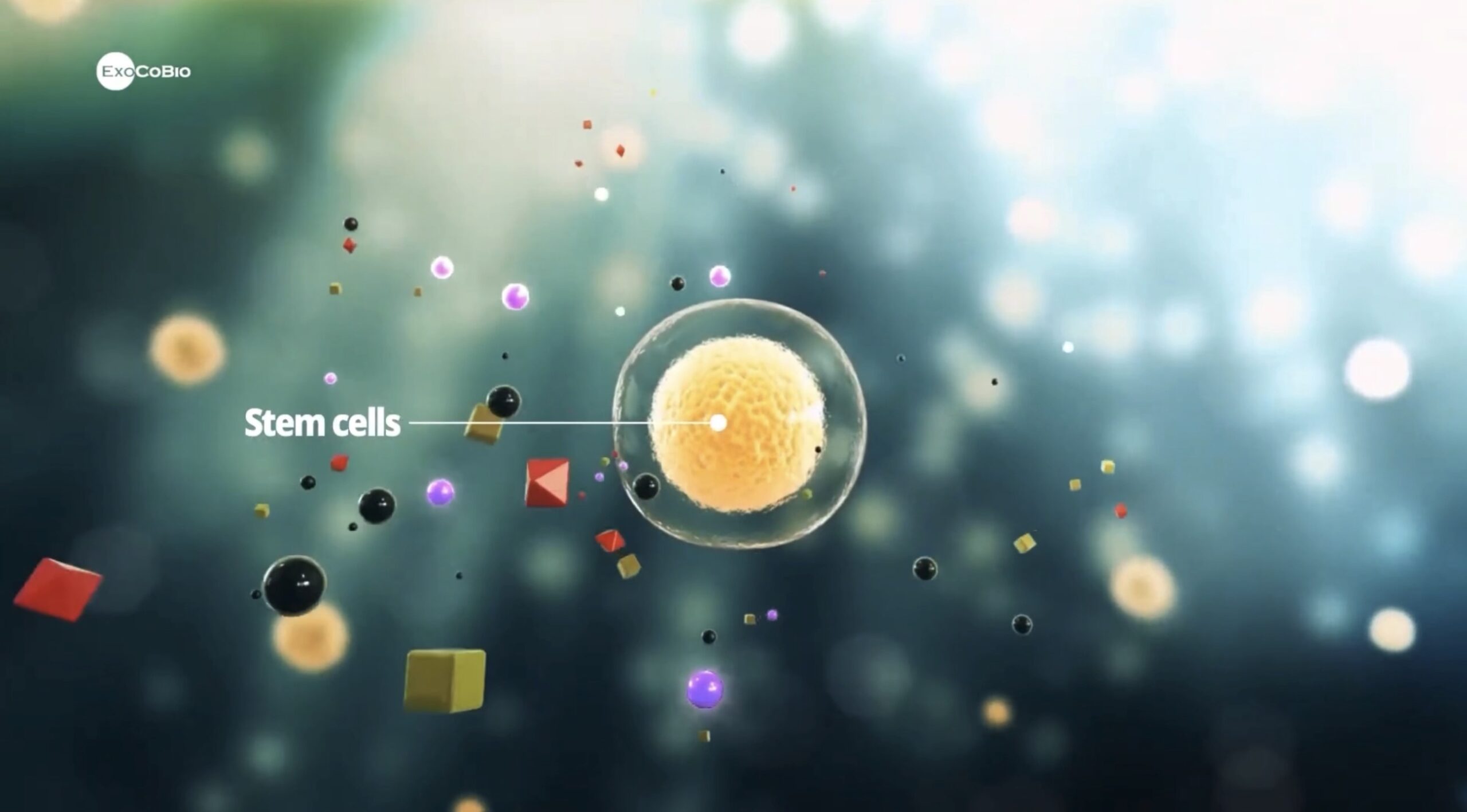
Stem cell conditioned media is a biological preparation containing the cytokines, growth factors, and exosomes that mesenchymal stem cells secrete into the culture medium. It is expected to calm micro-inflammation around the follicle and supplement signals related to angiogenesis and the activation of dermal papilla cells. However, it is not a “hair-growth drug” that replaces oral medication. In mid-game AGA treatment in the thirties, the role stem cell conditioned media plays is complementary: once the halting treatment has suppressed background progression, it conditions the environment so that follicles on the protectable-density side can return to their original thickness and anagen length. A practical design is an induction phase of once a month × 3–4 sessions, followed by maintenance at 6–10 week intervals aligned with the hair cycle.
Whether to Add Minoxidil or Morpheus8 Depends on Progression and Lifestyle
Topical and oral minoxidil act on vasodilation and anagen extension, and can be a main force for density recovery in AGA treatment in the thirties. However, oral minoxidil carries systemic side effects (edema, hypertrichosis, cardiovascular burden), and judgment must take into account underlying cardiovascular disease, health-check values, and the lifestyle side (whether extra body hair will affect work or grooming). The scalp setting of Morpheus8 sits as a combination therapy: micro-thermal stimulation and needling of the scalp increase the delivery efficiency of stem cell conditioned media. The design of the mid-game is not “all-in,” but adding only what is needed based on progression speed and patient tolerance.
Realistic Expectations and an Evaluation Plan When Starting AGA Treatment in Your Thirties
The most important thing in AGA treatment in the thirties is to share with your physician, at the very start, “where and how we will evaluate at 6 and 12 months.” The number of shed hairs is not something to reduce to zero, and initial shedding is a physiological response that can occur 2–8 weeks after starting treatment. Rushing to interrupt here resets a hair cycle that has just begun to settle. Combining fixed-point photography (same light, same angle, same hairstyle) with microscope-based hair-diameter and per-follicular-orifice counts, and turning them into objective data, becomes the infrastructure that lets you continue AGA treatment as a long game.
For hair regenerative medicine in your thirties, please also see our related column list on hair regenerative medicine for perspectives from other angles. For general guidance on AGA treatment and dermatological differential diagnosis, the guidelines of the Japanese Dermatological Association are also a useful reference.
Frequently Asked Questions
Q. Is it too late to start AGA treatment in my thirties?
It is not too late. On the contrary, the thirties are the decade in which the “density you can still protect” is often abundant, and in which AGA treatment carries the greatest meaning. However, it is not the case that regions already lost can be brought back to their original state — the central goal is to protect the transitional zone that may soften from here.
Q. Can AGA progression be halted with stem cell conditioned media alone, without oral medication?
We cannot assert that it can. Stem cell conditioned media is an approach that conditions the environment around the follicle; its action to suppress DHT-driven miniaturization itself is limited. In mid-game AGA treatment in the thirties, a realistic design is to build on a foundation of a “halting treatment” such as a 5α-reductase inhibitor and then combine conditioned media on top.
Q. After starting treatment, I began shedding more hair. Is this a failure?
In most cases it is not a failure but a physiological response in which telogen hairs are pushed out (shedding). It typically occurs around 2–8 weeks and settles in several weeks to about two months. Do not stop on your own here; it is important to follow the course while confirming the schedule with your doctor.
Q. How long a treatment period should I expect for AGA treatment?
Because of the hair cycle, expect at least six months to evaluate change, and around twelve months as a rough guide before density is felt. Even when moving into a defensive maintenance phase, AGA is a chronically progressive condition, so in many cases continuing with widened intervals is a realistic option. Ideally, “when to stop” is designed together from the first visit.
Q. How should I think about the cost-effectiveness of AGA treatment?
We recommend thinking not in per-session cost but in lifetime cost — “how much do I pay per year to maintain the density I can protect.” Mid-game AGA treatment in the thirties tends to be more cost-effective in the long run when a low-cost foundation of oral medication is layered with only the necessary number of stem cell conditioned media sessions, rather than pouring everything in at once.
──────────────
【Medical Supervisor】Shin Moriwaki (Supervising Physician)
Member, Japan Society of Aesthetic Surgery (JSAS) / Member, American Academy of Aesthetic Medicine
ECFMG Certificate (U.S. Medical Licensing Qualification)
──────────────
📍AVAN TOKYO Ginza Hair Regenerative Medicine
AVAN TOKYO Ginza Hair Regenerative Medicine
English / 中文 / Tiếng Việt available
Inquiries welcome via DM / LINE / Website / Phone.