


Secondary Knee Osteoarthritis Developing 10–20 Years After ACL Reconstruction: Why Restored Anterior-Posterior Stability Does Not Restore Joint Contact Stress Distribution, and Where Intra-articular Stem Cell Conditioned Media Can and Cannot Help — Dr. Moriwaki Draws the Line2026.08.06
“The surgery was supposed to have been successful, and yet my knee is starting to hurt again.” — patients in their 40s to 60s who tore their anterior cruciate ligament (ACL) in their youth, underwent reconstruction, and returned to sport, are increasingly showing up in the outpatient clinic with this exact complaint. Cohort studies have repeatedly shown that a reconstructed ACL knee is at significantly higher long-term risk of developing secondary knee osteoarthritis over the following 10–20 years. In this article we call this entity post-ACL-reconstruction knee osteoarthritis. Even when the anterior-posterior stability of the knee is restored by the reconstructed ligament, joint contact stress distribution does not fully return to normal, and cartilage and meniscus continue to wear down quietly. Here, Dr. Moriwaki honestly frames what an intra-articular stem cell conditioned media injection can and cannot target in this chronic intra-articular inflammatory environment.
Key Points
・Post-ACL-reconstruction knee osteoarthritis appears at a clearly higher rate than in uninjured knees, becoming manifest as secondary degeneration 10–20 years after reconstruction, according to multiple cohort studies.
・Even with anterior-posterior stability restored, residual micro-rotation at the tibiofemoral joint and reduced meniscal function redistribute joint contact stresses and silently drive degeneration.
・The realistic target of an intra-articular stem cell conditioned media injection is remediation of the chronic intra-articular inflammatory cycle, not correction of bone morphology or lower-limb malalignment.
・Conservative care requires parallel work: quadriceps strengthening, weight management, bracing/orthotics, and activity modification.
・For end-stage joint destruction or high-grade malalignment, orthopedic interventions such as total knee arthroplasty or high tibial osteotomy take priority.
Does Secondary Knee OA Really Increase 10–20 Years After ACL Reconstruction?
Multiple cohort studies have shown that knees with a history of ACL injury develop osteoarthritis at a significantly higher rate 10–20 years later, compared with the uninjured side or the general population. Risk is further amplified when the initial injury was combined with a meniscal tear, when a partial meniscectomy was added, or when the patient is overweight.
“If the reconstruction fixed the instability, why is the joint still degenerating?” — this is the hardest point to convey to patients. The answer is: stability ≠ normal joint kinematics. A reconstructed ligament cannot fully replicate the original ACL’s course or dynamic elasticity. Small residual rotational and translational deviations at the tibiofemoral joint accumulate over years, layering repetitive stress onto subchondral bone and meniscus.
Why Osteoarthritis Progresses Even After Stability Is Restored
Redistribution of Joint Contact Stresses
After ACL reconstruction, anterior tibial translation is limited but residual micro-instability in internal rotation (a lingering pivot shift) is often reported. This subtle rotational deviation raises local cartilage contact pressures inside the knee, concentrating chronic load on the medial femoral condyle and the posterior horn of the medial meniscus.
Reduced Meniscal Function
Concomitant meniscal injury at the time of ACL rupture is not rare, and knees that have undergone partial meniscectomy have reduced shock absorption and contact area. This is one of the most powerful drivers of secondary knee osteoarthritis, and its impact accumulates with years since surgery.
Chronic Intra-articular Inflammatory Cycle
Cartilage microdamage and meniscal deterioration trigger synovitis, sustaining elevated IL-1β, TNF-α, MMPs and other inflammatory cytokines and cartilage-degrading enzymes in the joint fluid. This intra-articular inflammatory cycle is the core mechanism that drives pain and degeneration simultaneously, and it is the layer that an intra-articular stem cell conditioned media injection tries to modulate.
What an Intra-articular Stem Cell Conditioned Media Injection Can and Cannot Target
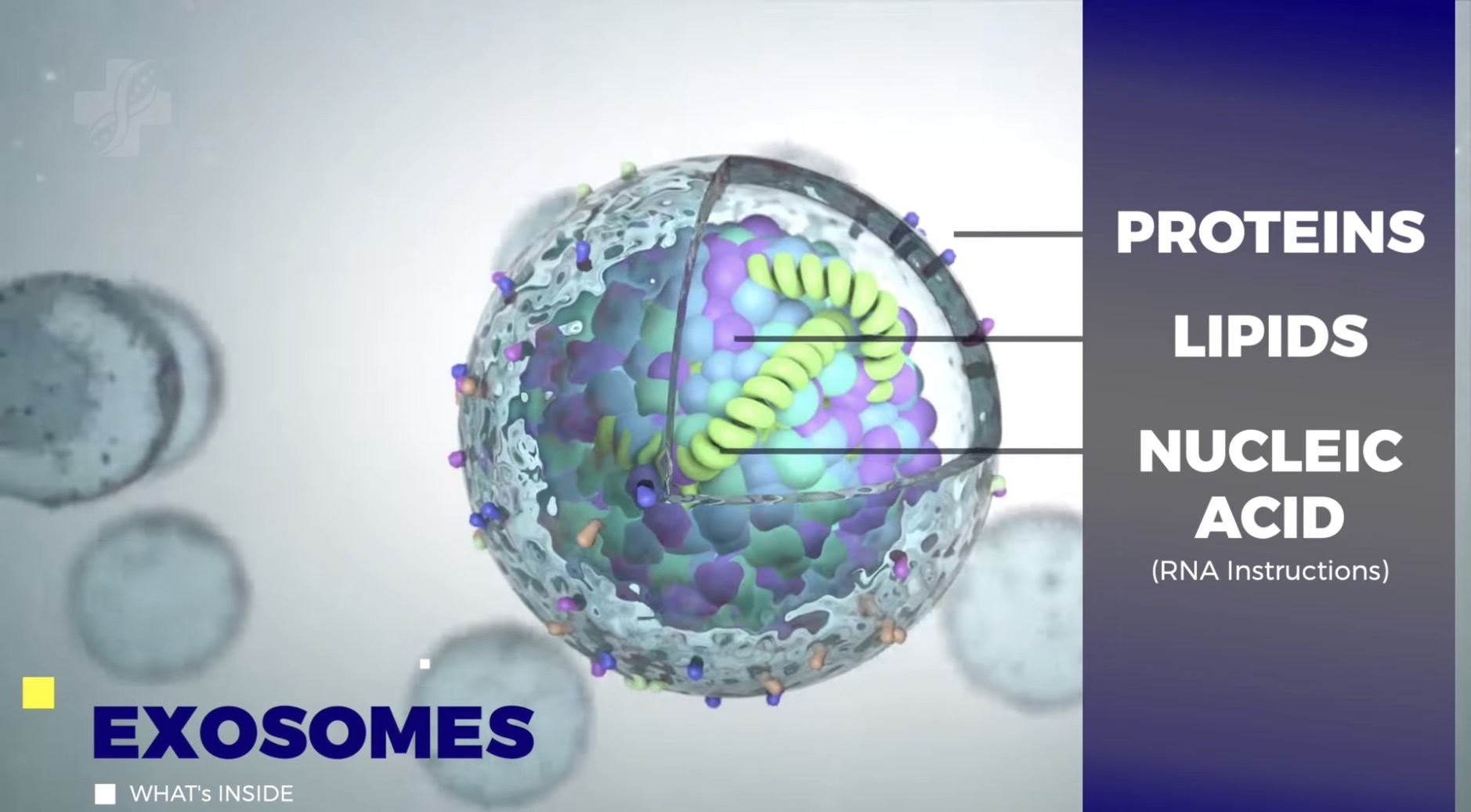
Stem cell conditioned media contains cytokines such as TGF-β, IGF-1, HGF, and VEGF, along with extracellular vesicles (exosomes) and their miRNA cargo. Preclinical in vitro and in vivo studies have repeatedly reported anti-inflammatory action and modulation of the tissue-repair environment.
For a knee with post-ACL-reconstruction knee osteoarthritis, the realistic primary target is remediation of the chronic intra-articular inflammatory environment. By quieting synovitis, it may lower the pain baseline and reduce joint load during daily activity. However, the following are outside its reach in principle:
・Rejuvenation of the reconstructed ligament or the bone morphology itself (it does not “remake” the existing reconstructed graft)
・Structural regeneration of a partially resected meniscus (the shape does not return)
・Correction of lower-limb malalignment such as varus or valgus (that is the territory of osteotomy)
・Reversal of advanced osteophytes or joint space loss
In other words, an intra-articular stem cell conditioned media injection is an option to buy time in conservative care by settling inflammation and pain — not a treatment that repairs structural breakdown. We share this boundary carefully with patients at consultation.
Please also see more on stem cell conditioned media joint injection here. For general information on joint disease, refer to the Japanese Orthopaedic Association.
Treatment Design and Combination Therapy for Post-ACL-Reconstruction Knee Osteoarthritis
Conservative care for post-ACL-reconstruction knee osteoarthritis is never completed by a single injection. The following must run in parallel:
・Quadriceps and hamstring strengthening (compensating for joint stability)
・Weight management (each 1-unit BMI increase adds several kg of load on the knee)
・Load control with braces and arch-supporting insoles
・Redesign of activity intensity (rethink contact sports and repetitive jumping)
・Consideration of combined use with analgesics or hyaluronic acid injections
Against this backdrop, an intra-articular stem cell conditioned media injection is introduced when intra-articular inflammation is judged to dominate the pain picture. Knees in KL Grade II–III, where joint space is still preserved and osteophyte change is moderate at most, tend to have a relatively broad range of expected response. In contrast, Grade IV end-stage deformity or knees with high-grade lower-limb malalignment are situations where orthopedic interventions such as total knee arthroplasty or high tibial osteotomy (HTO) take priority.
Related commentary on previous joint injections and rehabilitation appears in our column list as well.
Frequently Asked Questions
Q. It has been 20 years since my ACL reconstruction — is an intra-articular stem cell conditioned media injection still meaningful?
If joint space is preserved and inflammatory pain during daily activity is the main complaint, remediation of the intra-articular inflammatory environment is meaningful. However, if end-stage joint destruction is present, orthopedic surgical indication takes priority. The decision should follow imaging assessment and physical exam to confirm the current stage first.
Q. Can the reconstructed ligament itself become painful?
Degeneration of the reconstructed graft, tunnel widening, or impingement can be sources of chronic pain. This is a different layer from the pain addressed by an injection targeting intra-articular inflammation, and requires MRI evaluation. When the source is different, injection alone cannot be expected to provide adequate relief.
Q. If I get stem cell conditioned media, can I resume vigorous exercise again?
Activity level may rise as inflammation and pain ease, but a reconstructed knee is not identical to the original. Return-to-sport should be judged by pain plus strength, range of motion, and dynamic stability, taken together. It is safer to avoid the idea that an injection provides a shortcut.
Q. How many injections are needed?
A typical design is 2–3 sessions in the induction phase, with maintenance evaluated every several months to half a year based on response. Individual variation is significant, and effect is assessed on three axes: pain score, range of motion, and daily function. If response is poor, judgment must include continuing, changing, or switching to orthopedic re-evaluation.
Q. When should surgery be considered?
Persistent night pain, near-loss of joint space, and daily life that cannot be maintained even with bracing and medication — when these signs converge, it is time to switch to an orthopedic surgical indication assessment. The line between where conservative care can still hold and where surgery becomes appropriate must be judged carefully for each individual case.
──────────────
Supervising Physician: Shin Moriwaki, MD
Member of the Japan Society of Aesthetic Surgery (JSAS) / Member of the American Academy of Aesthetic Medicine
ECFMG Certificate (U.S. Medical License Qualification)
──────────────
📍AVAN TOKYO Ginza Regenerative Medicine
AVAN TOKYO Ginza Regenerative Medicine
English / 中文 / Tiếng Việt supported
Inquiries via DM / LINE / Website / Phone.