


Preparing for the Atopic Scalp Post-Procedure Flare That Returns After Stem Cell Conditioned Media Scalp Treatment in Patients with Atopic Dermatitis or Psoriasis — Dr. Moriwaki Explains How Microtrauma and Heat Trigger Itch and Eczema, and the Safe Margin for Restarting Topical Steroids and Moisturizers2026.08.03
We frequently hear from patients with atopic dermatitis or psoriasis asking, “Is it really safe for me to have scalp regenerative treatment?” The short answer is that when the skin is well controlled, the procedure is possible — but you need to prepare for the atopic scalp post-procedure flare, in which itching and eczema flare up several days to a few weeks after treatment, triggered by the microtrauma and heat load of microneedle RF or scalp injection. In this article Dr. Moriwaki of AVAN TOKYO Ginza walks through the mechanism, and the timing for restarting topical steroids, moisturizers, and washing.
Key Points of This Article
・The atopic scalp post-procedure flare is triggered by the microtrauma of microneedle RF or injection and the temporary drop in barrier function that follows
・The transient redness and warmth within the first 72 hours is qualitatively different from the eczematous flare that appears 2–4 weeks later — treat them separately
・For topical steroids the rule is “don’t tough it out — restart early,” while moisturizers can be restarted actively from the day after the procedure
・In psoriasis patients, watch for the Koebner phenomenon (new lesions triggered at sites of minor trauma); postpone procedures during active disease
・The single biggest way to reduce the atopic scalp post-procedure flare is to bring the skin to a “calm” state in the 1–2 weeks before the procedure
Why the Atopic Scalp Post-Procedure Flare Happens
In atopic dermatitis the scalp shows reduced filaggrin expression, lower ceramide content in the stratum corneum, and a disrupted sebum film, so the barrier is chronically fragile compared with healthy skin. In psoriasis there is overproliferation of keratinocytes and a Th17-dominated inflammatory background. Both conditions share a common substrate: skin that is primed to overreact to external stimuli.
Microtrauma and Temporary Barrier Compromise
Microneedle treatments such as Morpheus8 and Dermapen deliberately create tiny puncture channels in the scalp to open a delivery route for the stem cell conditioned media. On healthy skin the wound-healing cascade moves quickly, but on an atopic scalp barrier recovery is delayed, transepidermal water loss (TEWL) rises, and reactivity to environmental antigens and resident microbes increases. When histamine release and neuropeptide stimulation are added during this window, itching and eczema can appear well beyond the treated area.
RF Heat and Th2-Dominated Inflammation
When RF coagulation delivers transient thermal damage to the upper dermis, heat shock proteins and inflammatory cytokines (IL-1, IL-6, TNF-α, etc.) are released. Atopic patients already have an activated Th2 axis and IL-4/IL-13 pathway, so heat can easily push the Th2 arm further, and a “slow-onset itch” may appear a few days after treatment.
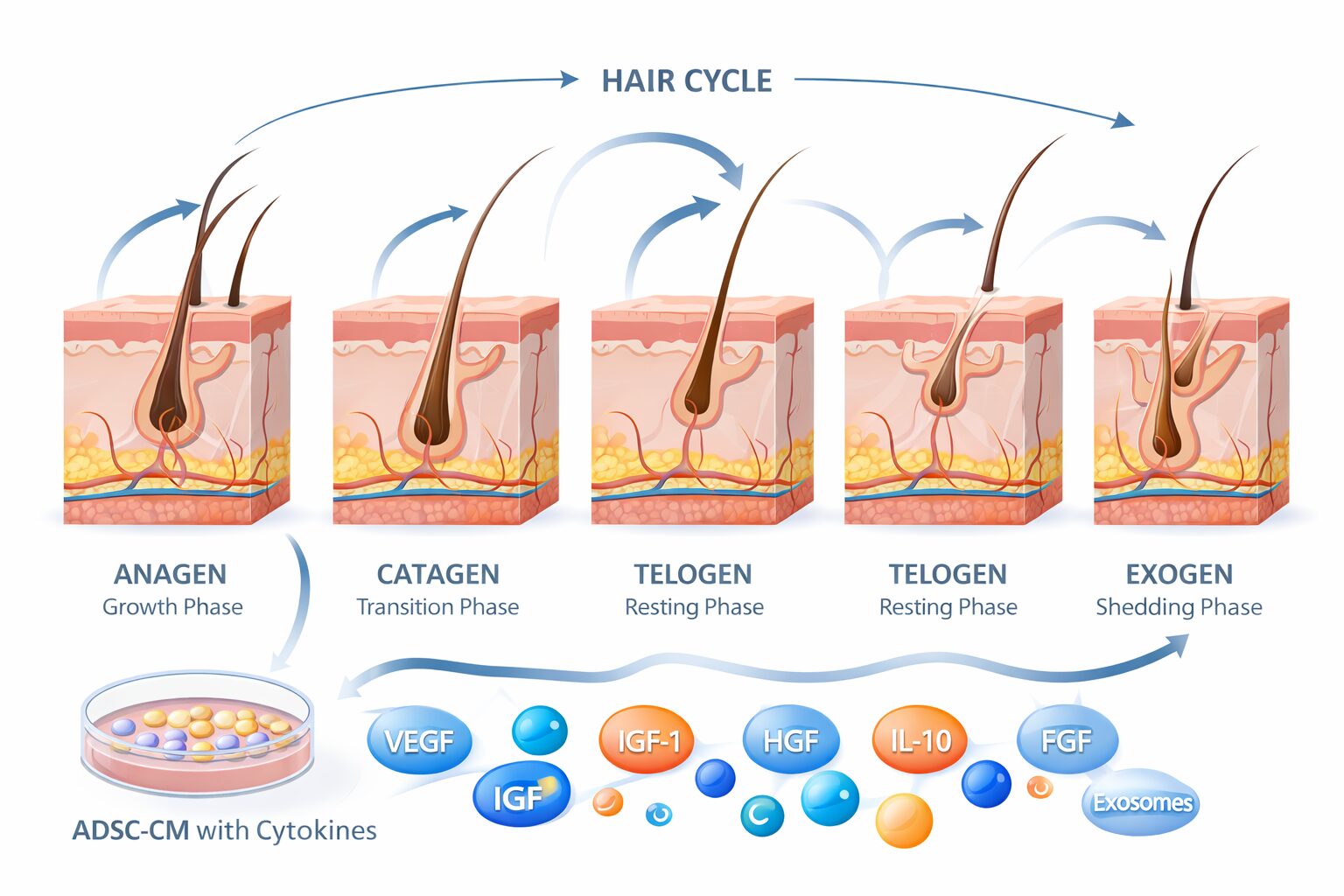
When and Where Does the Atopic Scalp Post-Procedure Flare Appear
Clinically the flare is observed in two distinct time windows. Confusing them leads to over- or under-response and can unnecessarily halt the treatment plan.
0–72 Hours: Transient Redness and Warmth
This is a normal wound response, and in most cases it settles within 1–3 days with cooling and moisturization. The redness and warmth are limited to the treated area and itching is mild. However, if the redness spreads well beyond the treated area, small papules cluster together, or fever appears, treat it as the early form of a flare rather than a routine post-procedure reaction and respond quickly.
2–4 Weeks: Delayed Eczematous Flare
Even when things look calm at first, whole-scalp itching, white scaling, and nummular-eczema-like erythema can appear 2–4 weeks later. This overlaps with the later wound-healing phase, when immune cell infiltration increases, and we evaluate it together with any reactivation of the underlying atopic dermatitis or psoriasis. In psoriasis patients, new lesions may emerge along the puncture tracks as the Koebner phenomenon and need to be distinguished from a routine atopic flare.
Timing for Restarting Topical Therapy to Calm the Atopic Scalp Post-Procedure Flare
A common misconception is: “I just had stem cell conditioned media put in, so I should hold off on steroids for a while.” In most situations this backfires. Letting a flare drag on worsens the follicular environment and forces you to stretch the interval before the next treatment, so the rule for topical steroids is to “restart on the safe side, and restart early.”
When and How Strong to Restart Topical Steroids
On the day of the procedure, restart moisturization first (low-irritant lotion or emulsion). From the next day, if there is itch or erythema, restart a scalp steroid lotion (medium to strong class) intensively for a short period. It is usual to step down half a class from the strength you were using for baseline control, and to first rule out folliculitis before use. If there are signs of infection — pustules, spreading pain, or fever — consider adding an antibiotic rather than using a steroid alone. For the overall framework of topical therapy in atopic dermatitis, please also refer to the guidelines of the Japanese Dermatological Association.
Redesigning Moisturization and Washing
Washing the scalp is generally skipped on the day of treatment; from the next day, resume short washes with lukewarm water (below 38°C) and a low-irritant shampoo, and apply scalp moisturizer immediately afterwards. Hot water, aggressive brushing, and alcohol-containing styling products can easily trigger a flare, so avoid them for at least two weeks post-procedure. Keep hairdryer heat at a distance and for short durations.
Designing Treatment to Prevent the Atopic Scalp Post-Procedure Flare
The most powerful preventive measure is to arrive on the day of the procedure with the skin in a “calm” state. Concretely, for the 1–2 weeks before the appointment, tighten up topical steroid use and moisturization so that there is no active eczema or erythema on the day. In psoriasis, postpone procedures during active disease when new lesions keep appearing, and plan them once remission is reached. Given the risk of the Koebner phenomenon, also check control of lesions on exposed skin outside the scalp.
For patients on biologics such as dupilumab or IL-17 inhibitors, even when skin control is good, the schedule should be built with the treating physician in the loop regarding infection risk and effects on wound healing. As a rule, keep the systemic therapy running and, on the scalp side, adjust interval, output, and puncture depth conservatively.
For other angles on stem cell conditioned media scalp treatment, please also see our hair regenerative medicine column index.
Frequently Asked Questions
Q. Does having atopic dermatitis mean I cannot receive stem cell conditioned media scalp treatment?
Not necessarily. If your skin is under stable control, the procedure is possible. During periods with active eczema or erythema we postpone treatment and first bring the skin into a “calm” state with topical therapy before proceeding.
Q. If I use topical steroids after the procedure, will they cancel out the effect of the stem cell conditioned media?
Letting inflammation persist actually worsens the follicular environment, so there is essentially nothing to gain by holding out on steroids during a flare. Use them for a short course at the minimum necessary strength and stop when things settle.
Q. I have psoriasis. Can I still have scalp Morpheus8?
It can be an option during remission, but because of the risk of the Koebner phenomenon we avoid procedures in active disease. When you are on biologics, we plan while sharing information with your treating physician.
Q. When does post-procedure itching count as a “flare”?
Redness and warmth in the first 0–72 hours are normal reactions. If the area spreads beyond that, or if new itch or eczema appears 2–4 weeks later, treat it as an atopic scalp post-procedure flare and be seen early.
Q. I use dupilumab. How should I align the procedure with the medication?
There is no need to disrupt the dosing cycle itself. Plan the procedure during a week when the skin is stable, and share the most recent dose date and the next scheduled dose with both the treating physician and the regenerative medicine side.
──────────────
Supervising Physician: Shin Moriwaki, MD
Member, Japan Society of Aesthetic Surgery (JSAS) / Member, American Academy of Aesthetic Medicine
ECFMG Certificate
──────────────
📍AVAN TOKYO Ginza Hair Regenerative Medicine
AVAN TOKYO Ginza Hair Regenerative Medicine
English / 中文 / Tiếng Việt supported
Inquiries: DM / LINE / Website / Phone.