


When You Change Your Hair Treatment Clinic Due to Relocation or Transfer: Dr. Moriwaki Organizes How to Hand Over Your Stem Cell Conditioned Media Treatment History to the Next Physician2026.08.03
Hair regenerative medicine is not a “one-and-done treatment” but a treatment whose course is followed over months to years. Precisely for this reason, situations arise where relocation, job transfer, or the limits of commuting burden force patients to change clinics. However, the hair treatment clinic transfer handover is not so simple that it can be completed by verbally passing along oral medication information alone. The dosing history of stem cell conditioned media, the phase of the hair cycle, lot information of the product used, and trichoscopy images — these multiple axes must be delivered in a form that the next physician can read on the same coordinate system. Here, Dr. Moriwaki at AVAN TOKYO Ginza organizes, in practical terms, what to prepare and how to prepare it for a hair treatment clinic transfer handover.
Key Points
・For a hair treatment clinic transfer handover, the top priority is to leave a record — on paper or PDF — of not only oral medication names, but the number of stem cell conditioned media doses, intervals, and lot information of the product used.
・Because the hair cycle moves on a 3–6 month scale, to avoid a “reset of efficacy assessment” immediately after transfer, the continuity of scalp photographs taken under identical conditions becomes the greatest asset.
・Preparing a summary that conveys “which phase you are in now (induction or maintenance)” in a single line to the next physician keeps the treatment design from drifting significantly at the first visit.
・Because this is self-pay medicine, there is no referral-letter custom as in insurance-covered care, and the process must be driven by the patient taking the initiative to carry the information.
Why the Hair Treatment Clinic Transfer Handover Is Harder Than in Other Departments
In a typical internal-medicine or orthopedic transfer, a referral letter (medical information provision letter) is issued, and examination data and prescription details arrive directly at the next facility. However, most hair regenerative medicine is self-pay, and the stem cell conditioned media products used, dosing protocols, and evaluation metrics vary from clinic to clinic. Even if both records say “scalp injection of conditioned media,” if the cell source, dose, and combined drug-delivery device are completely different, to the next physician the information is close to a “different treatment.”
Furthermore, the hair cycle rotates through anagen, catagen, and telogen phases on a scale of several months, so if a transfer happens without progress photographs, the next physician cannot judge whether “the current hair volume is the result of treatment or merely seasonal variation.” The first stumbling block in a hair treatment clinic transfer handover is this loss of “continuity on the time axis.”
Five Information Categories You Should Carry Out
1. Treatment Summary (Consolidated Onto One Page)
If you consolidate onto one A4 page the treatment start date, product name and cell source of the stem cell conditioned media used, number of doses and intervals, concomitant drugs (finasteride, dutasteride, topical minoxidil, etc.), and the current phase, communication at the first visit becomes dramatically faster. In practice, a summary the patient themselves can read is easier for the next physician to handle than handing over a full copy of medical records.
2. Lot Certificate of the Product Used (CoA)
Stem cell conditioned media does not have a completely identical growth-factor profile from lot to lot. If the next clinic uses a different product, the lot information becomes a reference point for comparing past responses. Even carrying copies of the CoA (Certificate of Analysis) for just the most recent few doses can serve as backing that no adverse events occurred previously.
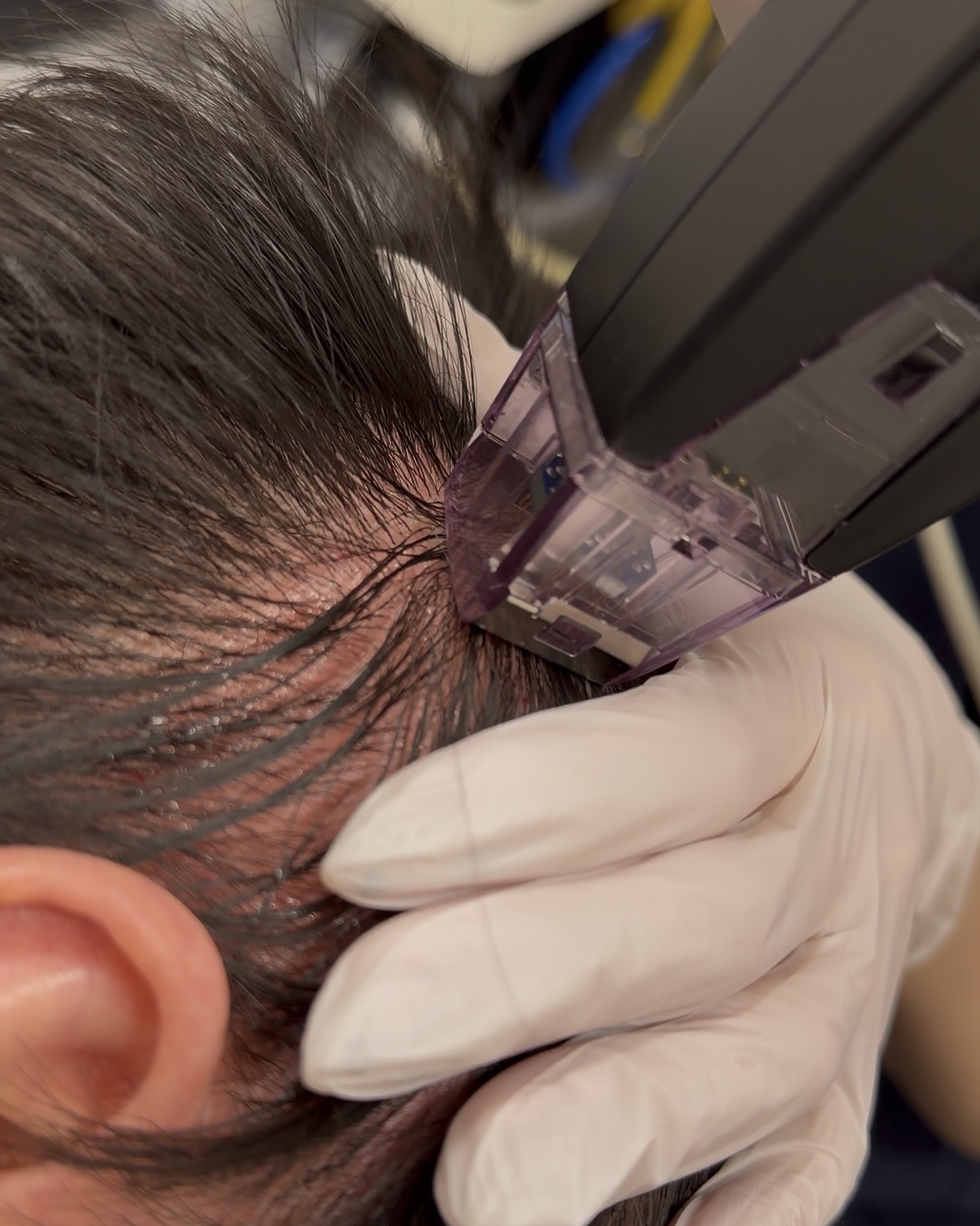
3. Fixed-Point Scalp Photographs (Taken Under Identical Conditions)
The most valuable item in the hair treatment clinic transfer handover is these fixed-point photographs. If frontal, vertex, and occipital photographs — taken at the same distance, the same angle, the same light source, the same hair parting, and the same wet/dry state — are lined up in chronological order, the next physician can read the treatment response objectively. Conversely, without these, there is no choice but to reset the baseline to the hair volume at the first visit, which amounts to a near-treatment-reset situation in effect.
4. Trichoscopy Images and Hair Diameter Measurement Data
If records exist of hair-diameter variability and hairs per follicular unit captured under a microscope, both the AGA progression stage and treatment response can be read. Even if numerical records are not preserved, it is worth requesting that at least the images be saved.
5. Records of Adverse Events and Physical Condition Changes
Episodes such as post-procedure scalp pain, itching, or transient increase in shedding are important information for the next physician when designing dose and interval. Leaving a record — including “nothing in particular happened” — becomes reassurance material.
Convey “Which Phase You Are in Now” to the Next Physician in One Line
Hair regenerative medicine is broadly divided into an “induction phase (period of establishing the follicular environment)” and a “maintenance phase (period of preserving the acquired density).” If this phase is ambiguous at the first visit after transfer, mismatched designs can occur — such as being placed on a maintenance protocol while still in the induction phase, or the reverse.
“I completed six scalp injections of conditioned media at monthly pace, and now I am on my second dose of the maintenance phase at three-month intervals” — if you can convey this level of granularity, the next physician can more easily build a design that respects the continuity of treatment. Rather than rushing, we recommend writing it down on paper first before your visit. Detailed indications and protocols can be checked at the list of related columns on hair regenerative medicine here.
Timing of Drug Interruption and Resumption
If you are combining finasteride, dutasteride, topical minoxidil, and so on, interrupting the drugs during the gap period leading up to the transfer risks losing the treatment effect itself, even before the hair treatment clinic transfer handover. Practical solutions include calculating prescription days to secure a stock that does not run out until the first visit at the next clinic, or temporarily inserting an online consultation. For AGA treatment guidelines, it is also worth referring to those of the Japanese Dermatological Association.
Three Questions to Confirm at the First Visit
When you have your first visit at the next clinic, the three points worth confirming on your side are as follows. First, “how will you reorganize the dosing interval, taking my previous treatment history into account?” Second, “if a different product is used from before, how will you evaluate the response immediately after switching?” Third, “what is the timing of efficacy assessment, and what are the criteria for reconsideration if the response is poor?” If a clinic returns concrete words on these three, the possibility that the hair treatment clinic transfer handover will proceed smoothly can be said to be high.
Frequently Asked Questions
Q. What should I do if the previous clinic does not write a referral letter?
Because there is no custom of referral letters in self-pay medicine, cases where none is written are not unusual. In such cases, the patient themselves requests copies of medical records, receipts, and product information. Since medical information belongs to the patient, disclosure requests are legally recognized.
Q. Will the treatment effect be reset by transferring?
The hair cycle itself is not reset, but if progress photos and records are interrupted, the “continuity of efficacy assessment” is lost. For the next physician, the hair volume at the first visit becomes the baseline, so the evaluation inevitably becomes close to a de facto restart. That is precisely why carrying out photographs and records is important.
Q. Is it okay to change the dosing interval of stem cell conditioned media immediately after transferring?
This depends on the next physician’s judgment, but if the phase (induction/maintenance) and the most recent response are accurately conveyed, adjustment is possible within a reasonable range. Conversely, if information is insufficient, a decision to err on the side of safety and restart from the induction protocol may result.
Q. Can treatment be continued via online consultation?
For oral medication prescription, continuation via online consultation may be possible under certain conditions. However, injections of stem cell conditioned media and device procedures such as Morpheus8 require in-person visits, so a hybrid arrangement in which only the in-person portion is done at the new clinic is also an option.
Q. What are the points to look at when searching for a transfer destination?
Registration under the Act on Securing Safety of Regenerative Medicine, willingness to disclose the CoA of the product used, and an attitude of carefully reading through the information you brought for this hair treatment clinic transfer handover — if these three are in place, the possibility of progressing to the next stage while protecting continuity of treatment becomes high.
──────────────
Supervising Physician: Shin Moriwaki, MD
Member, Japan Society of Aesthetic Surgery (JSAS)
Member, American Academy of Aesthetic Medicine
ECFMG Certificate
──────────────
📍AVAN TOKYO 銀座 毛髪再生医療
AVAN TOKYO Ginza Hair Regenerative Medicine
English / 中文 / Tiếng Việt available
For consultations, please contact us via DM / LINE / Website / Phone.