


For Those Whose Hip Osteoarthritis Now Interferes With Everyday Tasks Like Putting On Socks or Cutting Toenails — Dr. Moriwaki Draws the Line Between What Stem Cell Conditioned Media Hip Injection Can Address in the Intra-articular Inflammatory Cycle and What It Cannot Do for Structural Range-of-Motion Loss2026.08.04
“It has become hard to put on socks,” “I can no longer cut my toenails by myself,” “I can’t sit cross-legged anymore” — these changes in everyday movement can be a sign that hip osteoarthritis range of motion loss is quietly progressing beneath the surface. Because the pain is less intense than that of the knee or the lower back, it is easily dismissed as aging, yet the range of motion for hip flexion and internal rotation gradually narrows, and the burden spreads to the pelvis and lumbar spine as compensation. In this article, Dr. Moriwaki at AVAN TOKYO Ginza organizes why such range-of-motion limitation occurs — the mechanism of joint-capsule contracture and the intra-articular inflammatory cycle — and honestly draws the line between what stem cell conditioned media hip injection can target and what it cannot.
Key Points
・Hip osteoarthritis range of motion loss is accelerated not only by cartilage wear but also by fibrosis and thickening of the joint capsule intertwined with chronic synovitis.
・Flexion and internal rotation are lost first, so everyday tasks such as putting on socks, cutting toenails, sitting cross-legged, and squatting become difficult before other movements.
・Stem cell conditioned media hip injection is one conservative option that can act on the intra-articular inflammatory cycle to modulate pain and the synovitis environment.
・However, an injection cannot mechanically stretch a fibrotic joint capsule or regenerate cartilage that has already been lost.
・For end-stage cases with complete loss of joint space, or for rapidly destructive patterns, evaluation for total hip arthroplasty (THA) should take priority.
“Can’t Put On Socks, Can’t Cut Toenails” Is a Sign the Hip Has Stiffened
The hip is originally a ball-and-socket joint with a wide range of motion — roughly 120 degrees of flexion, and 40 to 45 degrees each of internal and external rotation. It is because this range exists that everyday movements — leaning forward from a chair to put on socks, folding the legs into a cross-legged posture, reaching down with a nail clipper to the toes, or squatting to sort a low shelf — can be performed without difficulty.
As hip osteoarthritis progresses, range-of-motion limitation begins to creep in either before or in parallel with X-ray findings such as narrowed joint space and osteophyte formation. Flexion and internal rotation are especially prone to loss. Thickening of the anterior joint capsule and chronic inflammation of the intra-articular synovium gradually stiffen the movements of bringing the thigh toward the chest and dropping the knee inward.
The person themselves may only feel that “I’ve gotten stiff because of age,” but this is a typical early pattern of hip osteoarthritis range of motion loss. To keep performing the movements, compensations such as posterior tilting of the pelvis and rounding of the lumbar spine occur, and secondary chronic low back pain or sacroiliac pain often appears as well.
Joint-Capsule Fibrosis and the Synovitis Cycle — Why the Range Does Not Come Back Easily
Hip osteoarthritis range of motion loss involves three broadly interwoven elements:
1) Physical contact between the femoral head and acetabulum due to cartilage wear
2) Reduced elasticity of the capsule itself due to fibrosis and thickening of the joint capsule
3) Intra-articular accumulation of inflammatory cytokines (IL-1β, TNF-α, etc.) from chronic synovitis
Among these, the third — chronic synovitis — has recently drawn attention for creating a vicious cycle within the joint: inflammation → cartilage matrix degradation → further synovial irritation. When the synovium swells with inflammation, the joint fluid increases and intra-articular pressure rises, making pain worse with every movement. The person then stops moving the joint, the capsule shrinks further, and the surrounding muscles (iliopsoas and gluteal groups) weaken — this is how hip osteoarthritis range of motion loss deepens through “not moving because of pain.”
In other words, this range-of-motion limitation is the result of “structural problems” and “inflammatory problems” intertwined; addressing only one side is insufficient. The guidelines of the Japanese Orthopaedic Association also position control of intra-articular inflammation as an important pillar of conservative therapy for hip osteoarthritis, alongside weight management and exercise therapy.
What Stem Cell Conditioned Media Hip Injection Can Target Is “Correction of the Inflammatory Cycle”
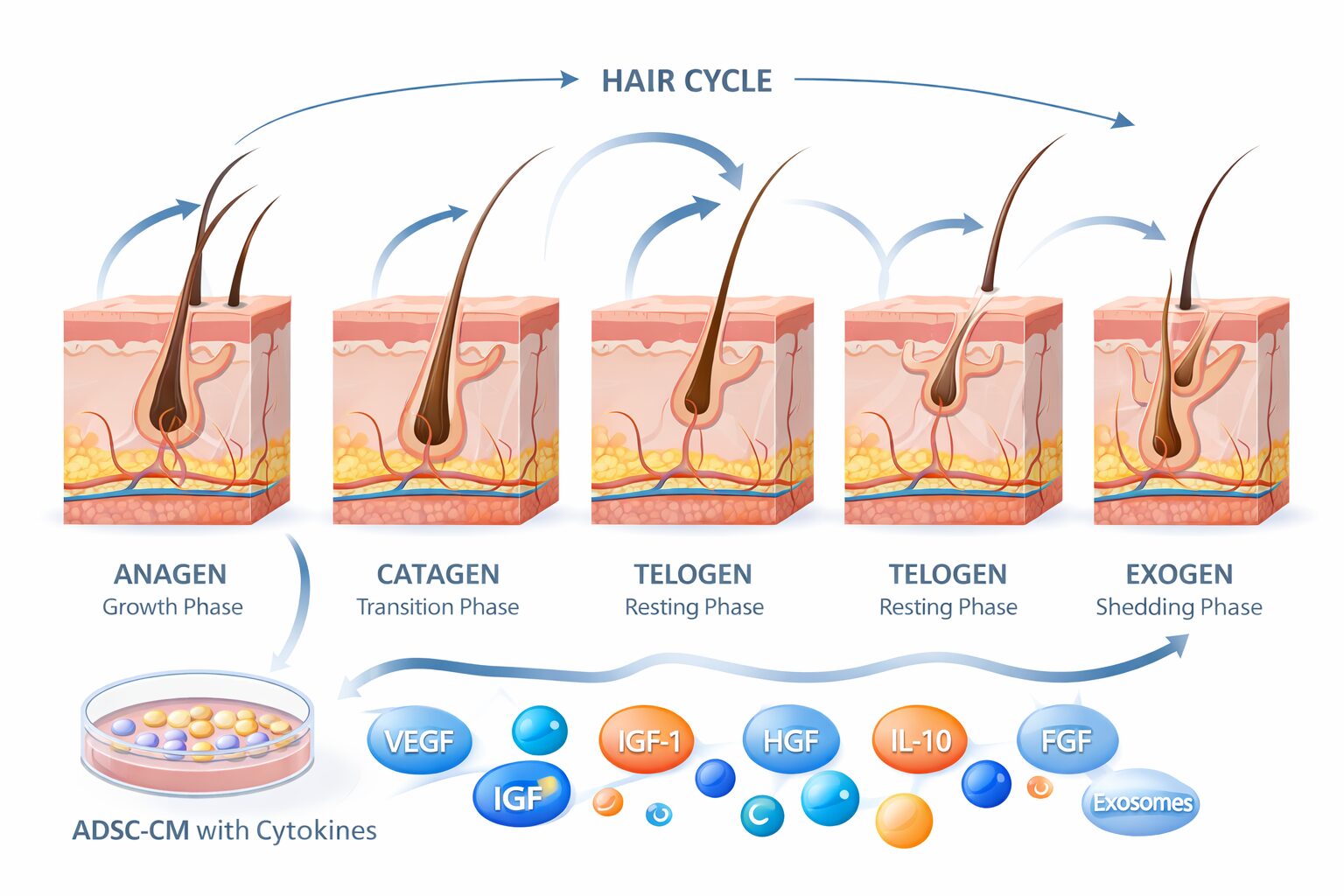
Stem cell conditioned media is the supernatant (secretome) produced when mesenchymal stem cells are cultured — containing growth factors, cytokines, and exosomes secreted by the cells. When delivered into the joint, these components may act on the signaling environment of synovial cells and chondrocytes, with the potential to reduce the expression of inflammatory cytokines and to increase factors involved in tissue repair, as reported in basic research.
What is clinically aimed at is precisely the interruption of the “chronic synovitis cycle” described above. When synovitis calms, the quality and volume of joint fluid normalize, intra-articular pressure drops, and pain lightens. When pain lightens, rehabilitation and walking within a manageable range can continue, and disuse-related decline of the surrounding muscles is suppressed. In this sequence — “quiet the inflammation, maintain a movable state” — cases in which people struggling with hip osteoarthritis range of motion loss gradually find everyday tasks easier can hold meaning as a conservative option.
For more on stem cell conditioned media joint injection, please also see details on stem cell conditioned media joint injection here.
What Cannot Be Targeted — Limits of Organic Contracture and Complete Cartilage Loss
On the other hand, there are things stem cell conditioned media hip injection honestly cannot target.
First, a joint capsule that has become hard and fibrotic over many years cannot be “mechanically” stretched open with an injection to widen the range of motion. Capsule extensibility is a change achieved by patiently accumulating range-of-motion exercises (ROM training), stretching, and in some cases aquatic exercise, in an environment where pain has been suppressed. Injection alone cannot be expected to push the angle itself wider.
Second, in end-stage cases where the joint space has completely collapsed and femoral head deformation has progressed markedly, even if intra-articular inflammation can be somewhat reduced, pain from the physical contact of bone on bone will remain. At this stage, structural reconstruction by total hip arthroplasty (THA) becomes the realistic option for resolving daily-life limitations.
Third, conditions such as septic hip arthritis, the rapid bone-destruction phase of femoral head osteonecrosis, and purulent arthritis are not appropriate for injection-based conservative therapy as first-line treatment. Because different conditions requiring specialist differentiation may hide behind similar-looking “hip osteoarthritis range of motion loss,” pre-treatment imaging evaluation and diagnosis are essential.
Combining Hip Injection With Exercise Therapy and Weight Management Is the Foundation
Even when choosing stem cell conditioned media hip injection, the realistic positioning is not that the injection alone restores daily movement, but rather that “in a state where inflammation has been calmed, you build the foundation for maintaining and recovering range of motion and muscle strength.”
Particularly important are:
・Stretching and strength training for the iliopsoas and gluteal muscles
・Weight management (the hip bears 3–4 times body weight during walking, and even more when climbing stairs)
・Reviewing Japanese-style habits (avoiding deep floor sitting, seiza, and very low chairs)
・Using assistive devices such as canes and appropriate shoes
Progressing these lifestyle and exercise instructions alongside treatment is key. Whether such exercise therapy can be built into the “low-pain period” gained through injection becomes a major divide in confronting hip osteoarthritis range of motion loss. Individual variation and the limits of indication must be the premise; please concretize any treatment design together with your attending physician, based on your own imaging and lifestyle context.
Frequently Asked Questions
Q. Will my hip osteoarthritis range of motion loss return to how it was before with stem cell conditioned media hip injection?
Unfortunately, this is not a treatment that can promise “back to how it was.” What can be targeted is to modulate the intra-articular inflammatory cycle and, in a state where pain is reduced, to build the foundation for engaging in exercise therapy and range-of-motion training. The range itself widens gradually only when rehabilitation and revised daily movement patterns run in parallel, and there is individual variation.
Q. If I have reached the stage of “can’t put on socks,” is total hip arthroplasty the only option left?
Not necessarily. If some joint space remains and the pain component from chronic synovitis is strong, conservative therapy including stem cell conditioned media hip injection may allow you to “hold on.” However, in end-stage cases with complete joint-space loss or significant femoral head deformity, evaluation for total hip arthroplasty (THA) becomes the priority. Careful judgment is needed based on both imaging findings and the degree of daily-life disability.
Q. Is a hip injection more difficult than a knee joint injection?
The hip lies deep beneath the skin, with major blood vessels and nerves running around it. For that reason, performing the injection under ultrasound (echo) or fluoroscopic guidance is important from a safety standpoint. Our clinic also confirms the needle tip’s position under imaging to ensure reliable delivery into the joint capsule.
Q. How many injections are needed, and at what intervals?
There is no single correct answer. A common design is to perform several injections at relatively short intervals during the induction phase, evaluate the response, and then widen the interval in the maintenance phase. Because the optimal interval and number vary with the degree of joint destruction, age, and lifestyle, it is realistic to discuss and decide after the first efficacy assessment.
Q. Can I bathe or walk on the day of the hip injection?
To avoid infection risk at the puncture site, it is common to avoid bathing (tub, hot spring, sauna) on the day and use only a shower. Walking is fine within a comfortable range, but exercises that place strong impact on the hip — long-distance walking, jogging, repeated stair climbing — should be avoided for a few days. Please follow the instructions given on the day of treatment.
──────────────
Supervising Physician: Shin Moriwaki, MD
Member, Japan Society of Aesthetic Surgery (JSAS)
Member, American Academy of Aesthetic Medicine
ECFMG Certificate (U.S. Medical License Qualification)
──────────────
📍AVAN TOKYO 銀座 再生医療
AVAN TOKYO Ginza Regenerative Medicine
English / 中文 / Tiếng Việt available
For consultations, please contact us via DM / LINE / Website / Phone.