


Is “Exosomes Alone” Enough?2026.04.29
A Doctor’s Perspective on the Difference Between Exosomes and Conditioned Media
In hair regenerative medicine and aesthetic regenerative therapy, two terms are frequently discussed:
Exosomes
Stem Cell Conditioned Media
Both are often grouped together under the broad image of “regenerative medicine,” but in reality they are not the same.
Many patients ask:
“Are exosomes alone enough?”
“Is conditioned media stronger?”
“Which one should I choose?”
The honest answer is:
It is less about whether exosomes alone are “good or bad,” and more about the goal, the treatment environment, and how the therapy is delivered.
At AVAN TOKYO, we focus not on trend words—but on content and treatment design.
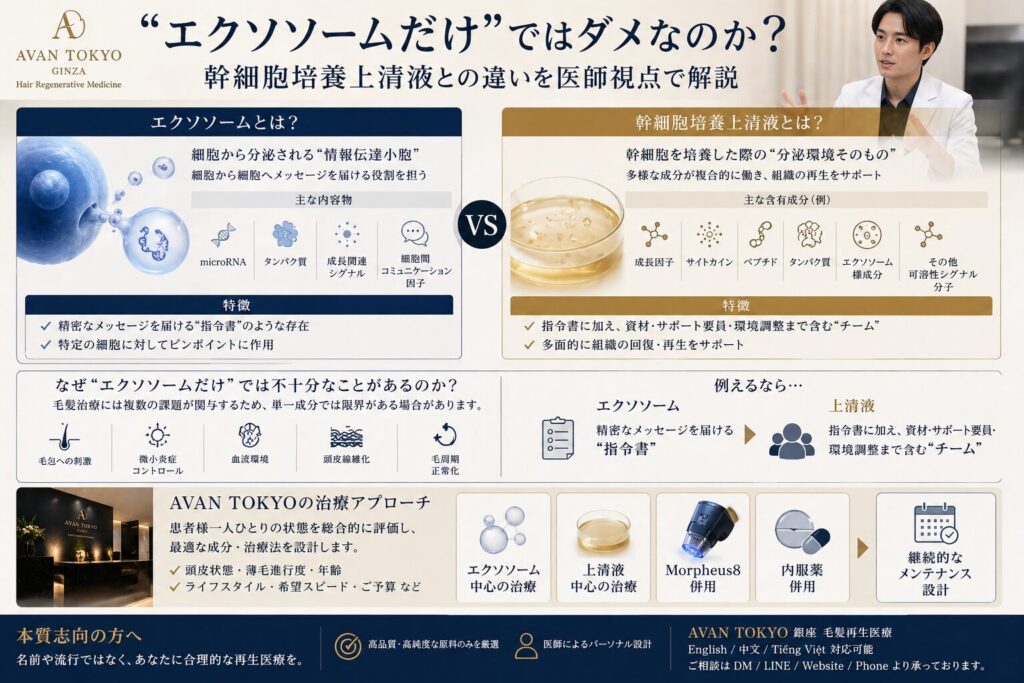
What Are Exosomes?
Exosomes are extremely small extracellular vesicles released by cells.
They may contain:
- microRNA
- Proteins
- Growth-related signaling factors
- Cell-to-cell communication molecules
Simply put:
They function as biological messengers between cells.
What Is Stem Cell Conditioned Media?
Stem cell conditioned media refers to the fluid collected after stem cells are cultured.
It may contain various secreted factors such as:
- Growth factors
- Cytokines
- Peptides
- Proteins
- Exosome-like components
- Other soluble signaling molecules
In simple terms:
It can be viewed as a broader secreted environment, rather than a single isolated component.
So, Are Exosomes Alone Not Enough?
The answer is nuanced.
Not necessarily.
But relying on a single-component mindset may be limiting.
Hair restoration often involves multiple factors:
- Follicular stimulation
- Micro-inflammation control
- Circulation support
- Scalp fibrosis
- Hair cycle normalization
For this reason, one isolated component may not address every issue.
A Simple Analogy
Exosomes
A precise instruction message.
Conditioned Media
A broader support team that may include instructions, resources, and environmental support.
Both concepts can be valuable depending on the case.
What Really Matters in Hair Regenerative Medicine
At AVAN TOKYO, we prioritize:
1. Origin and Quality
- Cell source
- Manufacturing standards
- Safety control
- Stability
2. Delivery Method
- Scalp injection
- Drug delivery support
- Combination with Morpheus8
- IV support when appropriate
3. Fit for the Patient
- Shedding-dominant concerns
- Thinning-dominant concerns
- Inflammatory scalp tendencies
- Preventive goals
In other words:
Not only what is used—but who it is used for, and how.
The AVAN TOKYO Approach
We do not build treatment plans around marketing buzzwords.
We evaluate:
- Scalp condition
- Degree of thinning progression
- Age
- Lifestyle
- Desired speed of improvement
- Budget
Then determine whether a patient may benefit more from:
- Exosome-focused therapy
- Conditioned media-focused therapy
- Combination with Morpheus8
- Medical therapy support
Why Sophisticated Patients Choose This Approach
Patients who value substance often care more about:
- Real quality over labels
- Reproducibility over hype
- Long-term outcomes over trends
At AVAN TOKYO, we focus on what is rational for the individual patient.
Conclusion
“Are exosomes alone enough?”
The more accurate answer is:
Single-component thinking may be too simplistic.
Results often depend on:
- Biological content
- Product quality
- Delivery design
- Scalp environment
- Continuity strategy
AVAN TOKYO provides regenerative medicine guided by substance—not marketing language.
📍AVAN TOKYO Ginza Hair Regenerative Medicine
English / 中文 / Tiếng Việt Available