


PCOS and Female Hair Loss: How Androgen Excess and Insulin Resistance Affect Hair Follicles, and Why Stem Cell Conditioned Media Matters2026.06.22
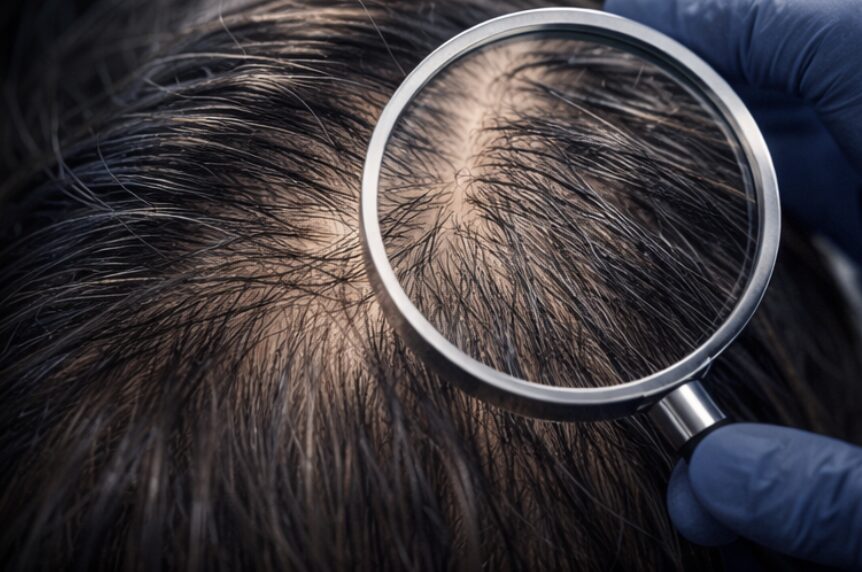
“My scalp started showing through at the crown in my late 20s.” “Irregular periods, acne, and hair shedding all increased at the same time.” In our clinic, women presenting with these complaints often turn out to have PCOS (Polycystic Ovary Syndrome) in the background. PCOS is one of the most common endocrine disorders, affecting an estimated 5–10% of women, and it causes not only menstrual irregularity and infertility, but also significant scalp thinning and FAGA (Female Androgenetic Alopecia). In this article, we organize why PCOS weakens the hair follicle at the molecular level, and explain the role that stem cell conditioned media plays as a regenerative option for the scalp.
What Is PCOS? A Dual Disorder of Hormones and Metabolism
PCOS is not simply a condition in which the ovaries develop multiple small cysts. It is a syndrome built on three intersecting axes: androgen excess, ovulatory dysfunction, and insulin resistance. Prevalence among Japanese women is reported at roughly 5–8%, spanning from puberty to perimenopause.
How Androgen Excess Damages the Follicle
In PCOS, testosterone and androstenedione derived from the ovary and adrenal glands tend to rise, and these are converted by 5α-reductase into the more potent DHT (dihydrotestosterone). DHT binds androgen receptors expressed on follicles of the frontal and vertex scalp, driving follicular miniaturization. The molecular pathway mirrors male AGA, yet in women the clinical picture is diffuse thinning known as FAGA. Concurrent virilizing signs such as facial acne, hirsutism, or voice deepening may also appear, so the issue must be approached as a whole-body androgen environment, not as a scalp-only problem. For clinical guidelines on AGA and FAGA, refer to the Japanese Dermatological Association.
Insulin Resistance and Chronic Inflammation
The second axis is insulin resistance. Hyperinsulinemia further stimulates ovarian theca cells to produce androgens, creating a vicious cycle. In addition, visceral fat accumulation and chronic low-grade inflammation (elevated TNF-α and IL-6) damage the perifollicular microenvironment and injure the hair follicle stem cell niche. AGEs (advanced glycation end products) generated by excessive carbohydrate intake also accelerate aging of the dermal papilla cells. PCOS hair loss is therefore best understood as a condition where hormonal and metabolic abnormalities multiply on the follicle.
Why Stem Cell Conditioned Media Is Effective for PCOS-Related Hair Loss
Because female hair loss in PCOS involves hormonal, metabolic, and inflammatory layers, response to minoxidil alone or oral therapy alone is often limited. This is where stem cell conditioned media is drawing attention as a regenerative therapy for the scalp.
A Cytokine Cocktail That Redesigns the Follicular Niche
Stem cell conditioned media is the supernatant collected from the culture of mesenchymal stem cells (typically adipose-derived) and contains hundreds of growth factors, cytokines, and exosomes. KGF, VEGF, IGF-1, HGF, and FGF-7 are among them, and they activate the Wnt/β-catenin pathway in dermal papilla cells, promoting transition from telogen to anagen. For the typical PCOS picture—”follicles remain but are miniaturized”—stem cell conditioned media plays the role of reigniting the signaling that grows hair back thicker and longer.
Anti-Inflammatory Action and Improved Scalp Blood Flow
Stem cell conditioned media also contains anti-inflammatory cytokines such as TGF-β and IL-10, which calm the scalp environment exhausted by PCOS-related chronic inflammation. VEGF-driven micro-angiogenesis restores scalp blood flow that has declined due to insulin resistance and replenishes nutrient supply to matrix cells. At AVAN TOKYO, we combine direct injection with Morpheus8 drug delivery so that stem cell conditioned media can reach the deep dermis and fat layer where the follicular stem cell niche resides. Even patients who dislike needles can benefit from uniform deep delivery beyond the epidermis.
Maximizing Treatment for PCOS Patients
Stem cell conditioned media is a powerful option, but when a systemic disease like PCOS sits in the background, it is unwise to rely on scalp therapy alone.
Running in Parallel With Gynecology and Endocrinology
We first recommend that patients have their gynecologist check hormonal panels (testosterone, DHEA-S, LH/FSH ratio), fasting insulin, and HbA1c. Combining systemic therapy—low-dose oral contraceptives, metformin, spironolactone—with local treatment using stem cell conditioned media allows us to address both the root cause and the phenotypic expression. Scalp therapy cannot rewrite systemic hormones, and conversely systemic medication cannot easily reverse structural follicular miniaturization. That is exactly why combining the two is the realistic approach.
Lifestyle Refinement Amplifies the Effect
A low-GI diet, moderate aerobic exercise, and adequate sleep directly improve insulin resistance. These shape the metabolic environment around the follicle and lift the ceiling of what stem cell conditioned media can achieve. Conversely, extreme carbohydrate restriction can backfire by inducing telogen effluvium, so the plan should be designed with a physician. For more on case design and clinical thinking, see our collection of hair regenerative medicine columns.
Summary
Female hair loss caused by PCOS is a complex condition layered with androgen excess, insulin resistance, and chronic inflammation. Superficial shedding remedies are not enough; hormones, metabolism, and scalp microenvironment must be addressed simultaneously. Stem cell conditioned media works directly on the follicular niche and offers a rational regenerative option for FAGA in the context of PCOS. Before giving up because “it’s a hormonal problem and can’t be fixed,” we encourage you to learn about the latest regenerative medicine for hair.
──────────────
Supervising Physician: Shin Moriwaki, MD
Member, Japan Society of Aesthetic Surgery (JSAS)
Member, American Academy of Aesthetic Medicine
ECFMG Certificate (USA)
──────────────
📍AVAN TOKYO Ginza Hair Regenerative Medicine
English / 中文 / Tiếng Việt available
Inquiries welcomed via DM / LINE / Website / Phone.