


For patients whose hair quality does not return to “the way it was” after chemotherapy: Dr. Moriwaki explains the mechanisms behind persistent chemotherapy-induced alopecia (CIA), and draws the line between what stem cell conditioned media scalp treatment can address (rebuilding the follicular microenvironment) and cannot address (replacing lost hair follicle stem cells themselves)2026.08.11
Six months, one year, or even longer after finishing chemotherapy, some patients tell us that their hair still does not have the body and thickness it once had, that only thin, weak vellus-like hairs come in and never fully mature, or that density around the hairline and crown remains stubbornly lower than before. Visits to AVAN TOKYO Ginza for this concern have been increasing in recent years. Chemotherapy-induced alopecia (CIA) has long been explained as “a side effect that will grow back naturally once treatment ends,” but in reality a certain proportion of patients experience chronic changes in the follicular microenvironment and a delayed reset of the hair cycle, and this is now recognized medically as “persistent chemotherapy-induced alopecia (persistent CIA).” In this article, Dr. Moriwaki honestly draws the line between what stem cell conditioned media scalp treatment can and cannot address in chemotherapy-induced alopecia.
Key Points of This Article
・Chemotherapy-induced alopecia is an acute hair loss that occurs when anticancer drugs, while targeting rapidly dividing cancer cells, also affect actively dividing hair matrix cells. In most patients, hair regrows within 6 to 12 months after treatment ends.
・However, in approximately 10 to 30 percent of patients, persistent chemotherapy-induced alopecia develops, in which hair quality, hair shaft caliber, and density never return to what they were before treatment. This is reported to be more common with taxane-based regimens and after conditioning for hematopoietic stem cell transplantation.
・The mechanisms are thought to involve damage to the hair follicle stem cell niche, ongoing microinflammation, and failure of the signaling that reactivates the anagen phase.
・Stem cell conditioned media scalp treatment is a complementary approach that acts on the follicular microenvironment (perifollicular blood flow, growth factors, inflammatory cycle) and is not a treatment that supplies replacement hair follicle stem cells themselves.
・The recommended sequence is to first obtain approval from the oncology treatment team (medical oncology, breast surgery, etc.) and then proceed stepwise in cooperation with dermatology and hair medicine specialists.
Why does chemotherapy-induced alopecia (CIA) occur?
Most anticancer drugs are designed to target cells that divide rapidly. Few agents can selectively strike only cancer cells, and normal tissues that also divide actively—such as the intestinal mucosa, bone marrow, and the hair matrix—are inevitably caught in the crossfire, which is why hair loss is an unavoidable side effect. Anthracyclines (doxorubicin), taxanes (paclitaxel, docetaxel), cyclophosphamide, and etoposide are among the regimens known to cause CIA with high frequency.
CIA falls broadly into two patterns. One is “anagen effluvium,” in which hair matrix cells in the anagen phase are abruptly halted by the drug and the weakened hair shafts shed all at once within two to three weeks after administration. The other is “telogen effluvium,” in which drug burden and systemic stress synchronize many follicles into the telogen phase and diffuse shedding follows several months later. In clinical practice, the two patterns often coexist.
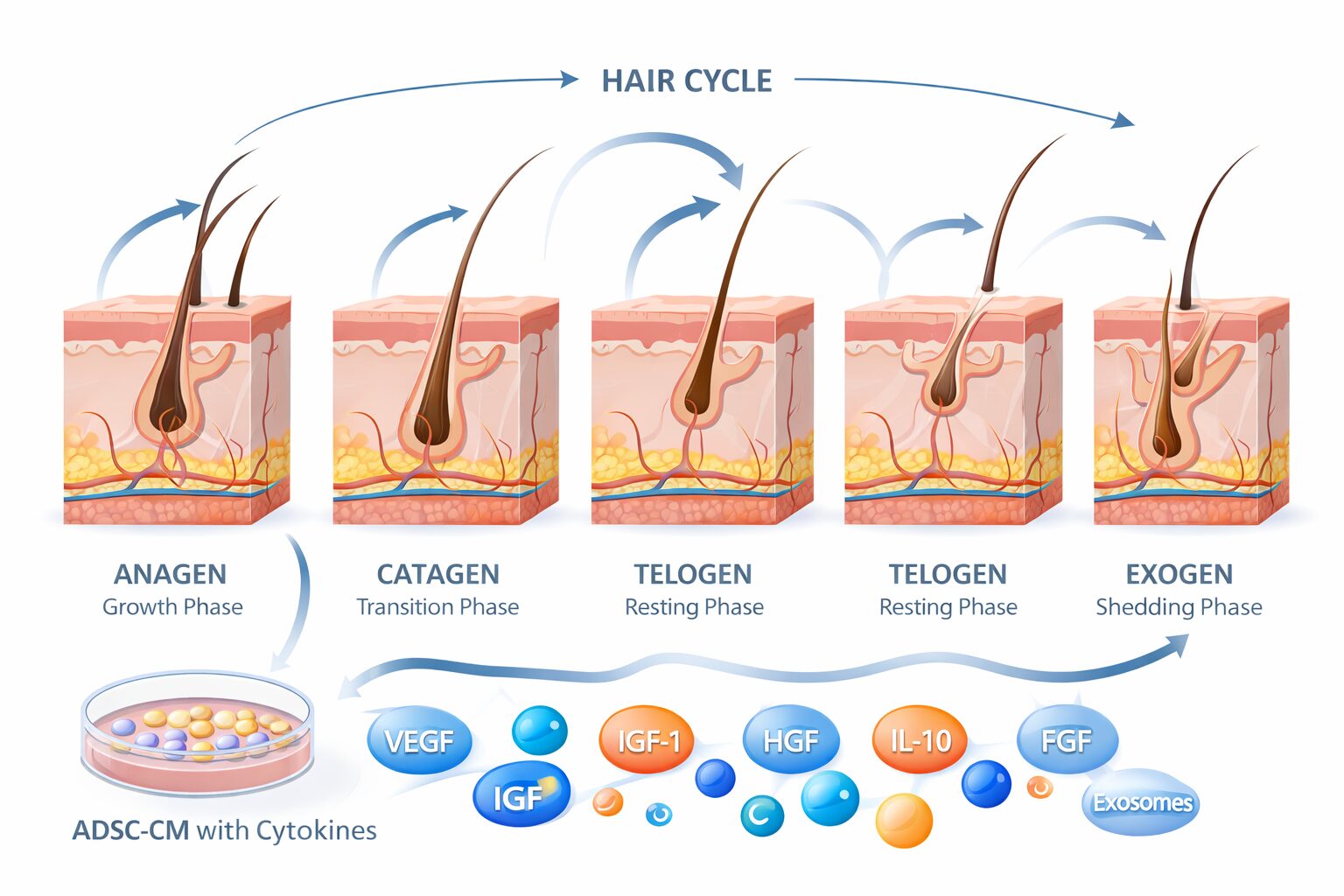
The reality of persistent CIA: recovery is not always “back to the way it was”
Once chemotherapy ends, surviving hair matrix cells resume division, and in most patients new hair fills in over the following 6 to 12 months. In recent years, however, it has become recognized that in about 10 to 30 percent of patients, “Permanent/Persistent CIA (pCIA)” occurs. It is reported to be more common with taxane-based regimens (often used for breast cancer) and with high-dose busulfan or cyclophosphamide conditioning before hematopoietic stem cell transplantation, leaving lasting effects on quality of life.
The pathophysiology of persistent CIA is not fully understood, but three factors are currently thought to overlap:
1. Damage to the hair follicle stem cell niche: stem cells in the “bulge region,” which drive follicle regeneration, are reduced in number and function by anticancer drugs.
2. Persistent microinflammation: abnormal activation of immune cells around the follicle and a tendency toward fibrosis continue.
3. Failure of hair-cycle restart signaling: pathways such as Wnt/β-catenin, which promote the transition from telogen to anagen, become sluggish.
As a result, hair may grow back but stay thin and weak, recovery may lag specifically at the hairline or crown, and hair quality may change from before treatment (curling, altered pigmentation).
What stem cell conditioned media scalp treatment can “target”
For persistent chemotherapy-induced alopecia, stem cell conditioned media scalp treatment can be considered as an option that works complementarily from the angle of “rebuilding the follicular microenvironment.” The mechanisms it is considered to target include:
・Improved perifollicular blood flow (through angiogenic factors such as VEGF)
・Encouragement of the transition from telogen to anagen (through growth factors such as IGF-1, HGF, and KGF)
・Suppression of chronic microinflammation (through anti-inflammatory cytokines and immunomodulatory factors)
・Support for hair-cycle reset, helping to raise hair caliber and quality
It is positioned as a conservative option that can approach the follicular microenvironment of the scalp directly and may be worth considering as a complementary treatment for persistent CIA that responds poorly to oral or topical therapy. Please also refer to our list of related columns on hair regenerative medicine.
Being honest about what it “cannot target”: indications and limits
At the same time, stem cell conditioned media scalp treatment for chemotherapy-induced alopecia has clear limits. Starting treatment while leaving these vague creates a gap between patient expectations and actual outcome, and risks further exhausting patients who have already had a hard time with persistent CIA.
・It is not a treatment that “supplies” replacement hair follicle stem cells that have been lost.
・It cannot restore areas where follicles have been fully scarred (scarring alopecia after trauma or severe inflammation).
・Individual response varies by the type of chemotherapy, the severity of persistence, and the time since the end of treatment.
・Strong evidence from large case series and comparative trials is still being accumulated, and effects cannot be guaranteed.
The Japanese Dermatological Association, which drafts the AGA clinical practice guidelines, also emphasizes the importance of individual evaluation in cooperation with dermatologists for post-chemotherapy hair loss, and we follow this stance at our clinic.
The sequence for considering treatment and cooperation with the oncology team
When a patient with chemotherapy-induced alopecia is considering stem cell conditioned media scalp treatment, we recommend the following sequence:
1. Obtain approval from the oncology treatment team (medical oncology, breast surgery, etc.) for injection- and energy-based procedures on the scalp.
2. Observe natural recovery for at least six months after the end of treatment (most acute CIA recovers during this period).
3. Dermatological evaluation: use trichoscopy to check microinflammation of the scalp, the state of the follicles, and to differentiate other forms of hair loss that need to be considered (such as prolonged telogen effluvium).
4. Introduce stem cell conditioned media scalp treatment stepwise as needed, and follow the course using hair caliber, density, and subjective assessment.
When immunosuppression is ongoing, when active infection is present, when there is thrombocytopenia or coagulation abnormalities, or when there is clear impairment of skin barrier function from chemotherapy, procedures should be postponed or judged not indicated. For patients still on hormonal therapy (such as tamoxifen or aromatase inhibitors for breast cancer), we make individual judgments including scalp condition and overall systemic status.
Frequently Asked Questions
Q. Is it safe to start stem cell conditioned media scalp treatment immediately after chemotherapy ends?
Immediately after chemotherapy, immune function, platelet counts, and the skin barrier are unstable. We recommend observing natural recovery for at least three to six months after the end of treatment, and then considering stepwise treatment only after receiving approval from the oncology team (medical oncology, breast surgery, etc.). Since most acute chemotherapy-induced alopecia recovers during this period, there is no need to rush external intervention.
Q. Does chemotherapy-induced alopecia always come back to the way it was?
Most patients recover within 6 to 12 months after the end of treatment, but there are reports that persistent chemotherapy-induced alopecia remains in about 10 to 30 percent. Frequency is particularly high with taxane-based agents and after conditioning for hematopoietic stem cell transplantation, and there are cases in which hair quality and density do not return to “the way it was.” Please observe the course without rushing, and consider consulting dermatology or hair medicine if recovery remains poor beyond 6 to 12 months.
Q. Can stem cell conditioned media rebuild the hair follicle itself?
No, it cannot. Stem cell conditioned media is a treatment that acts on the follicular microenvironment (perifollicular blood flow, growth factors, and the inflammatory cycle) and is not a treatment that “builds new” follicles or restores scarred scalp. It is strictly a complementary approach that supports the functional recovery of remaining hair follicles.
Q. I used scalp cooling during chemotherapy. How does that pair with stem cell conditioned media after treatment ends?
Scalp cooling is used during chemotherapy to reduce drug delivery to hair matrix cells; because its purpose and timing differ from stem cell conditioned media scalp treatment after chemotherapy, the two can coexist. Persistent CIA can occur even after scalp cooling, so please consider stem cell conditioned media based on the course after treatment as needed.
Q. If I have a history of cancer treatment, can I never receive stem cell conditioned media scalp treatment?
A history of cancer treatment is not itself an absolute contraindication. However, current systemic status, the view of the oncology team, the presence or absence of immunosuppression or active infection, the interval since surgery or chemotherapy, and other factors must be assessed comprehensively. Honestly sharing your treatment history, medications used, current oral medications, and whether hormonal therapy is ongoing at your first visit is the foundation of safe treatment design.
──────────────
Supervising Physician: Dr. Shin Moriwaki
Member of the Japan Society of Aesthetic Surgery (JSAS) / Member of the American Academy of Aesthetic Medicine
ECFMG Certificate
──────────────
📍AVAN TOKYO 銀座 毛髪再生医療
AVAN TOKYO Ginza Hair Regenerative Medicine
English / 中文 / Tiếng Việt supported
Consultations available via DM / LINE / Website / Phone.