


Can Hair Ever Regrow on a Scalp Made Smooth by Trauma or Burn Scars? — Dr. Moriwaki Organizes What Post-Traumatic Scarring Alopecia Actually Loses, and What Stem Cell Conditioned Media Can and Cannot Save2026.07.29
“After I split my scalp open in an accident, hair simply stopped growing on that patch,” “the burn scar from childhood is still smooth and hairless,” “the scar from my head surgery stands out and bothers me” — these are consultations we receive not infrequently at our hair regeneration outpatient clinic. Medically, this condition is called post-traumatic scarring alopecia, and it arises through a mechanism that is fundamentally different from AGA (androgenetic alopecia) or female diffuse thinning. Patients often hope, “maybe if you inject stem cell conditioned media, it will grow back,” but with scarred follicles there is an “area we simply cannot restore” that has to be communicated honestly. From Dr. Moriwaki’s perspective, this article returns to the underlying mechanism and organizes what stem cell conditioned media can and cannot do for post-traumatic scarring alopecia.
Key Points
・Post-traumatic scarring alopecia is a type of thinning in which the follicle itself has been replaced by fibrous tissue — pathophysiologically distinct from AGA or telogen effluvium.
・Follicles in fully scarred areas cannot be newly generated by current regenerative medicine, stem cell conditioned media included.
・What stem cell conditioned media can support is improving the environment of still-viable follicles at the scar margin, and assisting the control of active inflammation.
・Meaningful cosmetic improvement typically requires combination with hair transplant or dermatological/surgical treatment — dermatological evaluation should come first.
Post-Traumatic Scarring Alopecia Is Thinning Where the Follicle Itself Is Gone
Thinning is a single word, but what happens underneath differs completely by disease type. In AGA and female diffuse thinning, the follicle itself remains — changes in hair caliber and duration of the anagen phase produce a state where the hair “looks thin.” In alopecia left behind by trauma, burns, deep lacerations, or chronic inflammatory scalp disease, the structure we call the follicle has been destroyed physically and inflammatorily, and replaced by fibrous scar tissue.
What Sets It Apart from Non-Scarring Alopecia
In non-scarring alopecia (AGA, telogen effluvium, some forms of alopecia areata), the follicular sheath, the dermal papilla, and the follicular stem cell niche are largely preserved. That is why, when hormones, inflammation, and nutritional status are optimized, the follicle still has room to re-enter the anagen phase and grow hair. In scarred areas, however, once the follicle has been lost, fibroblast-derived collagen fills the space, and there is simply no “factory that produces hair” left. Sprinkling raw materials on an empty lot where the factory has been demolished will not produce a finished product — this is the fundamental reason why injecting stem cell conditioned media into a scar itself does not lead to new hair.
Three Structures Lost in Scar Tissue
When the scalp is deeply damaged by trauma or burns, three structures are irreversibly lost. First, the bulge region where follicular stem cells reside. Second, the vascular network of the papillary dermis. Third, the dermal papilla cells that act as the command center for follicular regeneration. When these three are lost together, no matter what growth signals are sent to surrounding cells, the origin point for reconstruction itself is gone. In dermatology, this is called a “follicle-destructive (cicatricial)” pattern and is strictly distinguished from non-scarring thinning.
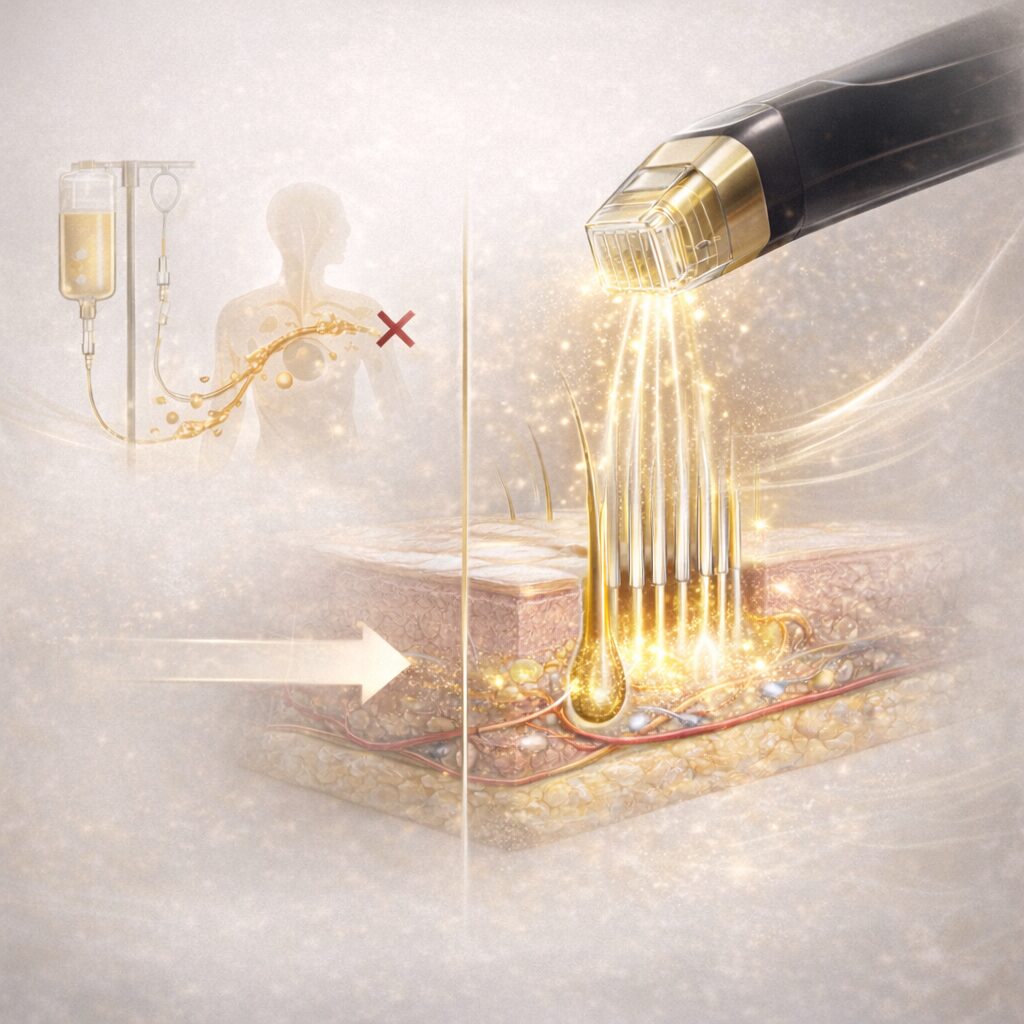
What Stem Cell Conditioned Media Can and Cannot Reach
The most common misconception is, “if you inject conditioned media, hair will grow out of the scar.” This is a point we need to communicate honestly.
What Cannot Be Restored: Follicles in a Fully Scarred Area
In fully fibrotic scar areas, no current regenerative treatment — stem cell conditioned media included — can newly generate the lost follicle itself. At the research level, follicular regeneration is being pursued, but we are not yet at a stage where we can say “it works” in everyday clinical practice. Even if the scar’s color and softness may change, this should be treated as a separate matter from “hair regrowth.”
What We Can Expect: The Scar Margin and Inflammation Control
On the other hand, at the periphery of the scar there are often follicles that are “still alive but beginning to miniaturize.” Here, cytokines contained in stem cell conditioned media — such as IGF-1, HGF, VEGF, and TGF-β — may have room to act. In cases such as lichen planopilaris (LPP), where follicular destruction is ongoing due to active inflammation, a realistic strategy is to first calm the inflammation with topical steroids or immunosuppressive treatment in dermatology, and then combine conditioned media as an adjunct to support the environment of surrounding follicles. For related material, please also see our hair regenerative medicine column archive.
Treatment Design by Type
Burn Scars and Post-Thermal Alopecia
In deep second-degree burns or worse, follicles in the deep dermis are lost en bloc. Regrowth cannot be expected there. If the scar area is wide, flap reconstruction or tissue expansion of hair-bearing scalp by plastic surgery becomes the first-line choice. If the area is narrow, hair transplantation to “move” hair into the scarred zone is a realistic strategy.
Alopecia After Head Trauma or Surgery
Suture-line marks and incision lines after neurosurgery form linear scars. Linear scars are well suited to hair transplantation, and it is common to plan transplant three to six months post-operatively, once the scar has matured. For miniaturizing follicles at the periphery, adjunctive use of stem cell conditioned media can, in some scenarios, contribute to caliber recovery.
Keloid and Hypertrophic Scar Phenotypes
Patients with a keloid phenotype run the risk of keloid flare or expansion if mechanical stimulation is applied to the scar itself with procedures such as dermapen or Morpheus8. It is safer to prioritize keloid and hypertrophic scar management along the lines of guidance from the Japanese Dermatological Association and to avoid direct intervention on the scar itself.
Priority Order to Keep in Mind for Post-Traumatic Scarring Alopecia
At AVAN TOKYO Ginza, when we receive consultations for post-traumatic scarring alopecia we hold to the following order. First, we check whether the scar has entered its “stable phase.” Within roughly six months of injury, when redness and firmness still remain, the scar itself is still moving, and injection or thermal stimulation can be counterproductive. Second, we rule out phenotypes such as lymphocytic scarring alopecia (LPP, frontal fibrosing alopecia, etc.) in which “follicles are still being destroyed by active inflammation.” Miss this, and the background inflammation will advance and the scarred area will simply expand. Third, we balance with surgical options such as hair transplantation and flap reconstruction, designing a “division of roles” that fits the patient’s scar type. We make sure at the first visit that patients understand results and cosmetic improvement vary between individuals and that we cannot guarantee complete restoration to the original state.
Frequently Asked Questions
Q. Can hair be regrown from an accident scar?
From a fully scarred area itself, current regenerative medicine — stem cell conditioned media included — cannot induce new hair growth, because the “factory that produces hair” (the follicle) is gone. That said, protecting living follicles at the scar margin, or combining with hair transplantation, can in some cases make the area less conspicuous cosmetically.
Q. Should stem cell conditioned media be injected directly into the scar itself?
Direct injection into the scar itself rarely provides the regrowth patients hope for, and in keloid-prone patients it can even be a risk. A realistic positioning is to approach still-viable follicles at the scar margin, or to use it as an adjunct that supports the surrounding environment after hair transplantation.
Q. How long after the injury can treatment be considered?
As a general rule, scars mature three to six months after injury or later. While redness, firmness, and itch are strong, the scar is still moving, so we prioritize scar management with dermatology or plastic surgery first. Once it enters the stable phase, we then design the indication for stem cell conditioned media or hair transplantation.
Q. What if AGA and scarring alopecia coexist?
In real clinical practice, we not uncommonly see scarring layered on top of a scalp already progressing with AGA. In this case we separately design treatment for the scarred area (= outside the reach of regenerative medicine) and the AGA area (= within reach of oral, topical, and stem cell conditioned media). Not treating the entire scalp as a single block is important.
──────────────
【監修】森脇 進 / Shin Moriwaki (Supervising Physician)
Member, Japan Society of Aesthetic Surgery (JSAS) / Member, American Academy of Aesthetic Medicine
ECFMG Certificate
──────────────
📍AVAN TOKYO Ginza Hair Regenerative Medicine
English / 中文 / Tiếng Việt available
Inquiries welcome via DM / LINE / Website / Phone.