


VEGF and the Hair Follicle Vasculature ── Is “More Blood Flow Means More Hair” Really True? A Medical Look at the Role and Limits of Angiogenic Factors2026.06.26
“If you improve scalp blood flow, hair will grow back” — anyone researching hair loss online runs into this idea sooner or later. It is true that the hair follicle is one of the most vascular-dependent tissues in the skin, and follicular angiogenesis has been a long-standing research theme for hair regrowth. In this article, we organize the relationship between VEGF (vascular endothelial growth factor), the leading angiogenic factor, and the hair follicle, and discuss medically how far it is actually true that increasing blood flow regrows hair — and where the limits lie.
Why Follicular Angiogenesis Matters for Hair Growth
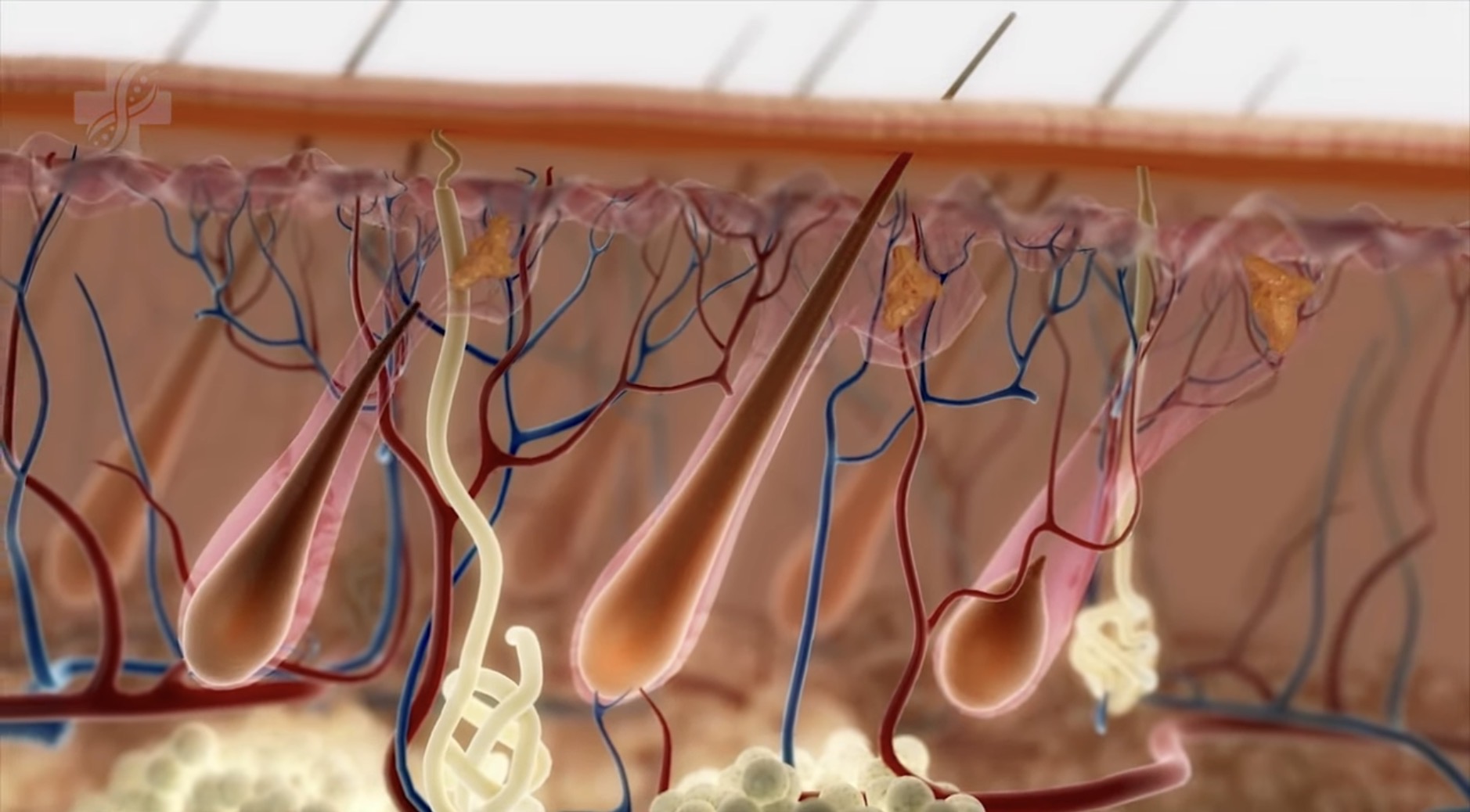
A scalp follicle contains a small structure called the dermal papilla, which is wrapped in a capillary network. The capillaries surrounding the papilla supply oxygen and nutrients to the hair matrix cells and carry waste products away. In the anagen (growth) phase, this vascular network expands richly; as the follicle moves toward catagen and telogen, the vessels regress. In other words, the hair cycle and the vascular state move in sync, and a follicle that has stopped growing is also, in a real sense, a follicle whose blood supply has thinned.
Histologically, the scalp of an advanced thinning area shows a clearly reduced density of capillaries around the follicles. Whether the decline in blood flow is a result or a cause of hair loss is a chicken-and-egg question, but either way, restoring the vascular environment around the follicle is a central theme of regenerative medicine.
VEGF as the Key Player
Among the signaling factors that drive angiogenesis, VEGF (Vascular Endothelial Growth Factor) is the most thoroughly studied. VEGF acts on vascular endothelial cells to form new vessels, and in the follicle it has been reported to be secreted by dermal papilla cells themselves. In animal studies, increasing VEGF expression in the dermal papilla makes the perifollicular capillaries thicker and more numerous, and increases hair shaft caliber.
So the idea that “supplying more VEGF will regrow hair” is theoretically reasonable. In fact, part of minoxidil’s mechanism is thought to involve up-regulation of VEGF expression, and follicular angiogenesis is now an unavoidable keyword in any serious discussion of hair-loss therapy.
“More Blood Flow = More Hair” Is Half True at Best
In clinical practice, however, the story is rarely as simple as “just boost blood flow and the hair will come back.” Temporary local increases in perfusion from scalp massage or oral vasodilators rarely produce a visible improvement in AGA on their own. That is because the core problem in hair loss is not “insufficient blood flow” itself but a combination of factors: aberrant signaling of follicular stem cells, microinflammation, DHT-mediated changes in receptor sensitivity, and others.
Angiogenesis serves as a foundation that creates an “environment where the follicle can function,” but if the follicle itself is not in working order, no amount of better blood flow will produce thick terminal hair. Indeed, in the clinical guidelines on AGA published by the Japanese Dermatological Association, finasteride, dutasteride, and minoxidil are positioned as first-line, and “blood-flow improvement” alone is not recommended as a stand-alone treatment.
How to Induce Follicular Angiogenesis in a Medically Sound Way
Why not simply inject VEGF directly? There are walls here too. Administering a single growth factor at high concentration can create immature, leaky vessels or provoke an exaggerated local reaction. What hair-regrowth medicine actually needs is to encourage angiogenesis “moderately,” within a physiological balance, and to lift the underlying signaling of the dermal papilla.
This is where the approach using stem cell conditioned media (and exosomes) has attracted attention in recent years. Supernatants harvested from cultured adipose-derived stem cells contain not only VEGF but also a broad cocktail of growth factors such as FGF, IGF-1, and HGF, together with exosomes that carry intercellular signaling cargo. Because multiple factors are present at near-physiological ratios, follicular angiogenesis, dermal papilla activation, and quieting of microinflammation can take place at the same time. This is the major difference between a “single-growth-factor injection” and conditioned media therapy.
How We Think About It at AVAN TOKYO
At our clinic, we design treatment not as “simply raise scalp blood flow” but as rebuilding the entire microenvironment around the follicle. Specifically, we deliver stem cell conditioned media into the scalp so that the signaling around the dermal papilla is lifted, and as a consequence both the vascular network and the follicle reactivate together. When we combine Morpheus8 microneedle RF, the heat-induced wound-healing cascade is leveraged so that growth factors in the conditioned media reach deeper layers of the follicle.
Going beyond the oversimplification of “better blood flow grows hair,” the modern direction of hair regenerative medicine is to prepare a soil in which the follicle itself can respond. Improving blood flow to the follicle is never a stand-alone solution; it must be considered together with follicular stem cells, microinflammation, and hormonal sensitivity.
You can read more topics in hair regenerative medicine at our related columns on hair regenerative medicine here.
Summary
Follicular angiogenesis is genuinely connected to hair growth, but the simple narrative “more blood flow = more hair” does not capture the picture. Angiogenic factors like VEGF only become meaningful when they work together with follicular stem cells and the dermal papilla. A multi-factor approach using stem cell conditioned media is one realistic option that respects this physiological balance while lifting the entire follicular environment. If you are concerned about your symptoms, please consult a medical clinic that specializes in hair regenerative medicine rather than relying on self-judgment.
──────────────
【監修】森脇 進 / Shin Moriwaki (Supervising Physician)
Member, Japan Society of Aesthetic Surgery (JSAS) / Member, American Academy of Aesthetic Medicine
ECFMG Certificate
──────────────
📍AVAN TOKYO Ginza Hair Regenerative Medicine
English / 中文 / Tiếng Việt available
Please feel free to contact us via DM / LINE / Website / Phone.