


Abdominal & Flank Fat Hybrid Breast Augmentation: Designing Waist and Bust in One Operation2026.09.14
In a representative case of a woman in her 30s, we performed an abdominal fat hybrid augmentation: liposuction of the abdomen and flanks combined with a silicone implant and fat grafting to the breast in a single operation. The goal was not simply to enlarge the bust, but to design a defined waistline together with a natural volume from the décolletage to the breast tops — all in one operation. In this article, our supervising surgeon explains why we chose the abdomen and flanks as donor sites, the intraoperative decisions on layered fat injection, and the postoperative course.
Key Points
・An abdominal fat hybrid augmentation harvests fat from the abdomen and flanks and combines it with a silicone implant to create natural upper-body volume.
・By “subtracting” the waist and “adding” fat to the breast, we design the entire upper-body contour — waistline and anterior projection — in a single session.
・Harvesting evenly from abdomen, flanks, and the area around the accessory breast avoids concentrated over-suction in one site and reduces the risk of contour irregularity at the donor sites.
・The implant provides the central volume and shape scaffold, while the injected fat serves as cover fat that hides the implant edge; we distribute fat across the subcutaneous, subglandular, and intramuscular layers.
・Because this involves wide-area liposuction, anesthesia management, blood loss control, and thromboprophylaxis are essential parts of an abdominal fat hybrid augmentation.
Case Overview (A Woman in Her 30s Requiring Wide-Area Liposuction)
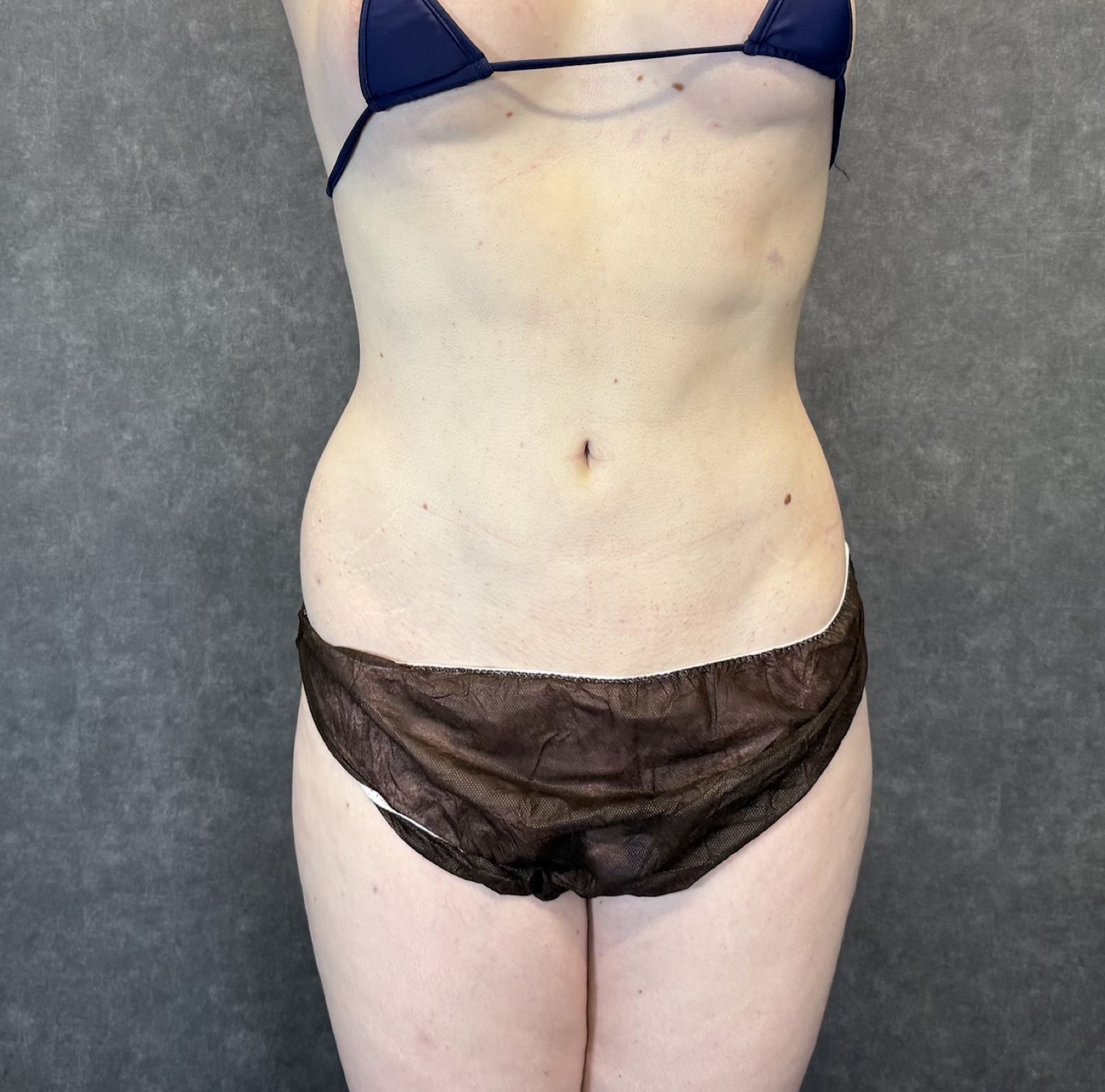
A woman in her 30s presented with the wish to “reduce abdominal and flank fat while simultaneously adding natural volume to the breast.” On palpation, there was diffuse subcutaneous fat over the abdomen and flanks (extending toward the lower back), while the upper body was relatively lean with thin subcutaneous tissue over the chest wall. The mammary gland volume was modest, so an implant alone would risk visible upper-pole edging. These findings made her an appropriate candidate for a hybrid procedure that recycles fat from the torso as cover fat for the breast.
Why We Chose the Abdomen and Flanks as Donor Sites
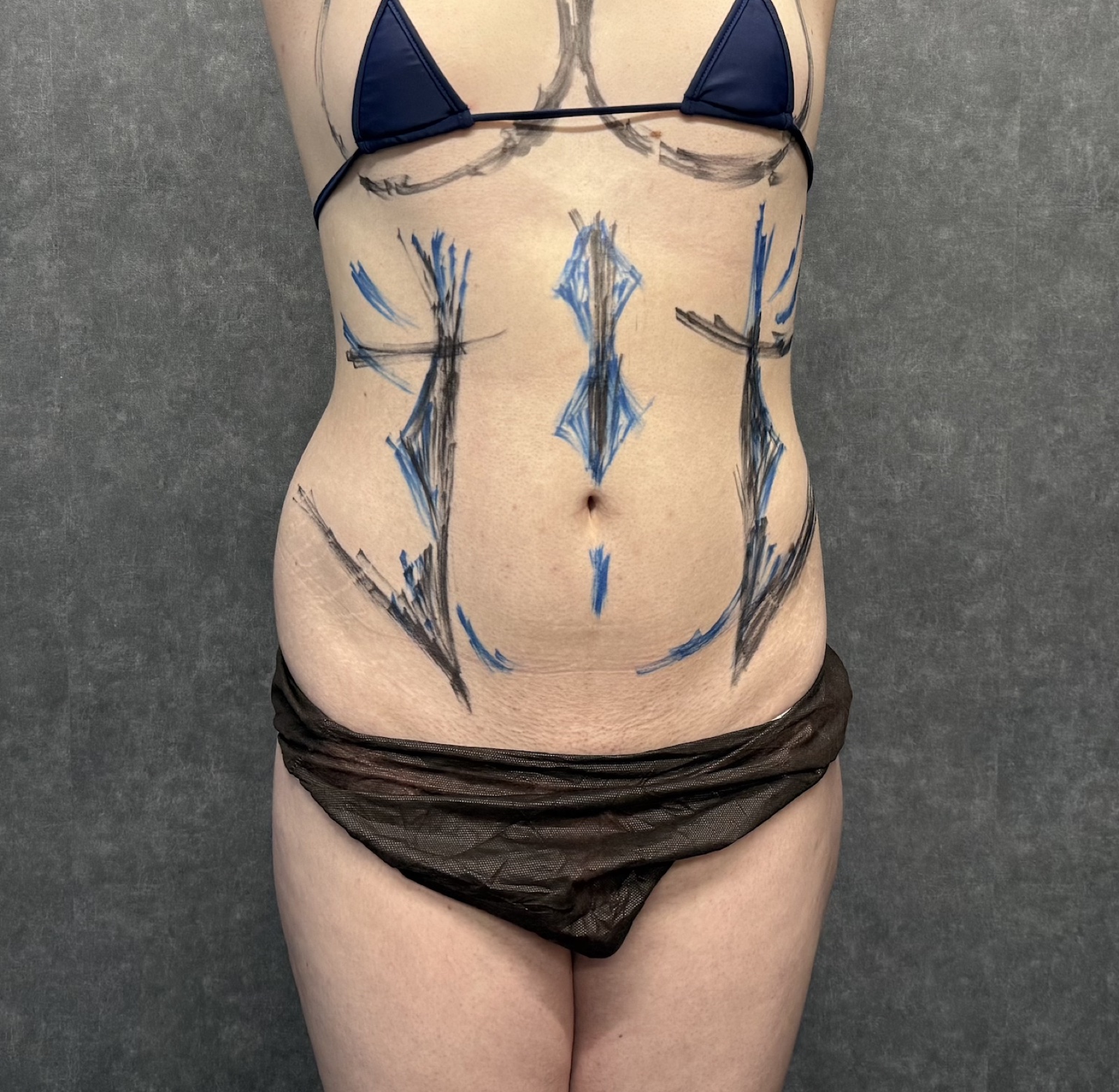
What matters most in hybrid augmentation is securing “high-quality fat” that can survive grafting, without leaving irregularities at the donor site. Abdominal and flank subcutaneous fat tends to have more uniform adipocyte sizes than thigh or arm fat, and after centrifugation the pure fat fraction (separated from blood, oil, and tumescent fluid) tends to be relatively stable. Harvesting the flanks also tightens the waistline from both frontal and side views, so that the visual contrast between the waist and the breast becomes more three-dimensional than what breast augmentation alone can achieve. By thinning fat evenly across the abdomen and flanks rather than concentrating over-suction in a single zone, we also spread the risk of dermal-layer damage and surface irregularity. In this case, harvesting was distributed across the abdomen, flanks, and the region around the accessory breast.
Why Designing Waist and Bust Together Matters
Breast appearance is not determined by breast size alone — it is determined by the contrast with surrounding structures. When the waist looks tighter, the same size of silicone implant reads visually as larger and more natural; conversely, if only the bust is enlarged while the torso stays wide, the upper body tends to look square. An abdominal fat hybrid augmentation “subtracts” from the waist (flanks, abdomen) and “adds” fat to the breast, so the entire upper-body contour is designed as a single three-dimensional silhouette — a defined waist with anterior breast projection. This simultaneous subtraction and addition is the value that neither implants alone nor liposuction alone can deliver.
Role Sharing Between the Motiva Implant and the Fat: Layered Injection Strategy
In this case, a Motiva silicone implant of low-to-medium projection was placed subglandularly via an axillary incision, and the fat was injected into multiple layers around the implant (subcutaneous, subglandular, and intramuscular). The implant provides the “volumetric and shape scaffold” of the central breast, while the fat acts as cover fat that hides the implant edge and creates the natural curve of the subclavicular area and the cleavage. In lean patients with thin subcutaneous tissue over the chest wall, rippling — where the implant’s upper edge shows through the skin — is more likely, so meticulous cover-fat injection into the subcutaneous plane strongly influences the final result. In this case, we intentionally used different distribution ratios between subcutaneous, subglandular, and intramuscular layers on the right and left sides, so that pre-existing asymmetry (gland volume, subcutaneous thickness, and thoracic cage shape) could be absorbed through the layered composition itself. Rather than injecting “the same volume into the same layer” symmetrically, adjusting layer-by-layer volumes based on preoperative asymmetry is the key intraoperative judgment.
Treatment Details, Cost, and Risks for This Case
・Treatment: Hybrid breast augmentation under general anesthesia (subglandular silicone implant + fat grafting) combined with liposuction of the abdomen, flanks, and the accessory-breast area.
・Cost: Fees vary depending on the extent of treatment, sites, and implant type. Please see our price page for details.
・Main risks / adverse effects: bruising, swelling, edema, fibrosis, asymmetry, infection, hematoma, seroma, capsular contracture, fat necrosis, palpable cysts, scarring, sensory changes, thromboembolism, and others. Individual results vary; the photograph is one representative case, and final appearance depends on body type, fat quality, and lifestyle.
Postoperative Course and Downtime Considerations
Because wide-area liposuction is involved, tightness and swelling of the abdomen and flanks are most intense for the first two to three days, with bruising peaking around the first week and the fibrotic (contracture) phase setting in over one to two months. On the breast side, the combined effect of implant, injected fat, and postoperative edema causes firmness for about one month, and softness gradually returns over about three months. Grafted fat that survives remains as the patient’s own adipose tissue and may fluctuate slightly with weight changes. Early ambulation, compression stockings, adequate hydration, and continued garment compression are important to reduce thrombotic risk after wide-area liposuction. For safety standards in aesthetic surgery, please also see the Japan Society of Aesthetic Surgery (JSAS). See also the full list of related columns on liposuction and hybrid augmentation.
Frequently Asked Questions
Q. How is abdominal fat hybrid augmentation different from doing abdominal liposuction first, on its own?
Abdominal and flank liposuction alone tightens the waist but does not change the visual contrast between waist and bust. Combining hybrid augmentation in the same operation lets us recycle the harvested fat as “cover fat” for the implant, so the entire upper-body silhouette is designed in a single session. However, the wider surgical field means greater demands on anesthesia, compression management, and the recovery period, so overall health must support the combined indication.
Q. Is fat from the abdomen and flanks better for augmentation than fat from the thighs or arms?
Adipocytes from any donor site are living cells, but abdominal and flank fat tends to allow larger harvest volumes and a more stable pure-fat fraction after centrifugation. Donor selection, however, is decided case by case based on the patient’s fat distribution, the desired body design, and the risk of donor-site irregularity. Donor-site smoothness is as important as graft take rate.
Q. Why is a Motiva implant often chosen?
Due to its surface architecture and gel characteristics, Motiva is often selected as an implant with a favorable profile for reducing capsular contracture risk and providing a more natural feel. However, the optimal type depends on individual chest width, height, subcutaneous thickness, and desired size. At our clinic, we choose between types such as Demi, Mini, or Full at consultation using physical samples placed against the patient’s chest.
Q. Isn’t harvesting from the abdomen and flanks at the same time risky?
Wide-area liposuction places greater demands on anesthesia management, blood loss, and thromboprophylaxis compared to single-site suction. At our clinic we perform preoperative work-up (ECG, blood tests, etc.), rigorous intraoperative vital-sign management, appropriate postoperative compression, early ambulation, and compression stockings. For patients with underlying conditions or those on anticoagulants, indication decisions must include an individualized medication-hold protocol, not a simple yes-or-no judgment.
Q. Why does the breast feel firm after surgery, and when does it soften?
For about the first month, the capsule-formation process around the implant overlaps with edema and inflammation from the injected fat, so the breast feels tight and firm. Softness typically returns gradually over about three months. Risks such as capsular contracture, fat necrosis, and palpable cysts are not zero, so if pain or firmness rapidly worsens or becomes markedly asymmetric, please contact the clinic early.
──────────────
Supervising Physician: Shin Moriwaki / 森脇 進 (Supervising Surgeon)
Member, Japan Society of Aesthetic Surgery (JSAS) / Member, American Academy of Aesthetic Medicine
ECFMG certificate holder (US medical licensure qualification)
──────────────
📍AVAN TOKYO GINZA LIPOSUCTION CLINIC
English / 中文 / Tiếng Việt available
For reservations and consultations,
please contact us via DM / LINE / Website / Phone.