


Can People with a Keloid Tendency Receive Scalp Treatment? — Dr. Moriwaki Reviews the Indications for Microneedle RF and Stem Cell Conditioned Media from the Angle of Scar Tendency2026.07.22
“Even small wounds heal raised and last for years.” “An injection scar once turned into something like a keloid.” — from patients who are aware of such a scar tendency, we increasingly receive the question of whether keloid-prone scalp treatment such as stem cell conditioned media scalp injection or microneedle RF (Morpheus8) is really safe to undergo. In short, having this tendency does not mean the treatment is uniformly contraindicated. It is a domain where the line should be drawn individually based on the sites of prior scars, how those scars spread, and the desired intensity of treatment. This article organizes the decision framework from Dr. Moriwaki’s perspective.
Key Points of This Article
・Keloid-prone scalp treatment is not uniformly contraindicated; the decision is individualized based on prior sites, past scar reactions, and treatment intensity
・The scalp is less predisposed to keloids than the chest, shoulders, or earlobes, but deep and wide penetration should still be avoided in those with the tendency
・Microneedle RF and direct injection differ in “depth and breadth of stimulation,” so people with a scar tendency should shift design toward injection
・When in doubt, perform a low-output, small-area test session and observe scar reaction for 2–3 months before the main treatment
・When collagen disease, inflammatory acne, or active folliculitis is present, dermatological control should precede regenerative treatment
What Is a Keloid Tendency — Distinguishing It from Hypertrophic Scarring
Medical Distinction by “Whether the Scar Spreads Beyond the Original Wound”
Keloids and hypertrophic scars both involve wounds that heal by rising, but medically they are treated as different entities. Hypertrophic scars rise within the boundary of the original wound and often settle over time. Keloids, by contrast, spread beyond the original wound as if “infiltrating” surrounding skin and do not easily shrink on their own. When considering whether keloid-prone scalp treatment is possible, confirming this distinction — through both self-report and examination — is the starting point.
The Scalp Is Not a Predilection Site, But Do Not Let Your Guard Down
Keloids tend to appear at sites of strong skin tension: the anterior chest, shoulders, upper back, earlobes, and lower jaw. The scalp is less frequently involved, but a certain number of patients have experienced hypertrophic scarring at the hairline, occipital trauma scars, or galea aponeurosis suture lines. Do not assume the scalp is absolutely safe; carefully gather the quality of prior scar history.
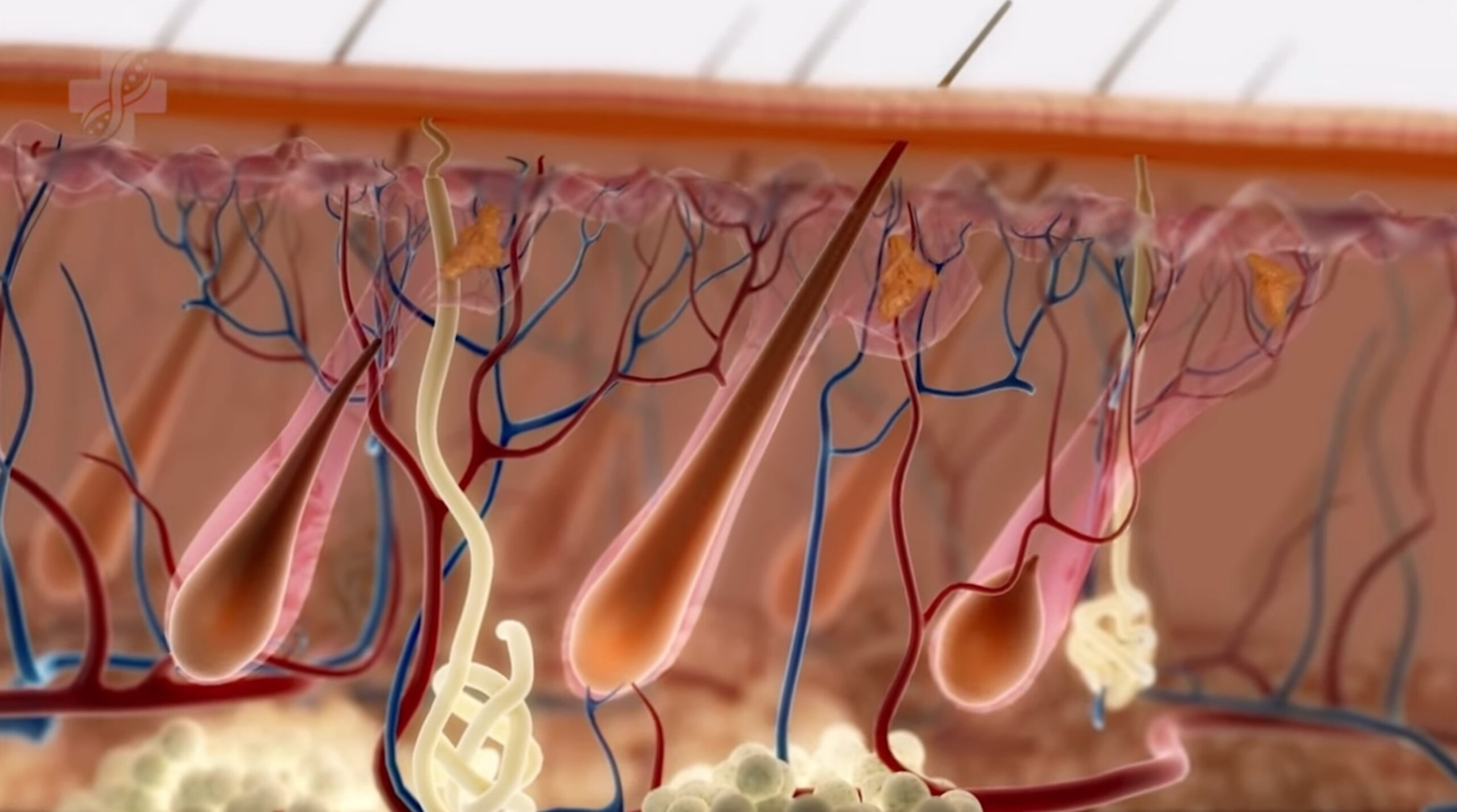
Difference in “Stimulation Profile” Between Microneedle RF and Stem Cell Conditioned Media
Morpheus8 Simultaneously Delivers “Wound + Heat” to the Dermis
Microneedle RF (Morpheus8) reaches the dermis with needles and adds radiofrequency energy, simultaneously creating micro-wounds and thermal coagulation. The usual aim is collagen remodeling around hair follicles and improved penetration of stem cell conditioned media, but in people with a scar tendency, the total “wound surface area” and “thermal stimulation” can also become factors that provoke excessive fibrosis. When choosing RF within keloid-prone scalp treatment, the principle is to design output, depth, and shot density conservatively and to narrow the treatment area.
Direct Injection Avoids Heat and Restricts Stimulation to Point-Like Areas
On the other hand, injecting stem cell conditioned media around the follicles with an ultra-fine needle involves no thermal stimulation, and the wound area is limited to points. For those with a clear scar tendency, a staged approach — introducing treatment first via direct injection rather than needling, and considering other modalities based on progress — is reasonable. The mindset is not to “narrow the range of available treatments” but to “match the stimulation profile to the constitution.”
The Indication Decision Flow for Keloid-Prone Scalp Treatment
Four Points to Confirm at the Interview
At the first visit, I always confirm the following four points: (1) how past wounds, surgery, injection sites, and BCG vaccination marks healed; (2) whether raised scars have ever spread beyond the original wound; (3) whether family members have a keloid tendency; (4) whether current scars are still active with itch, redness, or pain. If (1), (2), or (4) is positive, we always start with a test session on the first occasion. For related background on treatment, please also refer to our column index on hair regenerative medicine.
Observe the Test Site for 2–3 Months Before the Main Session
When the judgment is difficult, we perform a small-area, low-output test session at an inconspicuous occipital position and observe the scar reaction for 2–3 months. This period is enough to see the onset of keloid formation. If no redness, elevation, or itch appears at the test site, we proceed to the main session. If a reaction appears, we forgo RF and switch to direct injection of conditioned media only, or shift the strategy to oral and topical treatment. Because individual variability is large, results and safety cannot be asserted uniformly; a stance of judging by observed course is essential.
Alternative Approaches Available Even with a Keloid Tendency
Even when RF or needling is judged difficult, options remain. Building on standard therapies such as finasteride, dutasteride, and topical minoxidil, stem cell conditioned media is designed to be “delivered with minimal stimulation” via ultra-fine perifollicular injection, topical application to the scalp, or iontophoresis. For dermatological guidance on keloids and hypertrophic scars, please also refer to the guidelines of the Japanese Dermatological Association. When collagen disease, inflammatory acne, or active folliculitis is present, it is safer to first bring these under dermatological control — calming the ground that would otherwise promote scar reactions — before advancing to hair regenerative medicine.
Frequently Asked Questions
Q. My earlobe piercing scar became a keloid in the past. Should I give up on hair regenerative medicine for the scalp?
You do not necessarily have to give up. Earlobes are a representative predilection site, while the scalp has a lower frequency even in the same constitution. However, we always start with a test session and safely introduce treatment from direct injection of stem cell conditioned media.
Q. Is Morpheus8 absolutely off-limits for those with a keloid tendency?
It is not an “absolute contraindication,” but the decision is made carefully based on prior sites and current activity. If no problem appears at the test session, we switch to a design that introduces treatment with lower output and lower density than usual.
Q. Is it safe if I only apply stem cell conditioned media topically?
Topical application alone does not create wounds, so the scar risk basically does not rise. However, transdermal absorption has its limits, and the effect obtainable from topical use alone is limited compared with injection.
Q. How much time do you leave between the test session and the main session?
We leave at least 2–3 months to confirm the onset of any scar reaction. The same period also allows observation of shedding and hair cycle changes, so the time is not wasted.
Q. Does a keloid tendency improve over time?
Some people find their reactions become milder with age, but the constitution itself does not necessarily disappear completely. For those with past reactions, we recommend continuing careful judgment even after time has passed.
──────────────
Supervising Physician: Shin Moriwaki, MD
Member, Japan Society of Aesthetic Surgery (JSAS) / Member, American Academy of Aesthetic Medicine
ECFMG Certificate
──────────────
📍AVAN TOKYO Ginza Hair Regenerative Medicine
English / 中文 / Tiếng Việt supported.
Inquiries via DM / LINE / Website / Phone.