


Hair Coloring, Perms, and Hair Thinning — How Chemical Processing Damages Follicles and Why Stem Cell Conditioned Media Matters2026.06.16
Many people who regularly color their hair or perm it eventually notice that their hair volume has gradually decreased and that they are shedding more strands than before. In fact, scalps that have endured years of coloring and perming accumulate microscopic damage that is difficult to see, and that damage steadily weakens follicular function. As a new option for addressing this chemically induced scalp damage, stem cell conditioned media has been drawing attention as a regenerative treatment for the scalp. In this column, we explain — from a physician’s perspective — how hair coloring and perms medically affect hair thinning, and what kind of scalp regeneration approach AVAN TOKYO Ginza offers.
What hair coloring and perms really do to the scalp and follicles
Hair color and perm treatments are procedures that chemically alter the color or shape of hair.
The chemicals we feel we are “applying to the hair” actually reach not only the hair shaft, but also the scalp beneath and the opening of each follicle.
Let us examine, from a medical standpoint, how continuous chemical exposure changes the scalp environment and follicular function.
Oxidative dyes and alkaline agents destroy the scalp barrier
Most permanent hair dyes contain diamine-based oxidative dyes, hydrogen peroxide, and alkaline agents (such as monoethanolamine or ammonia) that raise the pH.
These open the cuticle so pigment can enter the hair shaft, but the same chemistry inevitably affects the scalp.
The sebum film and stratum corneum (the barrier function) are damaged, transepidermal water loss (TEWL) rises, and the scalp shifts toward a state prone to dryness and microinflammation.
The crown and hairline in particular tend to hold residual chemicals during the procedure, and barrier function deteriorates chronically with repeated exposure.
How perm solutions affect the hair shaft and the follicular opening
The thioglycolate or cysteine-based agents used in perms are powerful reducing agents that break and reform the disulfide bonds of hair.
They reshape the hair shaft as intended, but on the scalp side they also induce some protein denaturation and microscopic oxidative stress.
Immediately after a perm, the scalp is in a state where pH has been strongly disturbed, and the balance of resident microbes is easily disrupted.
When the scalp microbiome becomes imbalanced, organisms such as Malassezia or Staphylococcus aureus may temporarily dominate, leading to dandruff, itching, and low-grade inflammation.
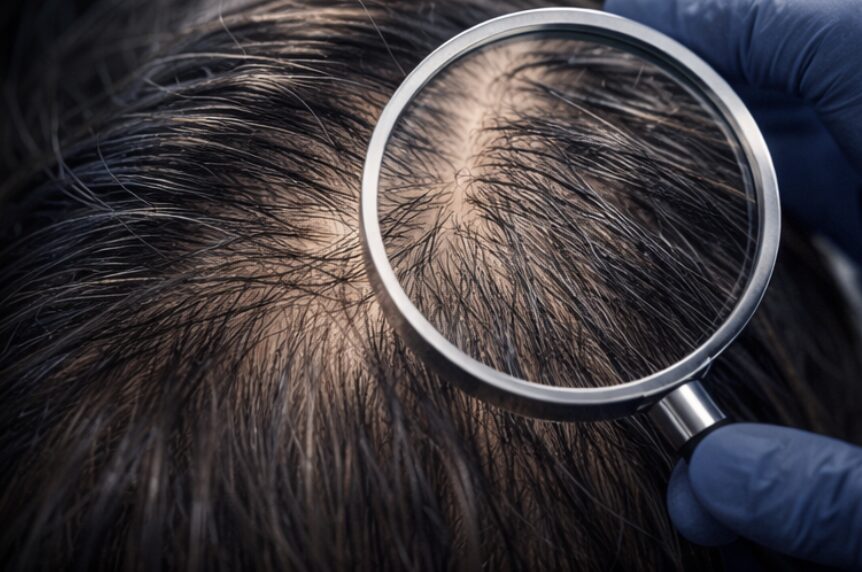
Why repeated chemical processing increases the risk of hair thinning
A single coloring or perm does not directly cause hair loss.
The real issue is the cumulative damage built up over years or even decades.
Here we organize, from a medical viewpoint, why chronic chemical exposure raises the risk of thinning hair.
Oxidative stress on hair follicle stem cells and chronic microinflammation
At the base of each follicle live the hair follicle stem cells (the bulge region stem cells) — the true protagonists of hair growth.
When barrier disruption and microinflammation repeatedly occur on the scalp, inflammatory cytokines such as TNF-α and IL-1β are chronically secreted in the scalp, producing a state often called “silent inflammation.”
This silent inflammation reduces the self-renewal capacity of hair follicle stem cells and gradually shortens the anagen phase of the hair cycle.
The result is hair that becomes thinner, shorter, and sparser.
This closely resembles the mechanism of AGA progression, and chemical processing is now thought to accelerate hair thinning via a pathway separate from male hormones.
The “thinning hair” caused by scalp barrier destruction
When the scalp barrier weakens, sensitivity to external stimuli (UV light, air pollution, shampoo ingredients) rises, and the scalp remains in a constant low-grade inflammatory state.
In such a scalp, capillaries around the hair roots tend to constrict, and nutrient supply to the matrix cells becomes unstable.
Follicles that no longer receive a stable supply of nutrients and oxygen cannot maintain thick, long hair and gradually shift toward miniaturization — an increase of fine, short hairs.
For AGA treatment guidelines, the Japanese Dermatological Association provides a helpful reference, and in recent years the importance of the “scalp environment” itself has been reevaluated.
Stem cell conditioned media as a choice for color- and perm-related hair thinning
Hair thinning caused by coloring and perms often cannot be adequately addressed by oral medication alone.
This is because the essential problem is not male hormones, but rather “chronic destruction of the scalp barrier” and “deterioration of the hair follicle stem cell niche.”
This is why, in recent years, stem cell conditioned media has attracted attention from the standpoint of scalp regeneration.
How cytokines and growth factors rebuild the follicular stem cell niche
Stem cell conditioned media is densely packed with cytokines and growth factors — VEGF, FGF, IGF-1, HGF, TGF-β — that are deeply involved in follicular regeneration.
These activate dermal papilla cells, promote new capillary formation, and rebuild the hair follicle stem cell niche.
In addition, the media contains anti-inflammatory cytokines (such as IL-10) and exosomes, which act to calm the chronic microinflammation of the scalp.
Against the vicious cycle of “inflammation × oxidative stress × niche degradation” caused by chemical processing, the major strength of stem cell conditioned media lies in its ability to intervene through multiple pathways simultaneously.
The conditioned media × Morpheus8 protocol at AVAN TOKYO
At AVAN TOKYO Ginza, for scalps exhausted by repeated coloring and perms, we combine the conditioned media with Morpheus8 (microneedle RF) to deliver it down to the follicular level.
Ultra-fine microneedles cross the barrier, RF energy adjusts the temperature and blood flow around the follicles, and the conditioned media is then delivered as drug delivery, reaching layers that topical application alone cannot easily access.
Treatment is repeated at intervals of several weeks to a few months, aiming to reset the scalp environment and reactivate the follicular stem cell niche.
At the counseling stage, we carefully review each patient’s history of coloring, perming, shampoo habits, and lifestyle, then design a frequency and combination tailored to that person.
For related articles on hair regenerative medicine, please also see our hair regenerative medicine column list.
Conclusion — so you don’t have to give up “coloring and perms”
Coloring and perms are styling choices that enrich daily life, and many people wish to keep enjoying them.
What matters is to correctly understand what chemical processing does to the scalp and follicles, and to pair it with appropriate scalp care.
To protect the scalp barrier and the hair follicle stem cell niche, an option exists to complement home scalp care with medical-grade regenerative treatment.
Scalp regeneration with stem cell conditioned media is a medically grounded approach for resetting a scalp exhausted by chemical processing and for maintaining beautiful hair into the future.
If you have any concerns, please consult a specialist.
──────────────
Supervising Physician: Shin Moriwaki, MD
Member of the Japan Society of Aesthetic Surgery (JSAS) / Member of the American Academy of Aesthetic Medicine
ECFMG Certificate
──────────────
📍AVAN TOKYO Ginza Hair Regenerative Medicine
English / 中文 / Tiếng Việt supported
Consultations available via DM / LINE / Website / Phone.