


How Far Can Joint Injections Take You in Hip Osteoarthritis? Early, Advanced, and End-Stage Boundaries for Stem Cell Conditioned Media2026.07.01
“My groin hurts when I start walking or climb stairs.” “My hip catches the moment I stand up.” Many patients who visit us with these complaints and are diagnosed with hip osteoarthritis wonder, “I’d like to avoid surgery a little longer — is there any conservative option I can lean on?” One approach that increasingly comes up in these conversations is joint injection using stem cell conditioned media.
Hip osteoarthritis is a progressive disease, and both what is happening inside the joint and what a treatment can realistically achieve change dramatically depending on the stage. To make a calm judgment about “how far you can go with injections,” it helps to first organize the stages of the disease and then understand both the mechanism and the limits of conditioned-media joint injections.
Stages of Hip Osteoarthritis and What Is Happening Inside the Joint
Hip osteoarthritis progresses gradually around the wear of articular cartilage. Clinically, it is often described along an early, advanced, and end-stage timeline, and both the intra-articular state and the patient’s symptoms change at each stage.
Early stage — joint space is still preserved
In the early stage, X-rays still show a preserved joint space between the bones. Typical symptoms include a mild ache after prolonged weight bearing, a dull post-exercise pain, and a catching sensation when starting to move in the morning.
Inside the joint at this stage, what is happening is minor damage to the cartilage surface and mild synovial inflammation. The bone itself is not yet significantly deformed. Many patients at this stage can be managed for a long time with conservative care alone — activity modification, weight control, and exercise therapy — and there is no need to rush into injections.
Advanced stage — joint space narrows and pain starts intruding on daily life
In the advanced stage, the joint space is clearly narrowed, and subchondral changes such as sclerosis, cysts, and marginal osteophytes appear on imaging. Start-up pain becomes persistent, and patients start avoiding certain motions during stair climbing or when putting on socks. Increased joint fluid from synovitis and a low-grade inflammatory cycle also start to prolong pain.
This is the stage where the option of a stem cell conditioned media joint injection is most often considered clinically. That said, no honest clinician can promise that it will “definitively halt progression” or “regenerate cartilage back to its original state.” It should be positioned as a conservative approach that works on the intra-articular inflammatory environment.
End stage — bone-on-bone contact
In end-stage hip osteoarthritis, the joint space disappears and the bones come close to direct contact under load. Both the acetabulum and femoral head become markedly deformed, and rest pain, night pain, limping, and range-of-motion restriction become prominent. Once the disease reaches this stage, the benefits achievable through conservative care and joint injections are limited, and it becomes necessary to consider surgical options including total hip arthroplasty (THA), taking the patient’s activity level and age into account.
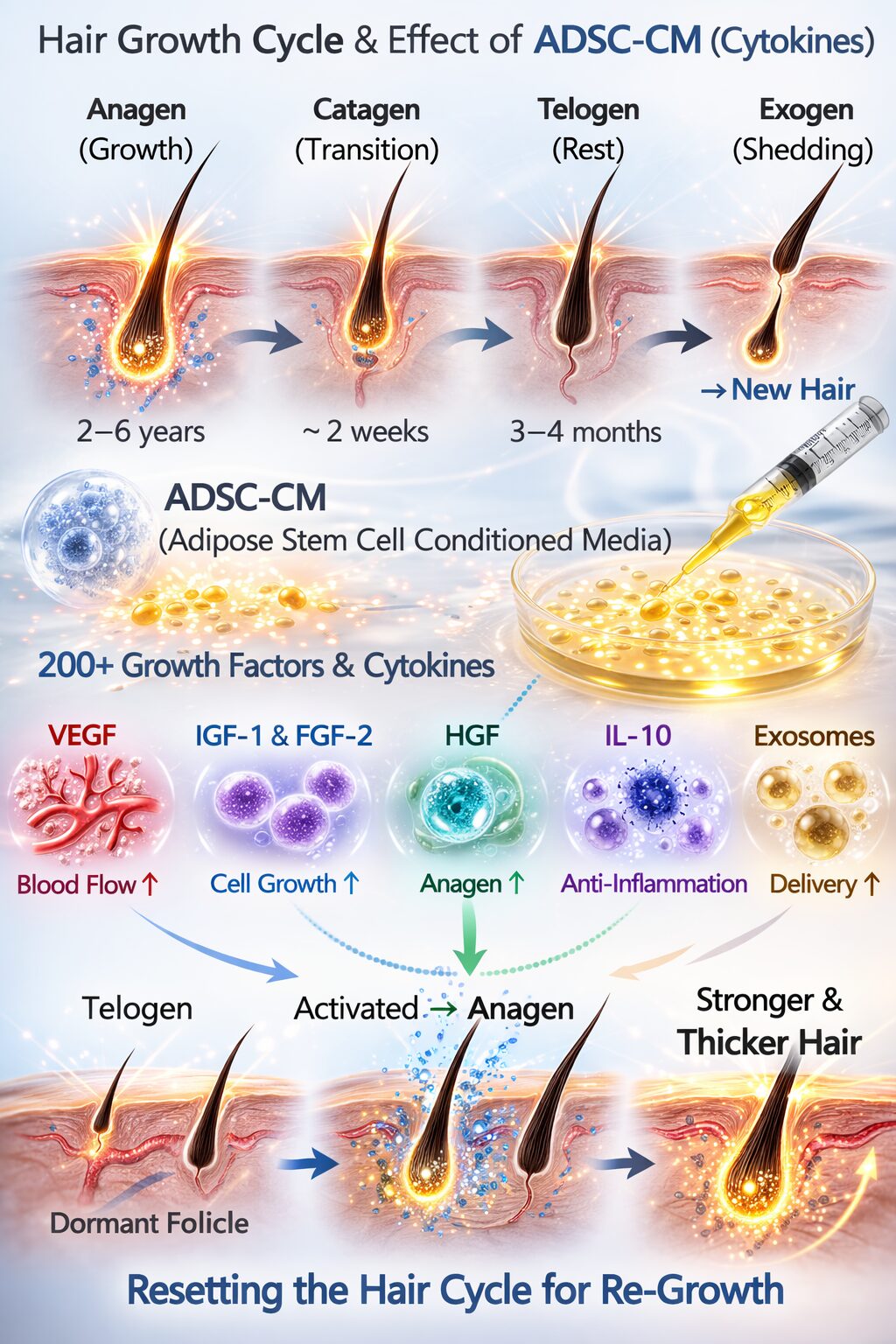
What Stem Cell Conditioned Media Joint Injections Can and Cannot Aim For
Joint injection using stem cell conditioned media for hip osteoarthritis does not involve transplanting cells themselves. Instead, the conditioned media — which contains growth factors, cytokines, and exosomes secreted by mesenchymal stem cells during culture — is delivered into the joint, typically under ultrasound guidance.
Working on the intra-articular inflammatory environment
Clinically, the main expected action of a conditioned media joint injection is to send signals that dampen pro-inflammatory cytokines within the joint and thereby potentially reduce pain and swelling from synovitis. At the same time, growth factors such as TGF-β and IGF-1 may act on chondrocytes and synovial cells, and basic research has reported the possibility that they can tilt the intra-articular metabolic environment toward repair.
However, this treatment does not reverse cartilage that has already been lost or bony deformity that has already progressed. That distinction is critical. For general information on joint disorders, the Japanese Orthopaedic Association website also provides a useful overview of the progression of osteoarthritis and where each treatment fits.
Realistic expectations by stage
Realistic expectations from a conditioned media joint injection differ by stage of hip osteoarthritis.
– Early to early-advanced: When there is pain or joint effusion from synovitis, it may be considered as one option aimed at symptom relief.
– Late-advanced: When daily activities are becoming difficult, it can be positioned as an option aimed at pain relief and preserving the joint environment. It is not a standalone therapy and needs to be combined with exercise therapy and modification of daily movements.
– End stage: Expected benefit is limited, and evaluation for surgical indication takes priority. Rather than spending time trying to “stretch the joint’s life” with injections, discussion with an orthopedic surgeon about surgical timing should come first.
Designing a plan that does not rely on injections alone
In the conservative management of hip osteoarthritis, joint injections are only one piece of the puzzle. Strengthening the muscles around the hip (gluteus medius, iliopsoas, etc.), weight management, review of pain-provoking movements, and use of a cane or brace when needed all combine with injection therapy to allow patients to actually feel the effect of conditioned media joint injections. For more on the concept and indications of this treatment, please see our page on stem cell conditioned media joint injections.
How to Decide Between “Still Holding On” and “Time for Surgery”
The question we most often hear in the clinic is: “Am I still at a stage where I can hold on with injections, or is it already time to think about surgery?” Three axes are involved in that judgment: imaging findings, symptoms, and quality of life.
Looking at imaging, symptoms, and daily function together
On imaging, the residual joint space, subchondral changes, and degree of femoral head deformity serve as indicators. Symptomatically, we look at the frequency and intensity of pain, whether night pain or rest pain is present, and how pronounced the limp has become. From the daily function angle, key questions include how well the patient can climb stairs, put on socks, and walk long distances, and whether there are activities they have given up because of pain.
When any one of these three axes has deteriorated markedly, it may be wiser to consult an orthopedic surgeon about surgical indication before pursuing more injections. Conversely, if imaging shows advanced-stage changes but symptoms are mild and quality of life is preserved, conservative management including stem cell conditioned media joint injections is a realistic path.
When to judge effect and when to reassess
Effect from a joint injection is generally judged around one to three months after the procedure, using pain scores, range of motion, and changes in daily activity as objective measures. If symptoms have not meaningfully improved after several months, or if the disease is clearly accelerating, a decision must be made among continuing the injection plan, changing the treatment content, or returning to an orthopedic surgeon to reevaluate surgical indication. Effects vary between individuals, and adequate symptom relief cannot be guaranteed for everyone — we say this openly at the first consultation. Hip osteoarthritis is not a disease that ends with a single injection; building both a follow-up schedule and lifestyle habits together is the surest way to keep walking on your own hip for as long as possible.
──────────────
Medical Supervisor: Shin Moriwaki, MD
Member, Japan Society of Aesthetic Surgery (JSAS)
Member, American Academy of Aesthetic Medicine
ECFMG Certificate holder
──────────────
📍AVAN TOKYO Ginza Regenerative Medicine
English / 中文 / Tiếng Việt supported
For inquiries: DM / LINE / Website / Phone.