


Why Hair Sheds After Scalp Shingles or Herpes: Dr. Moriwaki on Post-Viral Follicle Recovery and When to Restart Stem Cell Conditioned Media Scalp Therapy2026.07.16
“I had shingles (or a herpes flare) on my scalp, my dermatologist gave me antivirals, and the rash cleared up. But two or three months later, my hair started shedding heavily.” At AVAN TOKYO Ginza, we hear this concern about post-shingles hair loss and post-herpes shedding surprisingly often. After a strong inflammatory episode, scalp follicles are more fragile than patients expect. From the perspective of hair regenerative medicine using stem cell conditioned media, this article walks through why shedding increases after viral scalp inflammation, which shedding patterns can be expected to recover, and when it is safe to restart scalp treatment — organized by Dr. Shin Moriwaki.
Key Points
・Post-shingles hair loss is, in most cases, a form of telogen effluvium: viral inflammation and acute stress push the hair cycle into the resting phase, and natural recovery over 3–6 months is common.
・When lesions ulcerate or scar, follicles themselves can be lost as scarring alopecia — a zone where hair will not return. Distinguishing these two patterns is the starting point of treatment design.
・Stem cell conditioned media scalp therapy should not restart until the rash is fully epithelialized, crusts and exudate are gone, dermatologic control is confirmed, and at least a 2–4 week observation period has passed.
・In areas with post-herpetic neuralgia (PHN), needle stimulation can trigger pain, so injection sites and technique must be judged case by case.
What Scalp Shingles and Herpes Actually Do to Hair Follicles
Shingles is a reactivation of varicella-zoster virus (VZV) from the sensory ganglia, and herpes simplex arises when HSV-1/HSV-2 travels along nerve axons to the epidermis, producing vesicles and erosions. When these occur on the scalp, the surrounding follicular environment is directly affected by the same inflammatory cascade.
What Happens Around the Follicle During Viral Inflammation
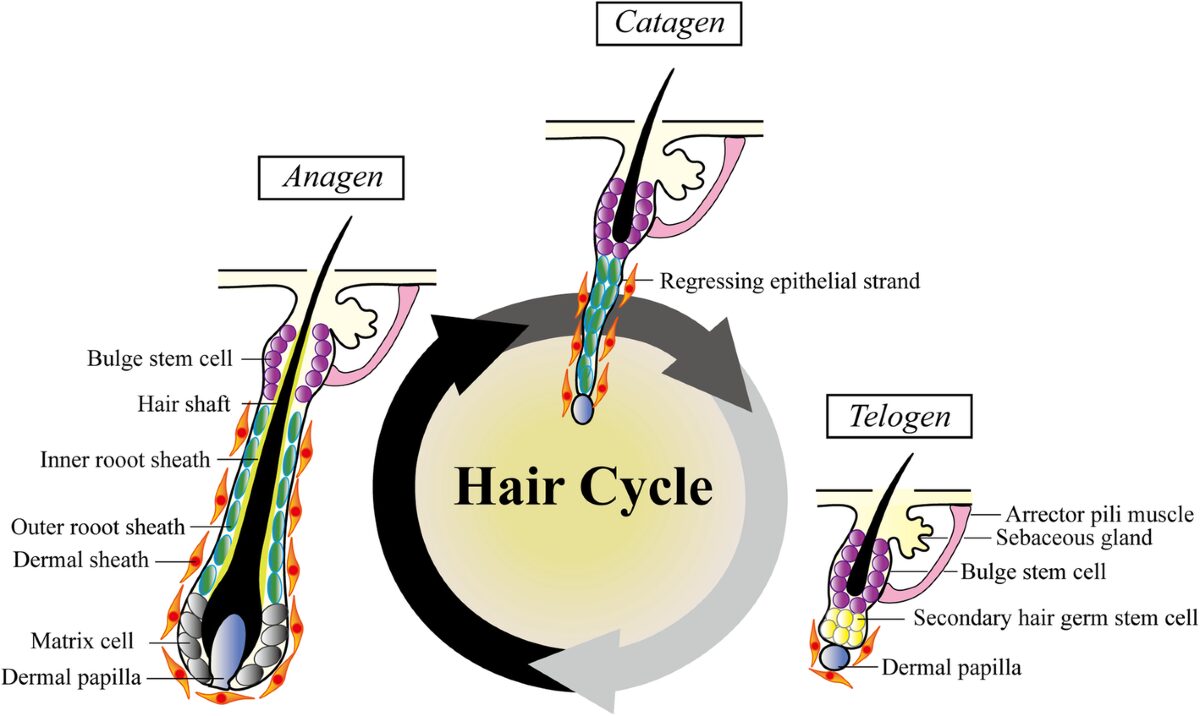
Once the virus reaches the epidermis and dermis, inflammatory cytokines such as TNF-α, IL-6, and IL-1β surge locally. Because follicles are embedded in the dermis, they are directly exposed to this inflammatory environment. The bulge region, home to follicular stem cells, is relatively protected, but rapidly dividing matrix cells in the anagen phase are highly sensitive to inflammation, hypoxia, and nutrient stress — so they can be pushed prematurely into the telogen (resting) phase. This is one reason shedding often arrives “late,” after the visible rash is long gone.
Why Shedding Comes Weeks After the Rash Clears
A hair pushed from anagen to telogen does not fall out immediately; it spends roughly 2–3 months in the resting phase before being shed. So when viral inflammation synchronizes many follicles into telogen at once, patients notice increased shedding 2–4 months after the rash itself has healed. From the patient’s point of view it feels illogical — “I recovered, so why now?” — but mechanistically it is a textbook form of telogen effluvium. Most post-shingles hair loss falls into this category.
Is Post-Shingles Hair Loss Reversible or Permanent?
Clinically, the first question is whether the shedding is transient (follicles intact) or irreversible (follicles destroyed).
Telogen Effluvium (Reversible)
When lesions stayed at the vesicle/crust level and did not destroy the deep dermis, follicular architecture is preserved even if shedding increases. After the pushed-out hairs fall, follicles re-enter anagen and density typically recovers gradually over 3–6 months. Rather than piling on aggressive treatment, there is a period where stabilizing the scalp environment and observing is more appropriate. Where stem cell conditioned media fits in this window is the core of treatment design.
Scarring Alopecia (Irreversible)
If lesions ulcerated or were complicated by secondary infection reaching the deep dermis, follicular stem cells can be lost together with the surrounding tissue, leaving a scarring alopecia zone. Scarred skin contains no follicles, and no oral medication, topical, or stem cell conditioned media can “regrow” hair where the follicle no longer exists. Being medically honest about this boundary comes first; then we design how to support the surviving follicles around it. Guidelines from the Japanese Dermatological Association also recommend careful evaluation including biopsy for scarring alopecia — a premise the hair regenerative field must share.
When Can Stem Cell Conditioned Media Scalp Therapy Restart?
Once post-shingles hair loss is diagnosed, patients most want to know when scalp injections or procedures can restart. The default position is caution.
Restart Criteria: Full Epithelialization, Crust Resolution, Dermatologic Control
Our criteria are: (1) complete epithelialization of the rash with no crusts, exudate, or active vesicles; (2) completion of antiviral therapy with confirmed dermatologic control; and (3) at least a 2–4 week observation window afterward. Needle-based procedures are not appropriate on scalp with active viral inflammation, given the risk of secondary infection and spread. Rushing back the week the crusts fall off tends to invite local trouble. Stem cell conditioned media therapy will still be there — we prefer to coordinate timing with the treating dermatologist.
Considerations When Post-Herpetic Neuralgia (PHN) Persists
After shingles, neuralgia (PHN) can persist for months or even years even after the rash resolves. Needle stimulation in these areas can trigger or worsen neuralgia, so we either avoid injection there or restrict it to very small volumes at superficial layers. Session by session, we map “safe zones” and “avoid zones” across the scalp. For broader coverage of scalp environment and hair regenerative topics, see our hair regenerative medicine article index.
Frequently Asked Questions
Q. Does post-shingles hair loss recover on its own?
If follicles are preserved (telogen effluvium type), density typically returns gradually over 3–6 months. However, in scarred zones the follicles themselves are lost, so hair will not regrow from those areas. Distinguishing the two is essential.
Q. Can stem cell conditioned media scalp therapy be used for post-shingles hair loss?
Once the rash is fully epithelialized, dermatologic control is confirmed, and at least a 2–4 week observation period has passed, it can be an option in non-scarred areas to support the scalp environment. It is not a treatment that restores hair to already-scarred zones.
Q. Can I have scalp injections while still on antiviral medication?
As a rule, needle procedures on scalp with active viral inflammation are avoided due to risks of secondary infection and spread. We consider restart only after antiviral therapy is complete and the skin has fully settled.
Q. Can stem cell conditioned media be injected into areas with PHN?
Because needle stimulation in PHN areas can trigger or worsen neuralgia, we either avoid those sites or use very shallow, low-volume approaches. Each session is decided in consultation with the patient.
Q. What should we suspect if shedding continues for many months?
If shedding clearly persists beyond 6 months, we reassess non-viral factors — iron deficiency, thyroid dysfunction, drug-induced shedding, chronic stress, or underlying AGA/FAGA that was already progressing. Not everything should be attributed to post-shingles hair loss alone.
──────────────
Supervising Physician: Shin Moriwaki, MD
Member, Japan Society of Aesthetic Surgery (JSAS)
Member, American Academy of Aesthetic Medicine
ECFMG Certificate (U.S. Medical Licensing Qualification)
──────────────
📍AVAN TOKYO 銀座 毛髪再生医療
AVAN TOKYO Ginza Hair Regenerative Medicine
English / 中文 / Tiếng Việt supported
Inquiries welcome via DM / LINE / Website / Phone.