


Menopause and Female Hair Loss — Scalp Changes from Estrogen Decline and Stem Cell Conditioned Media as a Solution2026.05.23
“My hair has suddenly lost its volume.” “My scalp is becoming visible through my part line.” We are hearing these concerns from women around the age of fifty more frequently than ever. This is by no means imagined. In women entering menopause, dramatic hormonal changes silently but profoundly affect both the hair and the scalp. At AVAN TOKYO, the number of cases in which we propose regenerative medicine using stem cell conditioned media for menopausal hair loss has increased year by year.
Menopausal hair loss has a fundamentally different mechanism from male AGA. Dismissing it as “just aging” risks missing the care that is truly needed. In areas that hormone replacement therapy (HRT) cannot reach, how can regenerative medicine contribute? In this article, we explain the essence of the issue from a medical perspective.
The True Reason Why Women’s Hair Changes During Menopause
Menopause refers to the period when ovarian function declines and estrogen secretion rapidly decreases. It typically arrives between the ages of 45 and 55, and its effects are not limited to “hot flashes” or “mood swings.” In fact, profound and invisible changes are also occurring in the scalp and hair follicles.
The Relationship Between Estrogen and the Hair Cycle
Estrogen extends the duration of the anagen (growth) phase of the hair cycle. The reason hair is less prone to shedding and gains luster during pregnancy is precisely because estrogen levels are maintained at a high value. Conversely, when estrogen decreases during menopause, follicles in the anagen phase transition prematurely to the catagen (regression) phase, and hair falls out before it can grow thick and long.
As a result, hair becomes thinner, loses body, and overall volume gradually decreases. The pattern that becomes especially noticeable from the part line or crown is the typical progression of female pattern hair loss (FAGA/FPHL).
The Scalp Itself Ages
Menopausal hair loss is not a problem of the follicles alone. Because estrogen is also deeply involved in collagen production in the skin, its decline causes the scalp itself to become thinner, harder, and drier.
When the dermis of the scalp thins, the capillary network supporting the follicles shrinks, and nutrient supply to the hair roots stagnates. Furthermore, when scalp flexibility is lost, chronic microinflammation around the follicles becomes more likely, creating a vicious cycle that further accelerates hair loss.
In other words, menopausal hair loss is a dual phenomenon in which “follicular aging” and “scalp environment aging” progress simultaneously. This complexity is precisely the greatest reason why oral medication alone cannot fully resolve the issue.
Why Stem Cell Conditioned Media Is Suited to the Menopausal Generation
Our reason for actively proposing stem cell conditioned media to women in menopause is clear. It is a treatment that does not replenish lost hormones, but rather elevates the regenerative capacity of the scalp and follicles themselves.
Acting Directly on Cells Instead of Hormones
Stem cell conditioned media contains hundreds of growth factors, cytokines, and exosomes. Signal molecules required for follicular reactivation — including VEGF (vascular endothelial growth factor), IGF-1 (insulin-like growth factor), KGF (keratinocyte growth factor), and HGF (hepatocyte growth factor) — are comprehensively included, and these act directly on hair matrix cells and follicular stem cells.
Because it is not a treatment that replaces estrogen, patients can continue long-term without worrying about hormone-dependent risks. This makes stem cell conditioned media a treatment we can safely propose even to patients with a history of breast cancer, for whom HRT is difficult to select.
Intervening in Scalp Aging Itself
Stem cell conditioned media acts not only on the follicles but also on the dermal layer of the scalp. By stimulating fibroblasts to promote collagen and elastin production, the thinned scalp regains thickness and flexibility, rejuvenating the very “soil” that supports the follicles.
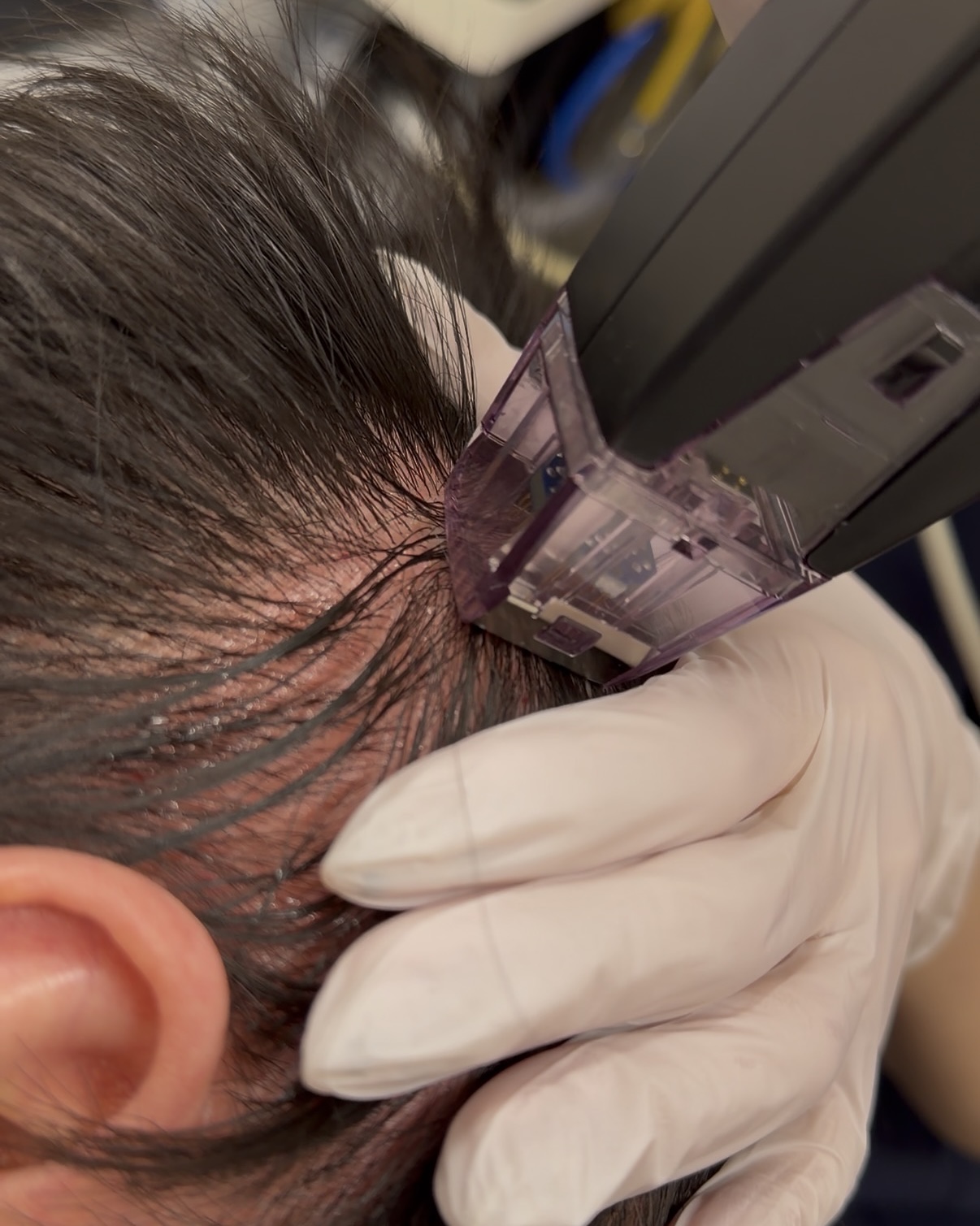
At AVAN TOKYO, by combining Morpheus8 drug delivery, we adopt a design that reliably delivers stem cell conditioned media into the deeper layers of the scalp. This approach — which sends active ingredients directly into the dermis and around the follicles, where surface application alone cannot reach — provides particularly strong results for the menopausal scalp.
How to Design a Scalp Strategy from Menopause Onward
For menopausal hair loss, it is important to design treatment with the mindset of “how to maintain the follicles we have for as long and as healthily as possible” rather than “how to replace lost hormones.”
Specifically, by performing a rebuild of the scalp environment with stem cell conditioned media at the early stage — intervening while the hair cycle is still disturbed but not lost — we can recover follicles that are still salvageable. Conversely, if follicles are left to completely disappear, even regenerative medicine has its limits. The moment when you first notice the change is, in fact, the period when treatment effects can be drawn out most fully.
Menopause is not an ending but the beginning of a new way of living with your body. The same is true for your hair: this is an important time to design how you will live with it over the coming decades. The option of stem cell conditioned media is, we believe, one answer that modern medicine offers to make that design possible.
──────────────
[Medical Supervisor] Shin Moriwaki (Supervising Physician)
Member of the Japan Society of Aesthetic Surgery (JSAS) / Member of the American Academy of Aesthetic Medicine
ECFMG Certificate
──────────────
📍AVAN TOKYO Ginza Hair Regenerative Medicine
English / 中文 / Tiếng Việt available
Consultations are accepted via DM / LINE / Website / Phone.